Get all your news in one place.
100's of premium titles.
One app.
Start reading
The Economic Times
The Economic Times
Neelanjit Das

Wife refused to leave sister-in-law’s house after husband moved out; Delhi HC orders her eviction

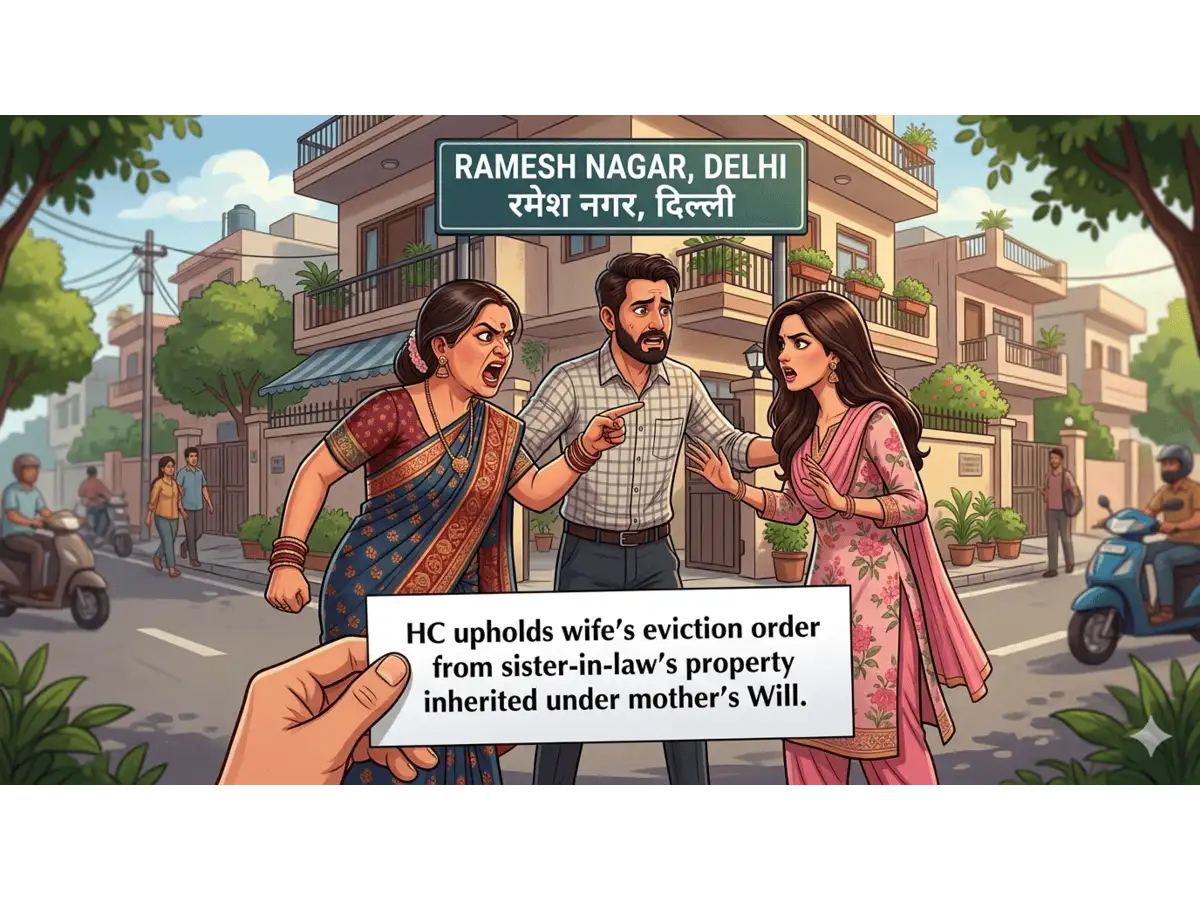
In October 2012, when Lakhina from Ramesh Nagar, Delhi married for the second time, he hoped for a fresh start after his first marriage had ended in a mutual-consent divorce. However, his second marriage to Smt Shalu also ran into trouble. Shalu alleged that she was subjected to harassment and threats by Lakhina and his family members, including his sister Smt Batra and thus she filed multiple police complaints.

However, Lakhina alleged that after his mother died, he married Shalu, but she made his life a miserable hell. He further stated that soon after the marriage, Sahlu started threatening Batra and he was called to the local Police Station, not less than 35-40 times and had been made to sit in the Police Station. He was regularly harassed and tortured.

This marital dispute between Lakhina and Shalu ultimately resulted in Shalu filing a domestic violence case against him in court, which is still pending.

However, this dispute also affected Lakhina's sister (Mrs Batra), who claimed that the constant complaints and police actions initiated by Shalu, she no longer wanted them both (Lakhina and Shalu) in her home. So, she served a legal notice to them to evict. Lakhina complied with the notice and vacated the house, but Shalu did not.

As a result, Batra (Lakhina's sister) filed a case in court to evict Shalu (Lakhina's wife). Thus the marital dispute between Shalu and Lakhina now escalated into a separate property dispute rights case. This Ramesh Nagar property dispute case between Batra and Shalu is being discussed in this article.

Who owns this Ramesh Nagar property?

The Ramesh Nagar house where Shalu and Lakhina lived originally belonged to Lakhina and Batra's mother, Smt Devi, who got it via a sale deed dated June 9, 1982. However, before her death in May 2012, Devi executed a Will dated February 6, 2012 bequeathing the property exclusively to Batra (Lakhina's sister). After his mother's death, Lakhina continued to live there with Batra's permission as a licensee.

Shalu argued that her husband and sister-in-law had colluded to oust her from the Ramesh Nagar property, which is her matrimonial home.

Batra, on the other hand, contended that she was the exclusive owner of the property under their late mother's Will and that Lakhina had merely been a permissive occupant whose licence to stay had been terminated. Since Lakhina himself had vacated the premises, Shalu could not claim a greater right to remain there, Batra argued.

Shalu in her written statement said that Lakhina had falsely shown that he was living in a separate house as if there was an inheritance dispute between him and Batra. Shalu argued that if there was any inheritance dispute, then Lakhina would not have so easily shifted leaving behind his daughter. In fact, Shalu claimed Lakhina and Batra were on good terms.

After hearing the evidence and looking at the facts, the Delhi High Court held that Shalu could not claim a permanent right of residence in her sister-in-law's property after her husband's right to occupy the premises had come to an end. So on this ground, Shalu was ordered to vacate the property.

Why did the wife lose this case?

Advocate Amitraj Kaushal, practicing in the Supreme Court of India, said to ET Wealth Online that this Delhi High Court ruling brings out a principle that is often misunderstood in matrimonial property disputes. A wife’s right to reside in a property is directly linked to her husband’s right to occupy it.

Kaushal says: "In this case the husband was only a licensee permitted to stay by his sister out of goodwill, not as a matter of right. Once that permission was withdrawn and he vacated the premises his wife’s occupation had no independent legal basis. She essentially derived her right to stay from him and when his right ended so did hers."

According to Kaushal, the high court also rightly held that the property could not be termed a shared household under the Domestic Violence Act since the wife and the sister-in-law never lived together or shared a common household.

Kaushal says that the remedy for the wife lies against her husband who should make alternate arrangements for her, not against the sister-in-law who in good faith had allowed them to stay. Matrimonial discord between a husband and wife cannot be allowed to become a burden on a third party (husband's sister in this case) who simply acted with kindness.

Delhi High Court order and discussion

A summary of the judgement (2026: DHC: 5085, dated June 5, 2026) is as follows:

Shalu is a trespasser once her husband lost the right to live in this property

The high court said that first and foremost, it is her husband Lakhina who had been permitted to occupy the property by his sister Batra, and after marriage, Shalu had merely joined him to reside there, as his wife.

The high court said: "Once, the right of Lakhina itself was terminated and he also vacated the premises, the status of Shalu becomes no better than that of a trespasser and she is liable to vacate the property."

The high court also observed that the civil judge in detail considered that Shalu and Batra never occupied the property together and they never jointly resided there and therefore, this house could not have been termed as a shared household.

It was also held that Shalu and Batra were not in a domestic relationship and she could not defend her possession by claiming any right, by virtue of being a family member in the property. These findings had also been upheld by the District Judge while deciding the Appeal vide Order dated November 22, 2021.

The facts and evidence shows no collusion between Lakhina and Batra

Shalu had claimed collusion between Lakhina and Batra, to which the high court said that if there had been a case of collusion, there would be disputed facts. On the contrary, the ownership of Batra or the fact that Lakhina was permitted to reside in the property has not been disputed by Shalu.

The high court said: "While she (Shalu) may claim that there is collusion, but in the facts and circumstances of the case, no collusion is evident."

Shalu has no right to stay in the property once Lakhina's right to stay here is revoked

The high court said that after Lakhina remarried and brought Shalu to his sister's Ramesh Nagar house, she had come to reside with her husband in the property as a permissive user and once, the permission was withdrawn, she had no right, title and interest to continue to reside in the property.

Dispute between husband and wife can't result in hardship for sister-in-law

Shalu had also argued that she was entitled to the right of residence, as has been held in the case of Satish Chand Ahuja and that Lakhina should have been directed to make an arrangement for her residence. Shalu herself had also stated that a Petition under Domestic Violence Act has already been filed by her, against Lakhina.

Therefore, once she has already resorted to requisite relief, her remedy lies against her husband and not against the plaintiff (Batra, sister-in-law) who happens to be the sister of her husband.

The high court said: "The discord inter-se the husband and the wife cannot become a penalty for a sister-in-law, who in good faith, had permitted them to occupy her property."

Order: Delhi HC said that there is no substantial question of law raised in the present Second Appeal. The findings and the challenge was only to the merits of the case, which have been rightly adjudicated by the two courts. There is no merit in the appeal, which is hereby, dismissed. The pending application(s) are disposed of accordingly.

Sign up to read this article
Read news from 100's of titles, curated specifically for you.
Already a member? Sign in here
Related Stories
Top stories on inkl right now
One subscription that gives you access to news from hundreds of sites
Already a member? Sign in here
Our Picks
Fourteen days free
Download the app
One app. One membership.
100+ trusted global sources.