Get all your news in one place.
100's of premium titles.
One app.
Start reading
Creative Bloq
Creative Bloq
Technology
Mike Griggs

Why your 3D renders look wrong, and how the camera object fixes it

Menus and images in a 3D app.

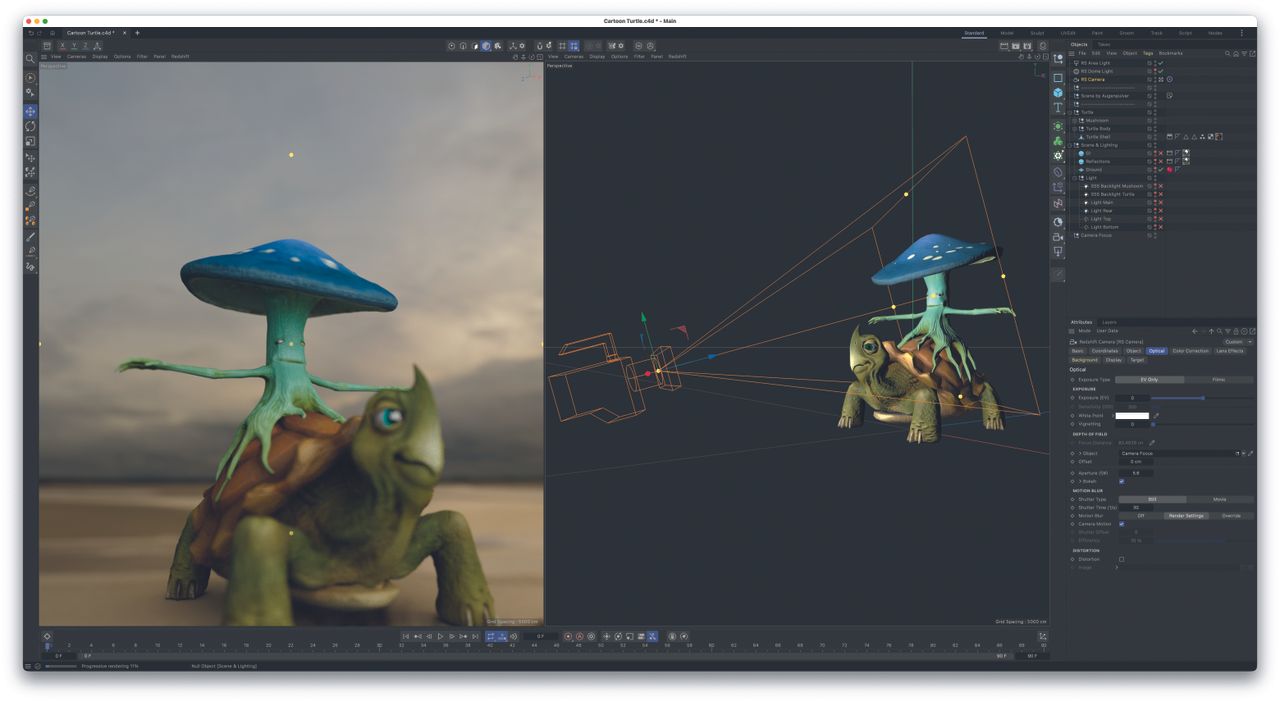
One of the most confusing aspects when starting with 3D modelling software is that when you render your first 3D scene, the output you get isn’t what you’re seeing in the 3D application’s viewport. This is because, nine times out of ten, the camera object in the 3D scene is not being used to view it, and that’s what the 3D application will typically default to when rendering.

It’s useful to remember that a 3D application is essentially an empty void in which you can create whatever you wish. In this environment, you will need a camera to capture the picture or movie you want, and this is what the camera object in a 3D application is for.
As so many 3D applications render using approximations of how light and materials work in the real world, it’s the same for a camera object. Camera objects work just like a real camera. The beauty of working within a 3D application is that you can just define the type of camera, lens, shutter and the exposure speed you want to use without spending thousands on expensive camera kit.

If you already have a background in photography or filmmaking, this can be invaluable for creating more authentic, realistic scenes more quickly than for artists without that background.

01. The camera is an object

Your 3D camera exists in the scene like any other object; most 3D applications show it as a movie camera or pyramid. It has a position and rotation and can be moved. Practically all 3D applications have a clear split between a camera view and a viewport view, and figuring out which is which is critical.

02. Frame your shot

The camera object defines the render view of the 3D application, whether it is a still or an animation. It can also define the focus point using the depth of field command available in most camera objects, dependent upon the render settings used. This can be a powerful tool for storytelling.

03. Control the output

Since the camera object works like a real camera, we can adjust the focal length to control how an object appears. A wide-angle lens will make an object look distorted; a telephoto lens may make it look more realistic or, when pushed to an extreme, diagrammatic.

Sign up to read this article
Read news from 100's of titles, curated specifically for you.
Already a member? Sign in here
Related Stories
Top stories on inkl right now
One subscription that gives you access to news from hundreds of sites
Already a member? Sign in here
Our Picks
Fourteen days free
Download the app
One app. One membership.
100+ trusted global sources.