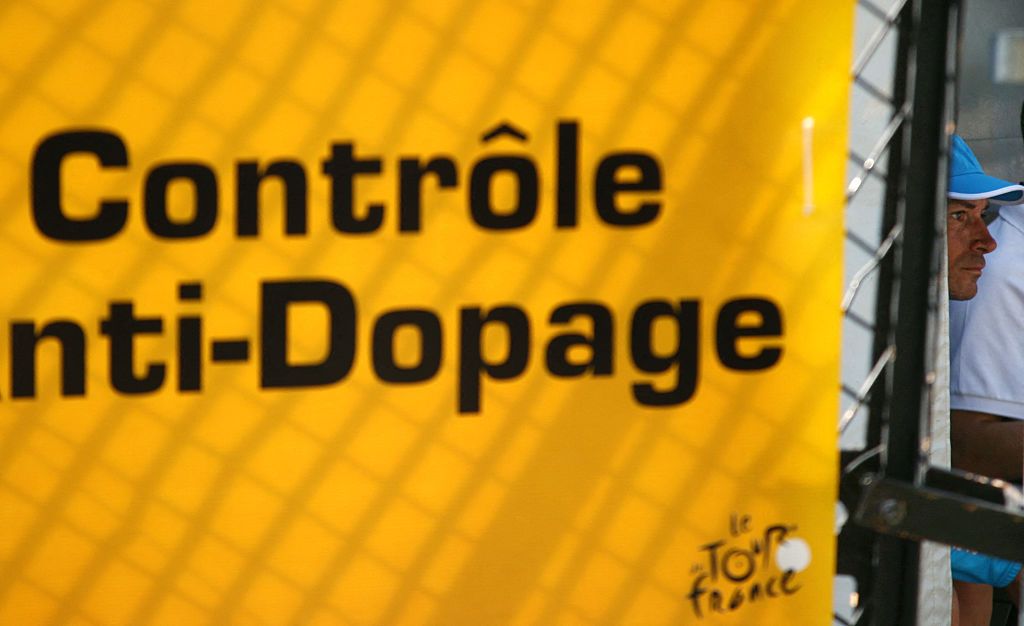
The International Testing Agency (ITA) has confirmed they carried out the nighttime anti-doping tests on Tadej Pogačar and Jonas Vingegaard at the Tour de France and has defended the need to disrupt riders' sleep and recovery to carry out "effective testing".
The ITA claimed in a statement sent to Cyclingnews and other media that the tests were done with "consideration for riders' welfare, equity and fundamental rights."
"The ITA is conscious that night-time testing may be disruptive to riders' rest and recovery. Due consideration has therefore been given to minimise as much as possible the impact testing activities have on riders," the ITA said in the statement.
"However, the ITA, on behalf of the UCI, has the responsibility to ensure the effectiveness of the cycling anti-doping program and the integrity of cycling races. As such, effective testing must, in limited and justified circumstances, be capable to occur outside standard daytime hours.
"All testing activities conducted at the Tour de France and at any other international events, including decisions as to the specific timing of such tests, are carried out in accordance with the ITA’s testing strategy and subject to the safeguards established under the World Anti-Doping Code, the UCI Anti-Doping Rules and French law, with due consideration for riders’ welfare, equity and fundamental rights."
The ITA is a not-for-profit organisation, based in Lausanne, Switzerland, with a mission to manage anti-doping programmes, independently for international federations and event organisers. Cycling's anti-doping programme is funded by the different stakeholders, including the UCI, riders and teams.
Pogačar and several other riders were critical of the night-time testing, with the Tour leader going as far as suggesting that Vingegaard's lack of sleep after his 2am anti-doping test could have been one of the reasons for his crash and fractured collarbone.
Both Vingegaard and his Visma-Lease a Bike team played down the idea that the nighttime anti-doping test was a factor.
Pogačar was tested at 5am before stage 15. He revealed he has also faced other early morning tests during the Spring Classics and the Tour de France.
"It's a little bit strange, but I accept it if this is necessary to still prove we are riding clean, then if this is necessary then I totally accept it and I commit to this. But it's a bit shit when you sleep for four hours in one day in the middle of a three week Tour," Pogačar said.
Pascal Chanteur, president of the French UNCP rider association suggested that the riders were being harassed, while Remco Evenepoel called on the CPA rider's association to act.
"It is inhuman to wake us up, we had a long transfer, and to wake them up like that is pretty disrespectful," the Belgian said.
However the UCI anti-doping rules are clear regarding nighttime testing between 11pm and 6am.
"The UCI may require any Rider over whom it has Testing authority, who has not retired, including Riders serving a period of Ineligibility, to provide a Sample at any time and at any place," rule 5.2.2 explains, but goes on to clarify that "Unless the rider has identified a sixty minute testing window between the hours of 11:00 p.m. and 6:00 a.m., or has otherwise consented to testing during that period, the UCI will not test a rider during that period unless it has a serious and specific suspicion that the Rider may be engaged in doping."
The ITA did not answer a specific question from Cyclingnews about any suspicions of doping in this case, saying its testing strategies remain confidential.
UAE Team Emirates and Visma-Lease a Bike have both been approached for comment.
Our view
Why test at odd hours?
While professional cycling has not seen a major doping scandal for a decade, it is theoretically possible that athletes could benefit from overnight micro-dosing of blood boosting EPO or recovery products, with any traces of the doping disappearing before daytime testing is carried out.
Before the Tour de France began in Barcelona, the ITA explained that its anti-doping strategy is "based on an adaptive risk assessment approach that integrates various dynamic factors, such as rider performance trends, to ensure strategic testing throughout the event. Insights from the ABP (Athlete Biological Passport), including the endocrine module, as well as information gathered by the ITA’s dedicated cycling team within its Intelligence & Investigations (I&I) department, inform these efforts."
ITA claimed it carried out over 360 out of competition tests in the month before the Tour de France, with 600 tests expected during the race. Samples will be kept for 10-years for potential re-analysis.
"Testing during the Tour de France will be targeted and may occur at any point during the three-week race, not just at stage finishes," ITA made clear on July 1 in a statement.
"We remain committed to protecting the integrity of the race and ensuring that all riders compete under the same rules and conditions," said ITA Director General Benjamin Cohen.
The world’s biggest bike race deserves world-class coverage. Subscribe to Cyclingnews for unlimited access to our unrivalled reporting of the 2026 Tour de France. From Barcelona through to Paris, our experienced team will bring you breaking news, expert insight, and in-depth coverage from every stage as the battle for the yellow jersey plays out. Plus, access the Cyclingnews app to follow the action on the go! Find out more.