Get all your news in one place.
100's of premium titles.
One app.
Start reading
Digital Camera World
Alan Palazon

Why use huge space telescopes for astronomy when you can blast an astronaut with a Nikon into space – new research paper suggests

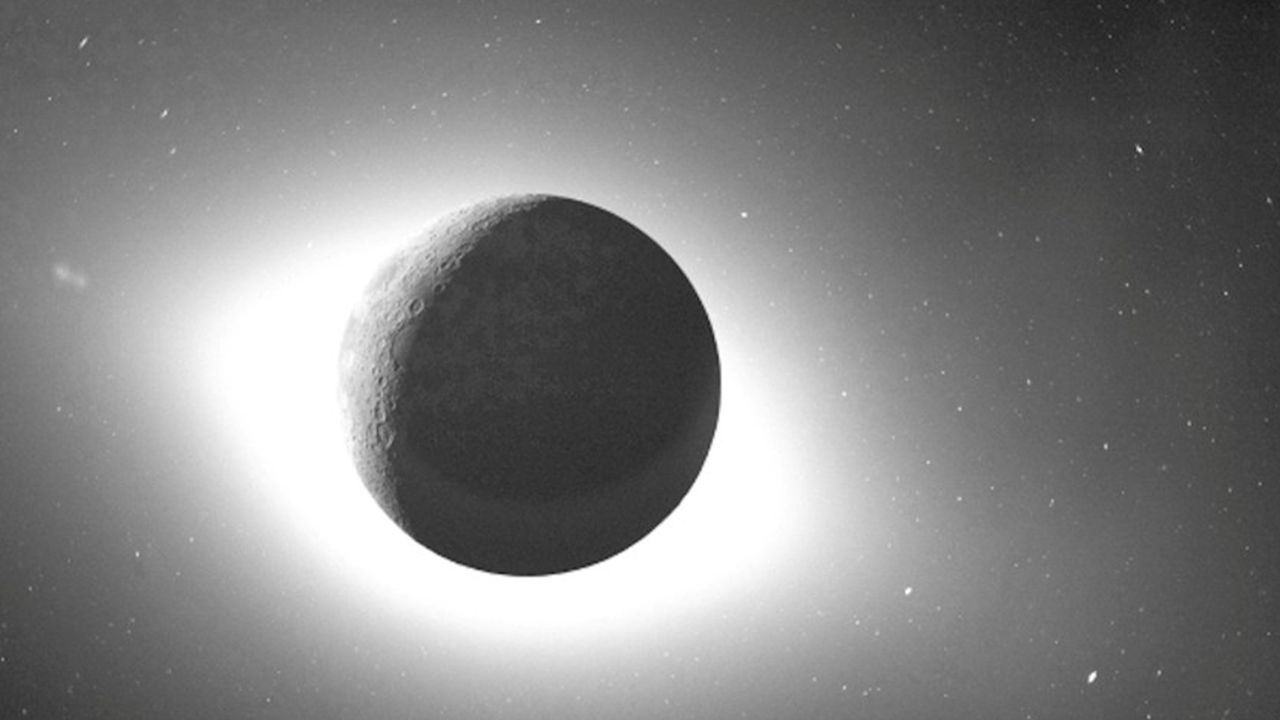
Total solar eclipse revealing F corona surrounding the Sun. .

Instead of relying solely on billion-dollar space telescopes, NASA should also consider using pictures taken by astronauts with commercial handheld cameras to study the cosmos. That’s what astronomers at Tokyo City University, Japan, have suggested in a new research paper.

The paper has revealed how an image taken by one of the astronauts during the recent Artemis II lunar mission has improved understanding of the F corona – scattered light from cosmic dust forming part of the outermost layer of the Sun's atmosphere.

The image was taken on day 6 of the lunar mission as the astronauts witnessed a total solar eclipse from the far side of the Moon. We don’t know which astronaut pressed the shutter, but we do know, thanks to EXIF data, that they used a Nikon Z9 and Nikkor 35mm f/2D lens, with settings: 2secs at f/2, ISO 1600.

Left: spread of the F corona as captured by Artemis-II / Right: spread of the F corona calculated by model (Image credit: Kohji Tsumura & Ko Arimatsu / CC BY 4.0)

According to the Japanese astronomers, the F corona is a faint spreading structure that can be seen in the image surrounding the Moon, which is obscuring the Sun, and special conditions such as a total solar eclipse are required for observation.

By analyzing the image, the astronomers deduced that the extent to which the F corona is distributed in the north-south direction is greater than scientific models have previously predicted, revealing new understanding of the origin and evolution of materials within the solar system.

The Tokyo-based researchers have said the study represents a pivotal intersection of science and human activity, as “a single photograph taken by a person in space” has highlighted a potentially crucial role astronauts using handheld cameras could play in the future of astronomy.

You might also like…

Discover our expert pick of the best Nikon cameras from basic beginner to advanced pro models.

Sign up to read this article
Read news from 100's of titles, curated specifically for you.
Already a member? Sign in here
Related Stories
Top stories on inkl right now
One subscription that gives you access to news from hundreds of sites
Already a member? Sign in here
Our Picks
Fourteen days free
Download the app
One app. One membership.
100+ trusted global sources.