
Get all your news in one place.
100’s of premium titles.
One app.
Start reading
Golf Monthly
Golf Monthly
Sport
David Usher

Why This Is The Perfect New Hybrid For The Average Golfer

TaylorMade Qi4D Max Hybrid Review.

Any new TaylorMade launch is always one of the highlights of the year and 2026 has been no exception, as the new Qi4D family of drivers, fairways and hybrids continue to build on the excellence delivered by the Qi10 and Qi35 line ups of the previous two years.

Whereas in 2025 there were only two models of hybrid in the Qi35 range, this year’s Qi4D features three hybrid models. The Core and Max models remain from last year, but for 2026 there is also a Max Lite model, which is a speed-focused option boasting a higher MOI and rear weighting to aid with launch and forgiveness. This makes it one of the best hybrids for seniors or golfers with slower swing speeds.

In terms of the tech story, it’s not too dissimilar to last year. The Qi4D hybrids feature a multi-material build, combining 450 stainless steel with an ultra-light carbon fibre crown to optimise mass placement. This helps deliver consistent carry distances and a steep, controlled landing angle. Proven TaylorMade technologies also remain, with a cut-through Speed Pocket preserving ball speed on low-face strikes and Twist Face tightening dispersion on mis-hits for dependable performance.

I was sent the standard Qi4D Rescue and the Qi4D Max Rescues for review and couldn’t wait to put them through their paces, especially after unboxing and seeing the premium, stylish design. I’ll be honest, I loved the look of the Qi4D just from the head cover alone. Very swish.

(Image credit: Future)

The clubs themselves follow suit. The overall design is simplistic but stylish. While you can see that the standard Qi4D and the Max version are clearly related, they’re more like normal siblings than identical twins, as there are clear differences between them.

Both share the same refined multi-material head design that pairs a clean stainless-steel body with an ultra-light carbon fiber crown, creating a subtle, high-tech two-tone appearance. Branding and graphics are kept to a minimum on both the crown and sole, which is far more appealing than bold colors or overly busy detailing.

(Image credit: TaylorMade Golf)

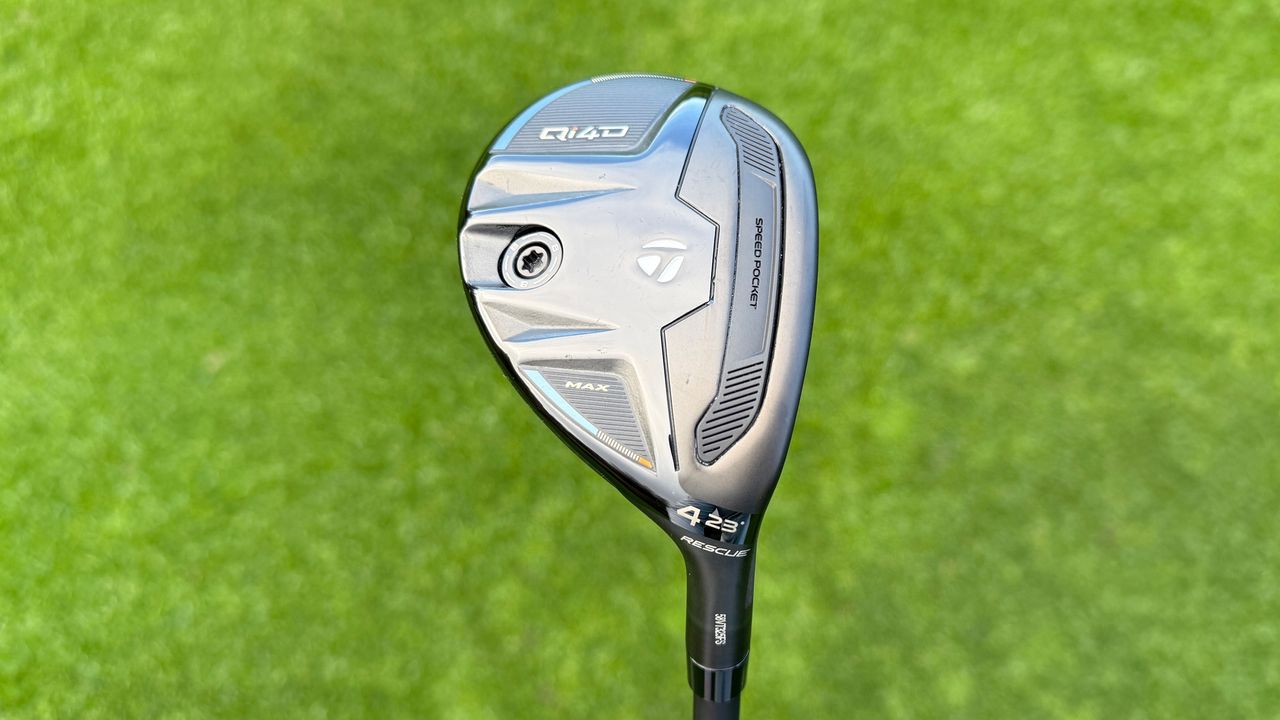
Looking down at address the difference is only slight between both models. The Max has a larger footprint but over the ball I don’t think that is too noticeable to the naked eye. It’s only when you view them from the sole you can really see the size difference. Additionally, you can see from the sole that there is a significant contrast in the weight distribution of each club. The standard Qi4D has the weight nearer to the face, whereas the Max is rear weighted to aid launch and forgiveness.

(Image credit: Future)

Unlike the standard Qi4D model, the Max has a bonded hosel and is not adjustable. This might put some golfers off, and if you do value adjustability then go with the standard Qi4D as it can be adjusted 1.5° up or down, which is very useful for gapping purposes. If you are happy with a set loft and lie though then you’ll be fine with the Max - it provides a cleaner look and there are plenty of loft options available.

While the difference between the two when sat behind the ball is minimal, the Max just seemed that tiny bit more inviting to me, possibly because subconsciously I was aware of the rear weighting which really gives you that sense you can get the ball flying high. This is significant for higher handicappers, who will benefit from the assistance that rear weighting gives you when launching the ball.

(Image credit: Future)

To compare the two clubs fairly I adjusted the standard Qi4D to the same 20° setting as the Max. The data was almost identical, although anecdotally I would say the Max performed slightly better, as the dispersion was tighter and it was a little more forgiving on mishits, as I would expect from a Max model. With the core Qi4D I was seeing a tendency for some shots to drift right, but the Max gave me a consistently straighter flight, even though unlike last year’s Max model it is not draw biased.

From a purely numbers point of view, both the Qi4D and the Qi4D Max performed as well as or better than any other hybrid I’ve tested this year. The distance numbers exceeded anything else I’ve tested recently, while I also experienced a slightly higher flight and faster ball speed from both Qi4D models in comparison to, say, the excellent Mizuno JPX One hybrid I reviewed recently.

(Image credit: Future)

While the Max performed a tad better on the range, on the course I was slightly more impressed with the standard Qi4D. I really enjoyed firing approach shots at the green with both clubs, but off the tee I found that the Max flew a little too high and spinny than I would ideally like. That isn’t a problem for me personally as I’m not a big hitter so would only ever use a hybrid off the tee on a long par three, or on holes when driver or fairway wood is simply not an option, but if you often use a hybrid off the tee then this is something to think about.

On the flip side, I found that I was able to get consistently better contact out of the rough with the Max than I did with the standard Qi4D. This is where this club really comes into its own, 'rescuing' golfers from bad lies with aplomb. I even tried a few chip and run shots around the green and it was surprisingly effective.

(Image credit: Future)

The better player will most likely be drawn to the standard Qi4D, particularly as the adjustability allows whatever tinkering is needed to fit in with specific gapping requirements, but the Max offers a little more forgiveness and consistency for those who need it (which is most golfers!), and both pack a punch in terms of distance.

The only downside to the Qi4D Max is the lack of adjustability, but that can be overcome by going for a fitting to determine exactly what loft and lie you require.

The Qi4D Max hybrids are available in lofts of 3 (20°), 4 (23°), 5 (26°), 6 (30°) & 7 (34°) and can be preordered now, before they go to retail on January 29th at a cost of $299.99 in the US and £269 in the UK.

Sign up to read this article
Read news from 100’s of titles, curated specifically for you.
Already a member? Sign in here
Related Stories
Top stories on inkl right now
One subscription that gives you access to news from hundreds of sites
Already a member? Sign in here
Our Picks
Fourteen days free
Download the app
One app. One membership.
100+ trusted global sources.