The NFL has changed rules to accommodate, protect and enhance the quarterback’s impact over the past quarter century.
This week, everyone’s getting to see both sides of that.

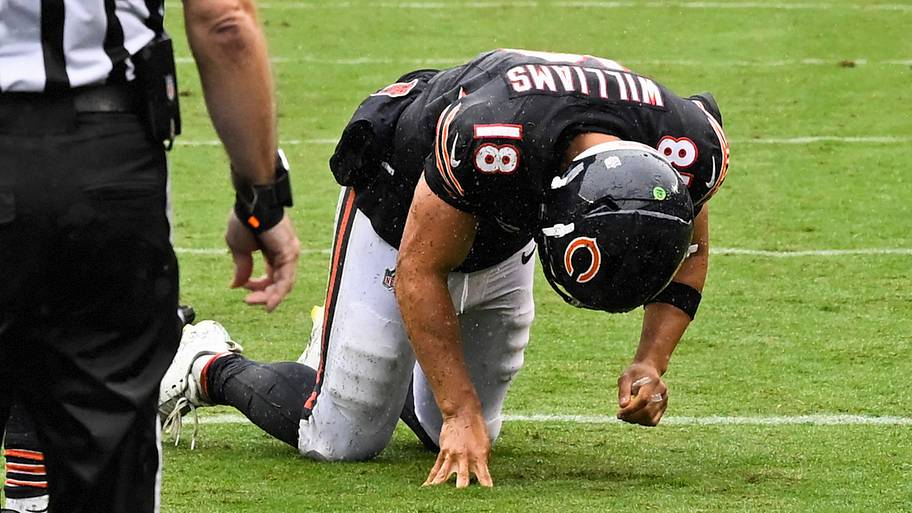
Maybe the Giants’ season isn’t over. Maybe the Commanders and Jayden Daniels have one heck of a comeback story coming—if a little later in the fall. The Bears, for sure, can count themselves lucky that Caleb Williams’s hamstring injury wasn’t as serious as it initially appeared (you can insert whichever meme you want here).
But early in the week, there were plenty of Chicken Littles in Chicago, New York and Washington. And rightfully so. In 2026, losing your quarterback can feel like a death sentence for your football season.
So, yes, the starting quarterback position is more important than it’s ever been, in part because the rules have only accentuated the importance of a position that’s always been the most important one.
And that’s why it’s so devastating when a starting quarterback goes down with an injury.
Is there a solution to preventing QB injuries?
Now, the bad news: There isn’t much the NFL can do about it, short of, in the words of the great quarterback hunter Terrell Suggs, putting flags on them.
When Carson Palmer tore his ACL and MCL, alongside a dislocated kneecap, in his left knee in the 2006 AFC wild-card game in January 2006, the league outlawed lunging at a quarterback’s lower half. When Anthony Barr slammed Aaron Rodgers to the turf and broke his collarbone in 2017, the league strengthened a rule about defenders landing on passers with their full body weight. Over the years, the league has made countless adjustments, tweaks and points of emphasis on top of rule overhauls.
All of which has left the league, again, with little wiggle room to protect the faces of the sport further. Meanwhile, the guys hitting the quarterback have only gotten bigger, stronger and faster, a trend that won’t be slowing down any time soon.
The most interesting part, to me anyway, might be how we got here.
As the position has gone from vital to seemingly omnipotent in the sport, the best athletes entering it have chosen to play there. High school and college offenses have evolved to highlight that natural ability and get them on the field faster. The result is a trickle-up effect that’s left the NFL with a different type of quarterback coming through its pipeline.
I had a coach this week, when asked about all the quarterback injuries through two weeks, respond with a simple question: “How many of those injuries happened when the passer’s back foot hit the ground and he was throwing on time and on rhythm?”
My response: None of them.
Sam Darnold’s hip injury came as he was leaving a muddy pocket, and Dre’Mont Jones wrestled him to the turf. Kyler Murray’s concussion came on a scramble, as he was diving to the ground and his head bounced off Evan Williams’s shoulder. Caleb Williams’s hamstring strain came on a bootleg, as he tried to outrace defenders and slipped on water-logged grass. Daniels’s elbow dislocation was the result of a simple accident (an offensive lineman stepped on his foot, and he tripped). And Dart’s knee injury came as he took too deep a drop out of the shotgun, giving two edge rushers a clean shot at him.
That’s not to blame the quarterbacks for what happened. It’s to show that all of this isn’t exactly bad luck.
Jaxson Dart was able to limp to the medical tent.
— Ari Meirov (@MySportsUpdate) September 22, 2026
This was the injury: pic.twitter.com/hLlmbDbh7g https://t.co/25U4MJkMlK
The first piece is having those more athletic quarterbacks capable of getting themselves out of trouble this way. The second is the quarterbacks being developed in a way that creates habits that don’t necessarily translate to the NFL game. The third is that the pressure to play those guys early on from coaches and front offices is immense, meaning many hit the field before developing the tools to protect themselves better. The fourth, again, is that defenses have similarly bigger and faster athletes, and are more complex than they’ve ever been, causing more quarterbacks to resort to playground ball.
Add it up, and you have a quarterback who’s programmed to use his body, rather than his mind, to get out of trouble more often, and now running his body into more violent collisions, at which point all of this turns into a game of physics.
The NFL’s counter has been to give the quarterbacks tools to protect themselves by strengthening rules around plays where they give themselves up (usually by sliding or going out of bounds). That is fine on first-and-10, when the quarterback already has picked up five yards. What happens, though, when that wildly athletic passer doesn’t like what he’s getting with the rush and the coverage, and it’s third-and-8?
Historically, plenty of examples show quarterbacks learning to protect themselves. Famously, after tearing his ACL in 2008, Tom Brady adjusted his game in several ways, even teaching himself how to fall. He didn’t miss a game due to injury in 23 of his 24 NFL seasons (the torn ACL provided the one exception). Peyton Manning received criticism for years for getting rid of the ball faster as he got older to avoid hits—and he played every game in 16 of his first 17 seasons in the NFL.
Bill Belichick used to tell a young Brady that his offense couldn’t do anything until the ball was out of his hands, a tacit reminder that he was out there to facilitate others. Since then, more quarterback talent has entered the league where that didn’t have to be the case, and organically that’s meant guys using their feet to escape.
What NFL data shows
The numbers the NFL keeps here bear that out. According to internal league data, there were 1,012 designed quarterback runs in 2005. That number fell to 681 in 2012. Ten years after that? The figure climbed to 1,501. It’s since come down each year, from 1,331 in 2023 to 1,329 in 2024 and then to 1,178. But even that last number doubles the 2012 figure.
The scrambling data is even starker. In 2005, the league recorded 556 quarterback scrambles. Last year, that number increased to 1,089, the third consecutive year it was a record for the period since ’05, and third straight year the number was over 1,000 (it never cracked 800 before 2020).
And on those scramble plays, quarterbacks aren’t nearly as protected, because the blocking isn’t set up for them, and the rules change. At that point, they become a ballcarrier like a running back, tight end or receiver; only they lack the callus that other skill players build up by taking hits through the summer to prepare for the season—a quarterback who doesn’t play in the preseason is taking his first hit in a game in Week 1.
Which brings you to the toughest part: There really isn’t a solution to prevent quarterback injuries.
The rules have already reached a breaking point, where in some circumstances a defender has to perform a superhuman feat to take a quarterback to the ground to avoid a penalty or fine. The rewards of playing the position, in so many ways, are such that you’re now always going to get the best athletes gravitating to play it. And high school and college coaches, under pressure to win, are going to do what they need to do with their best players to get the best results, since they aren’t judged as part of some minor-league system.
Then, these guys get to the NFL, often to bad teams with needs at the position; they get pushed onto the field too fast and aren’t given time to develop new habits.
Is it a killer for the sport? No. Football will keep thriving, as it has.
But weekends like the one we watched probably aren’t going anywhere, either. And that means the fortunes of any team can change in a second.
MORE NFL FROM SPORTS ILLUSTRATED
- 2027 NFL Draft: The Best Edge Rusher in This Class and Revising Our QB1 Tiers
- Albert Breer on Packers’ Problems, Chargers-Bills, Rams-Broncos
- Embarrassing Loss in Home Opener Exposes What’s Wrong with the Packers
- Kyle Juszczyk’s NFL Fine for Beer-Chugging Celebration Is Lame. Here’s What His Celly Actually Means.