
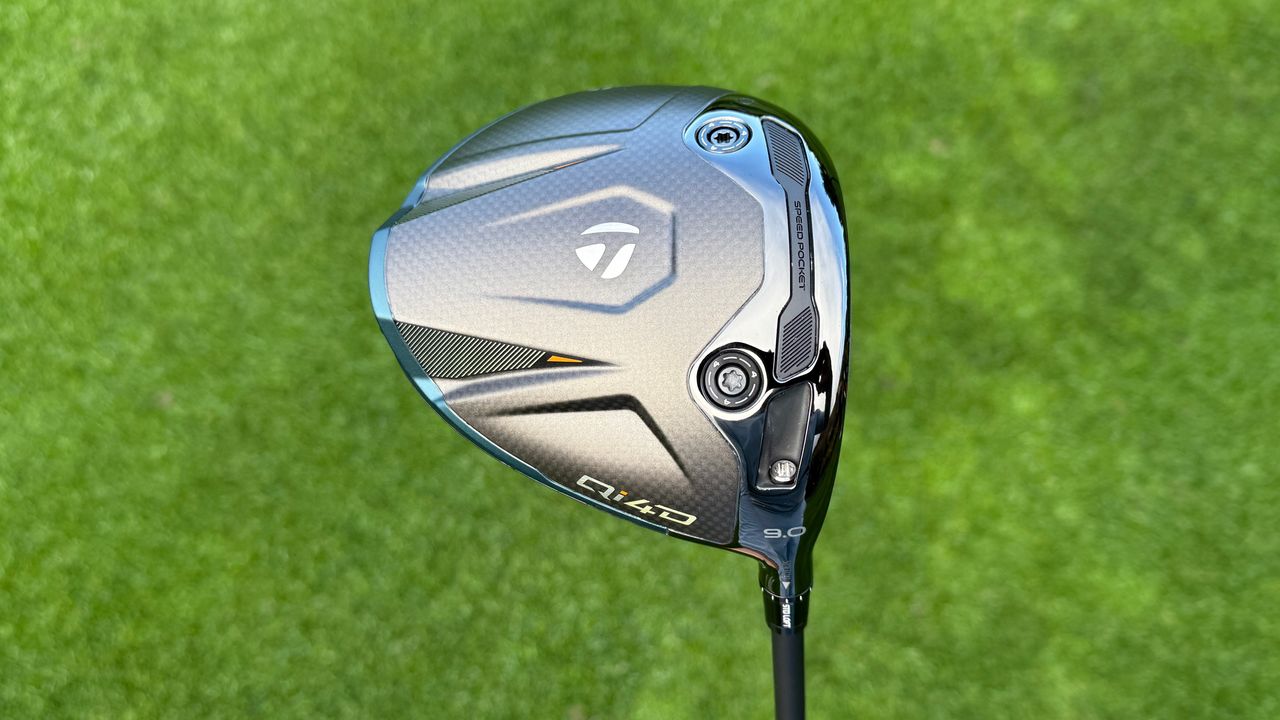
TaylorMade has absolutely thrown down the gauntlet with its latest flagship driver, the Qi4D, declaring it (as equipment manufacturers often do) the company’s fastest and most fittable driver family yet.
Following on from the Qi35 franchise, the Qi4D is basically designed around one primary goal: delivering speed off the tee. TaylorMade says that this new driver family represents much more than a cosmetic update; it's a technical evolution focused on aerodynamics, feel, and a revolutionary approach to shaft fitting.

WATCH: Kick Point: The Golf Gear Show gives their full verdict on the new Qi4D range.

As someone who was genuinely impressed by the overall package of the previous Qi35, I was curious to see where TaylorMade would take this launch, especially given the increasingly tight restrictions placed on club performance by governing bodies. So let me take you through my thoughts, and see if the Qi4D driver can upset some of the best drivers in the game.
Visually, the Qi4D has moved on from Qi35 in a couple of ways: colorway and head profile in the playing position.
Firstly, I have to admit a personal bias: I actually probably preferred the colouring of last year's Qi35. Its aesthetic was clean, modern, and with that light grey, matt finish, it was one of the best-looking drivers to my eye that I had seen in a long time.
The Qi4D adopts a slightly different, perhaps more understated palette, but while I may marginally prefer the previous model’s hues, this new core model's shaping has completely superseded any minor aesthetic preferences.

The Qi35 core model was quite significantly larger and more rounded than many other models on the market, and that voluminous footprint at address somewhat alienated a few players. It was a perfectly high-performing and forgiving head, but some (particularly better) players couldn't quite get comfortable with the profile.
One of the worst-kept secrets in the golf equipment space was that for the majority of the last couple of seasons, Scottie Scheffler and Rory McIlroy were using a tour-only 'dot' version of the older Qi10 core head. This smaller, slightly more traditional shape was clearly preferred by them and many others who value a compact look.
The exciting news is that, to my eye, it seems as though TaylorMade has replicated this tour-only 'dot' profile almost exactly in the new Qi4D core model, and it’s reasonable to assume this change was made with significant input from players like McIlroy and Scheffler.

In fact, when I went for my initial fitting, I actually found a spare 'dot' head (albeit a Qi35 version) lying around and put it side-by-side with the new Qi4D core model, and the profile was identical. This is a massive tick in terms of the playing profile, offering a look that will appeal to the widest possible range of golfers.
The true innovation in the Qi4D, though, lies in its relentless pursuit of speed. During the media presentations I attended, the major story was centered on aerodynamics, with one of the tag lines being, "there is no limit on clubhead speed" (or something along those lines!). This alludes to the fact that while limits exist on parameters such as ball speed (COR) and forgiveness (MOI), a golfer’s ability to move the club quicker remains uncapped.

TaylorMade has clearly invested heavily in this area, designing head shapes that maximize aerodynamic efficiency across the lineup.
I am pleased to report that this focus was unequivocally successful in my personal testing. I picked up around 1.5 mph of clubhead speed over and above any other driver I have tested this launch season, which I genuinely was not expecting. Furthermore, having seen Scottie Scheffler and Rory McIlroy's actual raw data from their test sessions, it seems I am not alone in this finding. This is not insignificant news.
The early adoption by McIlroy provides powerful validation of the speed story. After spending pretty much all of the previous two seasons in the Qi10, his immediate (in fact, early) switch into the Qi4D was telling.

His speed and distance numbers over the first two weeks of using the driver in Abu Dhabi and Dubai were significantly enhanced from his season average.
While I found that the head as such is no 'hotter' than anything else I have tested, the ability to just move it quicker resulted in a 2-3 mph ball speed gain for me and between 5-8 yards of additional carry. That is a real-world, tangible gain that will certainly translate to shorter approach shots on the golf course.
Interestingly, you can now purchase all of the new Qi4D drivers in two face options: Standard and another ‘custom fitting’ version, which is marked up with reflective markers embedded into the face. Referred to as Launch Monitor Enabled (LME) drivers, these markers allow for more accurate readings in terms of face angle, rate of rotation, and other key parameters when using camera-based launch monitors like the Foresight Sports GC Quad, eliminating the guesswork of constantly replacing stickers.

This neatly segways into a new fitting strategy TaylorMade is implementing around shafts.
TaylorMade says that through extensive research analyzing over 11 million driver shots, they can categorize players' swing types based on their release style, and "rate of rotation" through impact into three categories: High rotation, Mid rotation, and Low rotation, and they have partnered up with Mitsubishi to produce a bespoke line of shafts they are calling 'REAX' (a small but nostalgic step back in time for those who remember the name) to complement these release types.

TaylorMade emphasises that there is no such 'right or wrong' or 'good or bad' with these release types, citing that even within its tour staff, they have numerous players in each category of release. Charley Hull (Active), Rory McIlroy (Mid), and Collin Morikawa (Low), were the examples I was shown on video.

While I personally feel precise shaft fitting is a little more nuanced than a three-category system, I really feel this is an excellent way of breaking down shaft fitting into an easy-to-understand concept, and it can provide a great, easy-to-digest starting point for shaft testing, particularly for the average club golfer who finds shaft choices overwhelming.
While the speed gains massively grabbed my attention, my favourite aspect of the new Qi4D driver was actually the feel. As mentioned in my initial review, my one complaint with the previous Qi35, which I otherwise really liked, was that the feel was a little harsh, particularly on mis-hit shots.

I am not sure what has specifically changed to rectify that with Qi4D, or whether it is simply an accumulative effect of the various material and shaping advancements, but the feel is absolutely spot on.
Somehow, it has struck a beautiful balance of being both lively and soft at the same time, which is very tough to achieve. The acoustic is equally brilliant, sitting perfectly in that middle ground, neither high-pitched and ‘clangy’ nor dull and muted. It is, simply put, perfect. This improvement alone significantly enhances the player experience.

Overall, the TaylorMade Qi4D is a genuine upgrade that delivers on its promise of increased clubhead speed through aerodynamic efficiency. When you combine the knock-on ball speed gains with the adoption of a much preferred, tour-inspired head profile and a completely optimized feel and sound, the result is a driver that is simply outstanding.
Despite marginally preferring the visual colouring of the Qi35 (which is entirely subjective), the total package is impossible to ignore here.
I fully anticipate this being a roaring success both on tour and at retail, and this is the driver that will be (starting at least!) in my own personal bag for 2026.
You can purchase the standard TaylorMade Qi4D driver for £549/$649.99 or the LME head for £579.00/$699.99.