Get all your news in one place.
100's of premium titles.
One app.
Start reading
The Conversation
The Conversation
Rebecca Hutcheon, Research Fellow at the Faculty of Business and Creative Industries, University of South Wales

Why the places we love in books can never quite be found in real life

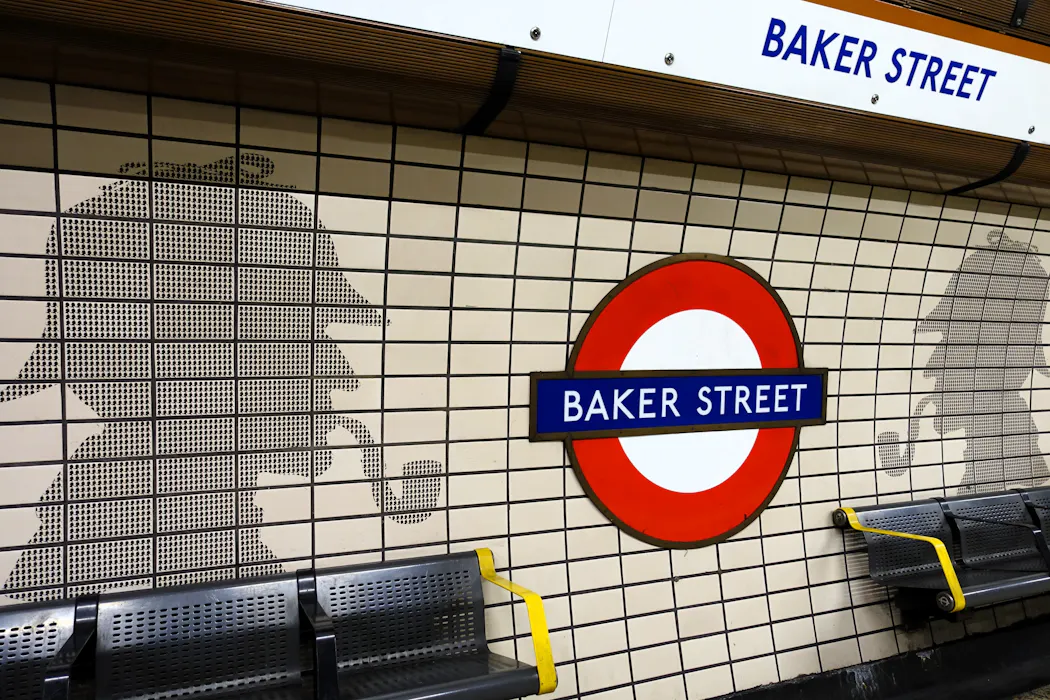
Baker Street London Underground station with silhouette motifs of Sherlock Holmes. Peter_Fleming/Shutterstock

From the Brontës’ Haworth to Jane Austen’s Bath, Wordsworth’s Lake District and Thomas Hardy’s Dorset, literary places continue to exert a powerful hold over readers.

Literary tourism appears to be enjoying renewed popularity, from visits inspired by classic novels to the TikTok trend of turning books into travel itineraries. But what exactly are literary tourists hoping to find when they get there? The answer is more complicated than it might seem.

Haworth, Bath and Dorset all exist, obviously. They can be found on a map and visited. But the Brontë moors, Austen’s Bath, Wordsworth’s Lakes and Hardy’s Wessex are also literary reimaginings of those places. They may never have existed in quite the form readers imagine.

Our fascination with literary places has a long history. Literary geography, which combines physical geography with literary studies, emerged in the late 19th century as the novel grew in popularity and, in many ways, grew alongside literary tourism.

In 1899, William Lyon Phelps created his Literary Map of England, marking locations associated with authors and literary works. A few years later, William Sharp’s Literary Geography (1904) mapped regions such as “Dickens land”, “the Brontë country” and the literary geography of the English lakes.

Parade of people dressed in period costume from the Georgian era as part of the annual Jane Austen festival in Bath
Parade of people dressed in period costume from the Georgian era as part of the annual Jane Austen festival in Bath. Jeremy Richards/Shutterstock

These early literary maps invited readers to see where fictional and geographical worlds appeared to overlap. More than a century later, readers are still seeking those points of intersection.

Thomas Hardy’s Wessex offers a notable example. Hardy borrowed and invented place names to create a fictional territory mapped onto the geography of southern England. Readers soon came to regard this invented landscape as real. Guides to its literary landmarks even appeared during his lifetime, prompting Hardy to worry that readers were taking his landscape too literally.

Wessex was, in Hardy’s words, a “partly real, partly dream” country: an amalgamation of imagined and real-world geography. That dream country continues to attract visitors. In 2025, a Guardian article described a walking pilgrimage through Hardy’s Dorset in search of the landscapes associated with his fiction.

The novelist V.S. Naipaul offers an insight into why literary places can become so powerful. Reflecting on reading Dickens as a child in Trinidad, Naipaul wrote of how Dickens created “a city of fantasy” that readers could reconstruct using what they already knew to imagine what they did not.

What’s remarkable about Naipaul’s observation is that it turns conventional assumptions about realism upside down. Dickens’s achievement was not simply that he described London accurately. His language was open enough to allow readers to create their own version of the city.

The London in a reader’s head could therefore become as vivid as the one on a map.

Real versus imagined

When visitors reach Haworth, Grasmere or Dorset, they are not encountering those places for the first time. They have already visited them in their imagination. Their version of the landscape has been assembled from books, films, photographs, places they have visited and other cultural references. When they arrive, they compare the physical location with that imagined one.

The feeling that emerges from this comparison might be described as “anemoia”, a term coined by writer John Koenig to describe “nostalgia for a time you’ve never known”. Naipaul’s account of reading Dickens suggests a spatial equivalent: a longing for a place never personally experienced.

Literary tourism is one expression of this process. Readers do not simply consume literary landscapes but participate in creating them in their imagination. This may be particularly true of 19th-century realism. Realist writers sought to represent the social and geographical world around them, but their novels still depended on selection, omission and invention.

Exterior of the Bronte Parsonage Museum in Haworth, the historic former home of the Bronte sisters in West Yorkshire,
Bronte Parsonage Museum in Haworth, the historic former home of the Bronte sisters in West Yorkshire, Sergii Figurnyi

Do museums blur fact and fiction?

Many of the most popular literary destinations are writers’ houses. They promise access to authors and to the origins of literary works: the room where a novel was written, the house where a writer lived or the landscape believed to have inspired it.

In this sense, literary pilgrimage attempts to anchor literature in geography. Yet these sites rarely draw a clear line between life and art. Instead, they often weave biography and fiction together. At Haworth, visitors move through domestic spaces associated with the Brontë family while simultaneously encountering the imaginative worlds of Jane Eyre and Wuthering Heights.

The Brontë Parsonage museum in Haworth derives much of its power from bringing biography, landscape, family tragedy and fiction together in one place. Jane Austen’s house at Chawton makes a similar move. Its director has described how visitors seek intimacy with Austen through the house and hope to enter the world of her novels.

Blue plaque with detective Sherlock Holmes name on Baker Street 221b, London.
Sherlock Holmes’ blue plaque at 221b Baker Street, London. Mistervlad/Shutterstock

Some literary sites go further by giving geographical form to places that never existed at all. Sherlock Holmes’s famous address, 221B Baker Street, appears not to have corresponded to a real house when Arthur Conan Doyle began writing the Holmes stories. Indeed, the address itself was impossible within the street numbering system of the time.

Today, however, visitors can tour the Sherlock Holmes Museum – located at a now very real 221B Baker Street – as though Holmes really lived there. An imaginary location has become a geographical destination.

From the earliest maps of Dickens land and Brontë country to today’s literary pilgrimages, the goal has remained remarkably consistent: to find the point at which real and fictional worlds collide. Literary geography suggests that this point may never quite be reachable. Perhaps that is precisely why readers keep looking for it.

This article was originally published on The Conversation. Read the original article.

Sign up to read this article
Read news from 100's of titles, curated specifically for you.
Already a member? Sign in here
Related Stories
Top stories on inkl right now
One subscription that gives you access to news from hundreds of sites
Already a member? Sign in here
Our Picks
Fourteen days free
Download the app
One app. One membership.
100+ trusted global sources.