
Get all your news in one place.
100’s of premium titles.
One app.
Start reading
Times Life
Times Life
Nidhi

Why the Deity at Kamakhya Temple Bleeds Once a Year

There are temples that calm you down. And then there are temples that quietly disturb your thinking.

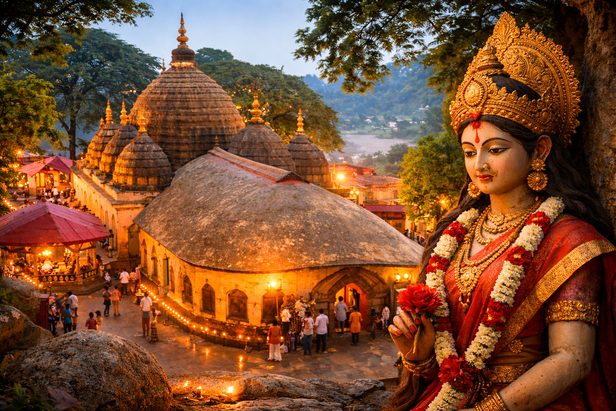
Kamakhya Temple, sitting on Nilachal Hill in Assam, belongs to the second kind. There is no idol here. No serene marble face of the Goddess. And once every year, the temple shuts its doors because the Goddess is believed to menstruate.

For three days, no rituals are performed. The sanctum remains closed. When the temple reopens, devotees are given a piece of cloth touched by reddish water from inside. This event, known as Ambubachi, has been happening for centuries, openly and unapologetically.

To understand why this belief exists, you have to step away from modern discomfort and go back to a time when nature, the body, and divinity were not seen as separate things.

1. The Place where Sati’s womb is believed to have fallen

Guwahati, Jan 01 (ANI): A devotee pays obeisance at Kamakhya temple on the first...

Guwahati, Jan 01 (ANI): A devotee pays obeisance at Kamakhya temple on the first day of New Year 2026, in Guwahati on Thursday. (ANI Photo)

Kamakhya is not just any temple. It is one of the most important Shakti Peethas in India.

According to the ancient story, Goddess Sati sacrificed herself after being insulted at her father Daksha’s yajna. A grieving Shiva carried her lifeless body across the universe. To stop him from destroying creation in his sorrow, Vishnu cut Sati’s body into pieces, which fell across different places on earth.

Each place became a Shakti Peetha. Kamakhya is believed to be the spot where Sati’s womb or yoni fell.

This belief changes how everything at Kamakhya is viewed. The temple is not about form. It is about origin, creation, and the raw power that gives life.

2. A Goddess who is not imagined, but felt

Unlike most temples, Kamakhya has no idol. Inside the sanctum is a natural rock fissure shaped like a yoni, fed by an underground spring.

Devotees do not look at the Goddess. They experience her presence through the earth itself. Water flows continuously through the stone, making the sanctum feel alive rather than constructed.

When this water turns reddish during the monsoon, the belief of the Goddess bleeding feels less like metaphor and more like the earth responding to seasonal change.

3. Ambubachi and the belief of the Goddess resting

Goddess Sati
Why Lord Vishnu Used His Sudarshan Chakra on Goddess Sati

Every year during the peak of the monsoon, the temple closes for three days. This period is known as Ambubachi.

The belief is simple. The Goddess is menstruating. She is resting. Just as a living being rests during this phase, the Goddess must not be disturbed.

There is no panic, no fear, and no sense of impurity. There is waiting. When the temple reopens, it marks renewal, not cleansing.

This idea comes from a time when menstruation was seen as powerful, not problematic.

4. The Earth, the monsoon, and fertility

Ancient communities watched nature closely. They noticed that before the land could produce crops, it went through a period of saturation and rest.

Kamakhya reflects this understanding. The Goddess bleeding aligns with the monsoon, the season when the earth prepares itself to become fertile again.

In this belief system, the land itself undergoes a cycle similar to a woman’s body. Kamakhya gives spiritual language to that natural rhythm.

5. What Science can explain and where it stops

From a scientific lens, Nilachal Hill has underground water channels and mineral rich soil. During heavy monsoon rainfall, the water flowing through the rock fissure can take on a reddish hue.

This explains the physical appearance. What it does not explain is why this natural process became ritualized with such accuracy centuries ago, long before modern geology existed.

Science explains the mechanism. It does not explain the meaning people attached to it or why that meaning has survived unchanged.

6. A Rare temple that openly honors menstruation

Devi

In many cultures, menstruation is still treated with silence or shame. Kamakhya does the opposite.

The Goddess bleeds, and that bleeding is sacred. She rests, and that rest is respected. There is no attempt to hide or purify this phase.

For many women, Kamakhya feels deeply personal. It acknowledges the female body not as something to correct, but as something divine.

7. Tantra and the acceptance of life as it is

Kamakhya is a powerful center of Tantra, a tradition that refuses to divide life into clean and unclean.

Tantric belief sees creation, desire, decay, blood, and renewal as expressions of the same energy called Shakti. The Goddess bleeding is not a flaw. It is energy in motion.

This worldview makes Kamakhya uncomfortable for people who want spirituality to be neat and detached from real life.

Sign up to read this article
Read news from 100’s of titles, curated specifically for you.
Already a member? Sign in here
Related Stories
Top stories on inkl right now
One subscription that gives you access to news from hundreds of sites
Already a member? Sign in here
Our Picks
Fourteen days free
Download the app
One app. One membership.
100+ trusted global sources.