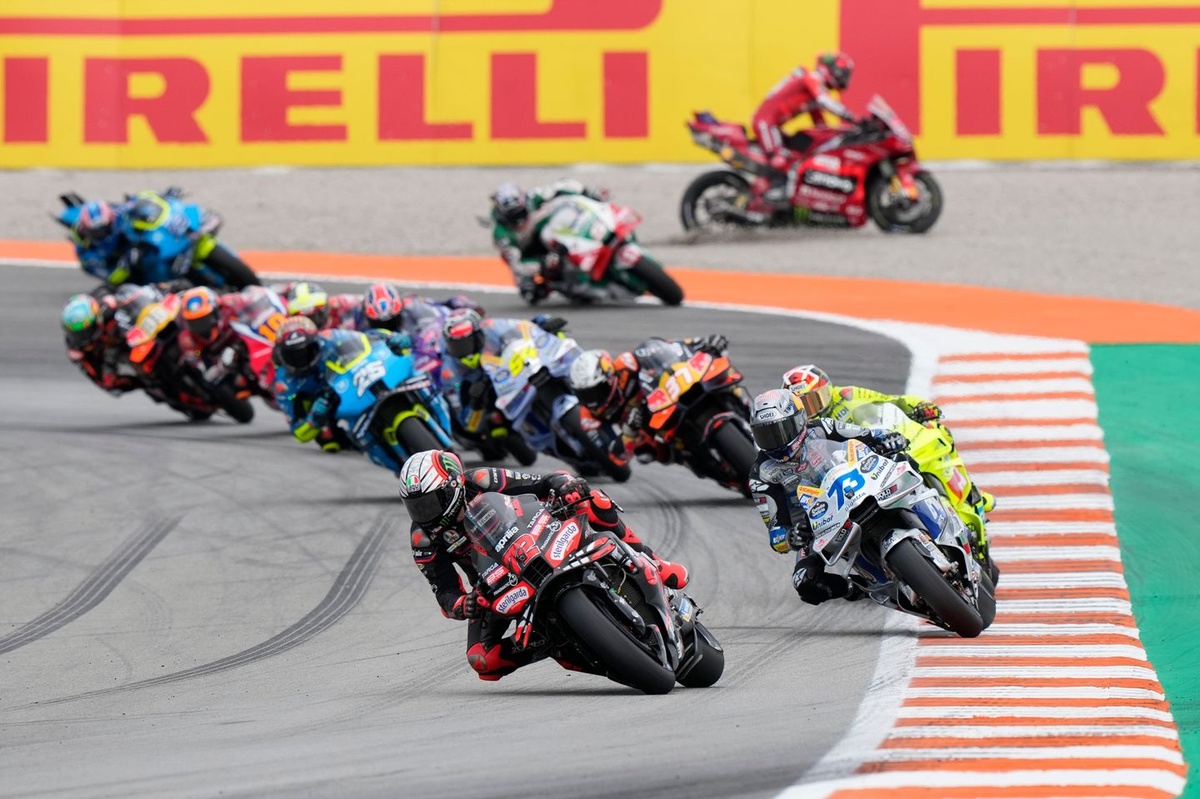
The status quo established and dominated by Ducati, together with the introduction of the new technical regulations from 2027 onwards, means that most manufacturers competing in the MotoGP world championship are approaching 2026 as a year of transition.
The four consecutive titles amassed by the Italian brand since 2022 are the clearest evidence of its superiority under the current regulatory framework. However, that landscape will give way to a completely new one the following year, with the introduction of 850cc bikes and revised aerodynamics.
It's a change that opens a window of opportunity for the other manufacturers, who hope to seize the chance to fight at the front again. In terms of performance and results, Aprilia is currently the constructor closest to Ducati, although the numbers still show that the Noale-based manufacturer is not yet in a position to be considered a genuine threat. KTM appears to have put behind it — at least temporarily — the economic turmoil that shook the company and its racing division. Honda is hoping to consolidate the recovery shown last season, while Yamaha is banking on the massive investment it has made finally starting to bear fruit.
With all of the above in mind, logic and testimony from several contenders point to 2026 being a transitional year for a number of reasons. First of all, it is worth noting that engines have been frozen since the beginning of 2025, eliminating any development margin for one of the most complex components of the bikes. In addition, the bike update schedule will also differ significantly from what could be considered conventional.
The arrival of the new regulations in 2027 will mean that the vast majority of upgrades are introduced during the first part of the season. “Before the summer break — scheduled for July — I will already be focusing exclusively on the 2027 bike,” admits Aleix Espargaro, Honda test rider.
Along the same lines, tyre specifications will remain unchanged, given Michelin’s exit at the end of 2026 and Pirelli’s arrival in 2027. The French supplier’s plan for its final year in MotoGP includes reducing the available front tyre specifications from three to two, as well as halting the introduction of a new front compound.
This shift in priorities is further reinforced by the desire of certain teams to convince riders they want to retain — or, in some cases, sign. Yamaha, KTM and Honda are particularly under pressure in this regard. The Iwata-based brand would love Fabio Quartararo to renew his deal, which expires at the end of 2026. ‘El Diablo’ appears to be running out of patience, at least judging by the statements he has made in recent months, and is still waiting for a performance breakthrough from the M1 that would be compelling enough to persuade him not to look elsewhere.

KTM finds itself in a similar situation with Pedro Acosta. The rider from Murcia already explored the possibility of an early exit at the end of 2025, one year before his contract expires, but the executives in Mattighofen did not even sit down to negotiate a compensation figure. Acosta has Ducati and Honda in his sights, and KTM knows that its slim remaining chances of extending its relationship with the Spaniard hinge on delivering him a rocket ship during pre-season that makes him hesitate, especially as Motorsport.com understands that Acosta's intention is to have his future settled before the championship begins in Thailand in early March.
As for Honda, the Tokyo-based factory is, on paper, the manufacturer that improved the most compared to 2024, scoring 25% more points. Whether that indicator is representative enough to conclude that the Japanese giant has truly awakened from its slumber will become clearer in the coming months.
Although no participant will openly admit to being more focused on the 2027 project than on the championship that gets underway in Thailand next March, reality points in that direction. “No one should expect the picture to be very different this year, because things will be more or less the same as in the past,” a Honda executive told Motorsport.com.
Yamaha shares Honda's point of view. With an eye on 2027, it has reshuffled its structure and regained its satellite team, hoping that this injection of capital would translate into on-track performance — something that has yet to materialise. Yamaha already split its efforts last season, racing the M1 with the inline four-cylinder engine while developing the V4 in parallel, with Augusto Fernandez already competing with it at some rounds on the calendar.
Aprilia’s performance is also unlikely to differ significantly from what it delivered last season, although the main question mark surrounds Jorge Martin and how he will approach the second year of his contract after a first one plagued by setbacks. The RS-GP can certainly continue to improve, but statistics highlight that, over the course of a full championship, it remains a long way from the Desmosedici. Considering the effort Aprilia has to make for parent company Piaggio to release funds under normal circumstances, it will probably be even harder on the eve of a regulatory change that will require a higher-than-usual investment.
Read and post comments