
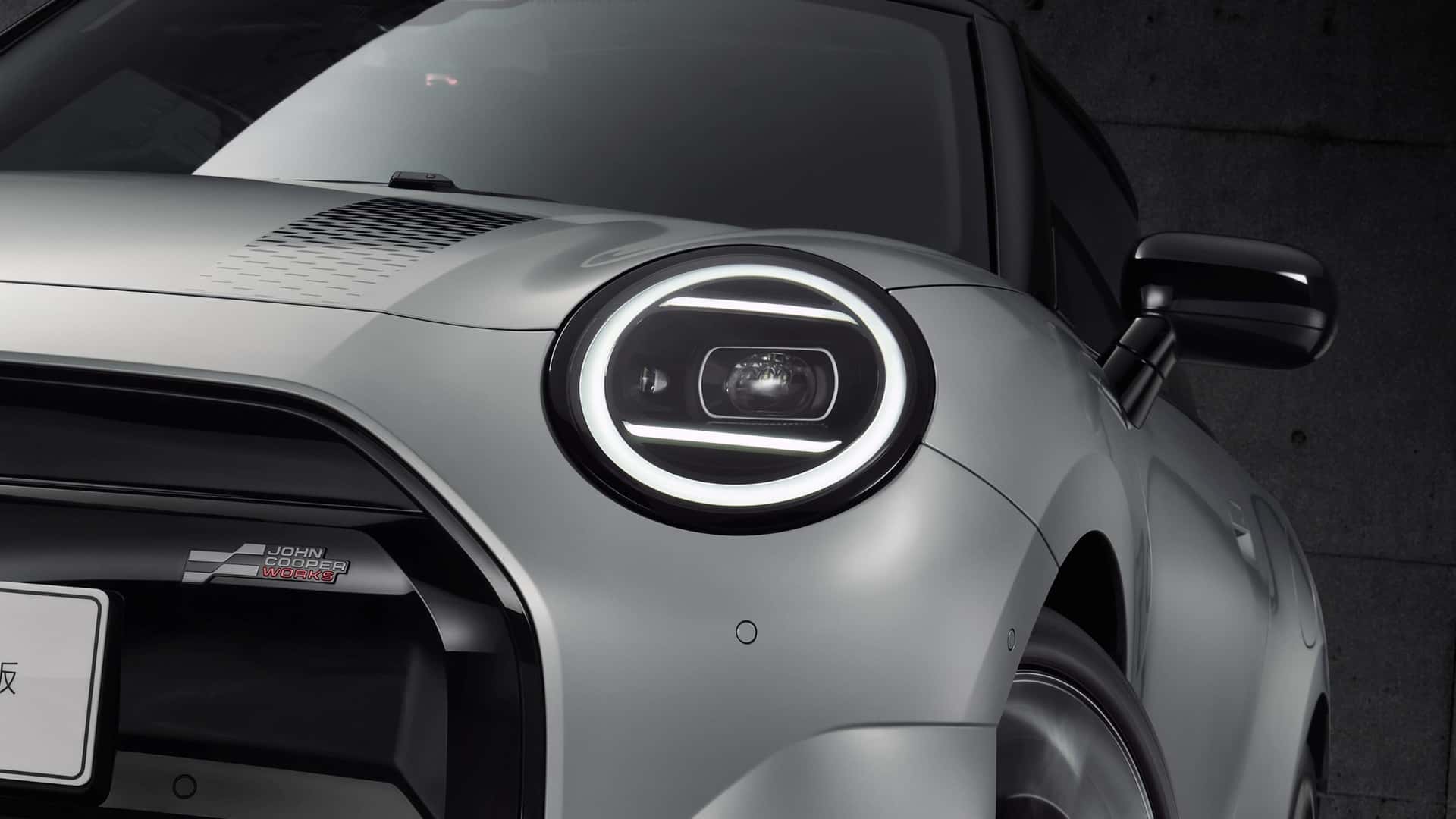
For many years, the round headlight seemed destined to disappear. First came rectangular lamps, then complex polyellipsoidal units, and later ever-thinner light strips that appeared to close a chapter in automotive history for good. Yet a look at some of the newest models suggests something has changed.
Today, the circle no longer exists to house a reflector or a bulb. Instead, it has become a lighting signature — a graphically defined ring that evokes the past while using entirely different technology. It is one of the more curious cases in which progress chooses to revive a historic shape.

When The Circle Was A Necessity
For decades, the round headlight was not a styling choice but a technical necessity. Circular reflectors were simple to manufacture and provided effective illumination, becoming one of the most recognizable elements of cars such as the original Fiat 500 and classic Mini.
Over time, however, that shape became part of certain models’ identities. The Mini, in particular, turned round headlights into one of its defining styling signatures, to the point that even today it would be hard to imagine it with a completely different front end.
When the Rectangle Looked Like the Future
Starting in the 1960s, the rectangular headlight became a symbol of modernity. Lower front ends, improved aerodynamics, and greater design freedom convinced nearly every automaker to move away from the circle, which suddenly seemed tied to an outdated idea of the automobile.
Many popular models followed that path. Think, in different eras, of the transition from the Fiat Ritmo to the Fiat Tipo, and earlier still, Pio Manzù’s front-end design for the 127 compared with the first 128. Citroën and Peugeot also equipped many models with rectangular, trapezoidal, or faired-in headlights. The goal was a clearly more technological image than before.
LEDs Redraw The Past
The arrival of LEDs changed the rules completely, because the light source no longer needed to take a specific shape and designers could use illumination as a graphic element. That is how the circle returned to center stage — no longer as a technical constraint, but as a design language.
The new Renault 4 E-Tech, the Fiat 500, and the Mini all reinterpret the same principle. They do not recreate the old round headlight; they simply trace its illuminated outline, creating an immediate connection to the model’s history. The paradox is that the rectangular headlight, considered for more than 20 years a symbol of the future, now feels far more tied to the past than the luminous circle drawn by LEDs.
Not Just Nostalgia, But Identity
The return of the round headlight, at least as an outline, shows that automotive design never moves in a straight line. One technology replaces another, but it can also bring back shapes that seemed forgotten, giving them an entirely new meaning. Today, the circle no longer exists to hold a bulb; it tells a story.
That may be why so many contemporary cars feel familiar at first glance. LEDs do not turn back time, but they allow designers to build a bridge between past and future, transforming a simple ring of light into one of the most effective elements of a brand’s identity.
Gallery: MINI Cooper S Classic