Get all your news in one place.
100’s of premium titles.
One app.
Start reading
Autosport
Autosport

Why rain is a growing concern for teams early in the 2026 F1 season

Safety concerns have led to changes in Formula 1's starting procedures for the 2026 season, and to a lower cap on the amount of energy which can be harvested on straights.

But there are also worries emerging about how the new cars will perform in the wet, since very few teams have engaged in any meaningful running in low-grip conditions.

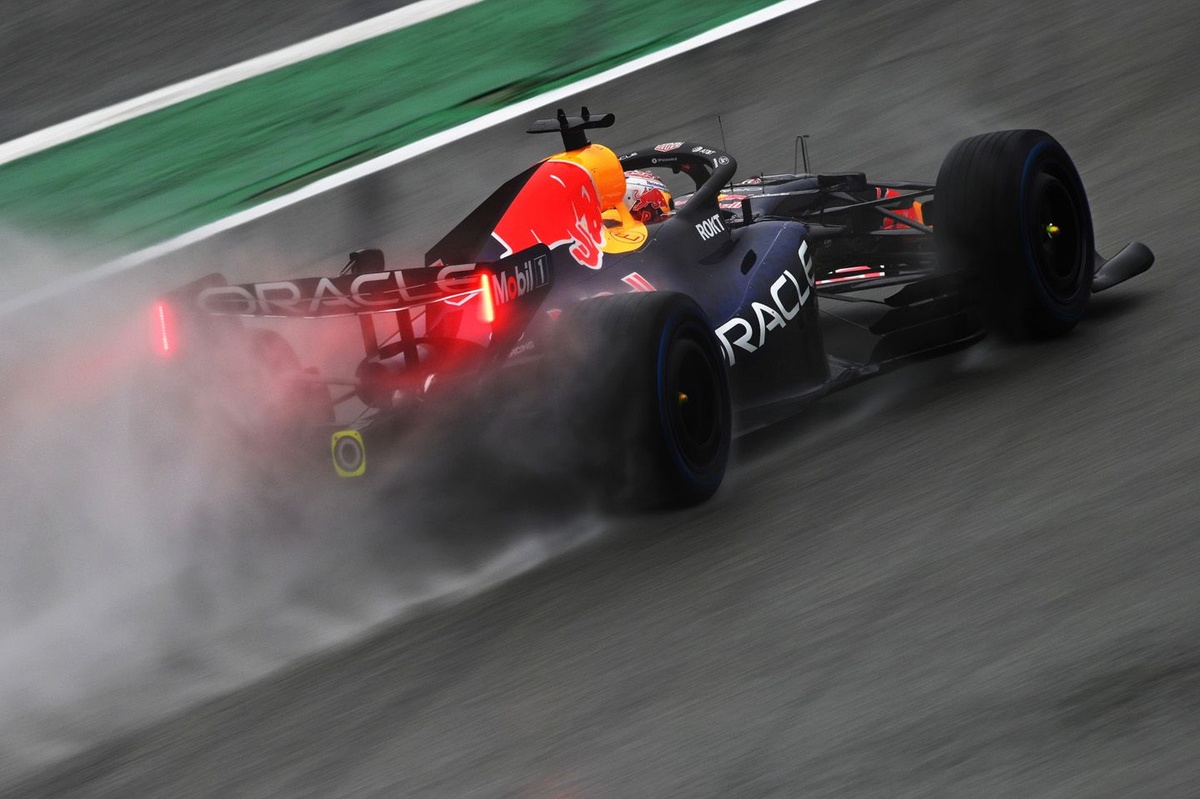
Both three-day tests in Bahrain naturally took place in warm and sunny – if occasionally windy – ambients, while the Barcelona ‘shakedown week' was predominantly cold rather than wet. Teams could run on three of the five days, and only Red Bull and Ferrari opted to ‘spend' one of those running on the Tuesday, when it was forecast to rain and the heavens duly opened.

In recent seasons visibility has been the key issue in wet conditions. One unanticipated side effect of the shift to underbody aerodynamics from 2022 onwards was how much water would be channelled through the ground-effect venturi and spat out into the slipstream of each car, on top of the surface water being displaced by the tyres.

Now the areas of concern are the cars' behaviour under acceleration and braking – or, to be strictly accurate, deceleration. Under the new power unit regulations where nearly 50% of the power delivery comes from the electrical motors, much of the decelerative force will come from the motors rather than conventional braking.

Lewis Hamilton, Ferrari (Photo by: Ferrari)

"To be honest I drove it [the 2026 car] in damp conditions in Fiorano for the first time," said Haas driver Oliver Bearman during the first Bahrain test.

"Of course I was just pootling around. But, yeah, it's a question mark, that's for sure. With the speeds that we can go to and the amount of power that we have, especially in the first part of the straight, it's a point to be aware of for all of us.

"It's a shame that we can't do a wet test, almost."

Such a test was actually on the cards, planned for the weekend preceding the Australian Grand Prix. But this will use ‘mule cars' provided by McLaren and Mercedes rather than actual race cars, and will take place in Bahrain on an artificially wetted track surface, so it will not be entirely representative.

Indeed, the purpose of the test is to help Pirelli improve the usefulness of its wet-weather offerings – currently the difference in lap time between the wet and intermediate is too great – rather than to help acclimatise drivers to the effects of electrical deployment and harvesting in low-grip conditions.

"It's a huge challenge, testing and understanding, really huge," said Racing Bulls team principal Alan Permane during the Bahrain test.

"We can model what to do in lower-grip conditions. The fact of the matter is, you've got a huge recovery from the rear wheels – and in [dry] conditions like this, we're not really using the rear brakes.

Max Verstappen, Red Bull Racing (Photo by: Formula 1)

"That's how powerful... You're stopping the car from 330km/h down to 60, 70, 50km/h [at Bahrain Turn 1] without touching the rear brakes. That's how powerful the MGU-K is.

"So in wet, however much grip you take away, it's going to be... It's definitely going to be a challenge."

In wet conditions, ‘straight mode' using the active aerodynamics will be fully or partially disabled – in the latter case, only the front wings will activate. The problems here are intertwined, because if the electrical motor is set in too ‘greedy' a mode for maximum harvesting, its interventions will be more abrupt and come at the cost of stability. But if it harvests less energy, then the risk is that drivers will end up using more electrical power than they can recover.

Either way, the results could be expensive.

"We did weigh up whether we should have run on that second day in Barcelona," said Permane.

"We just felt it was too much of a risk with one car there and no spares whatsoever. I'm pretty sure most people are in that situation, but it was just... It wasn't worth it.

"Again, you're always evaluating. It's always pros and cons, and there's a good side to do it and there's a bad side to do it. And we decided it was too much of a risk, but it certainly would have been useful."

Sign up to read this article
Read news from 100’s of titles, curated specifically for you.
Already a member? Sign in here
Related Stories
Top stories on inkl right now
One subscription that gives you access to news from hundreds of sites
Already a member? Sign in here
Our Picks
Fourteen days free
Download the app
One app. One membership.
100+ trusted global sources.