In February 2025, NASA published its latest annual report on the state of small spacecraft technology. The report notes the growing interest in miniaturization across the aerospace industry: some of these spacecraft can be the size of a large postage stamp and weigh less than 10 grams. But as miniaturization advances, so do the precision requirements for the components that make up these satellites, since those parts have to become more compact and geometrically complex at the same time.
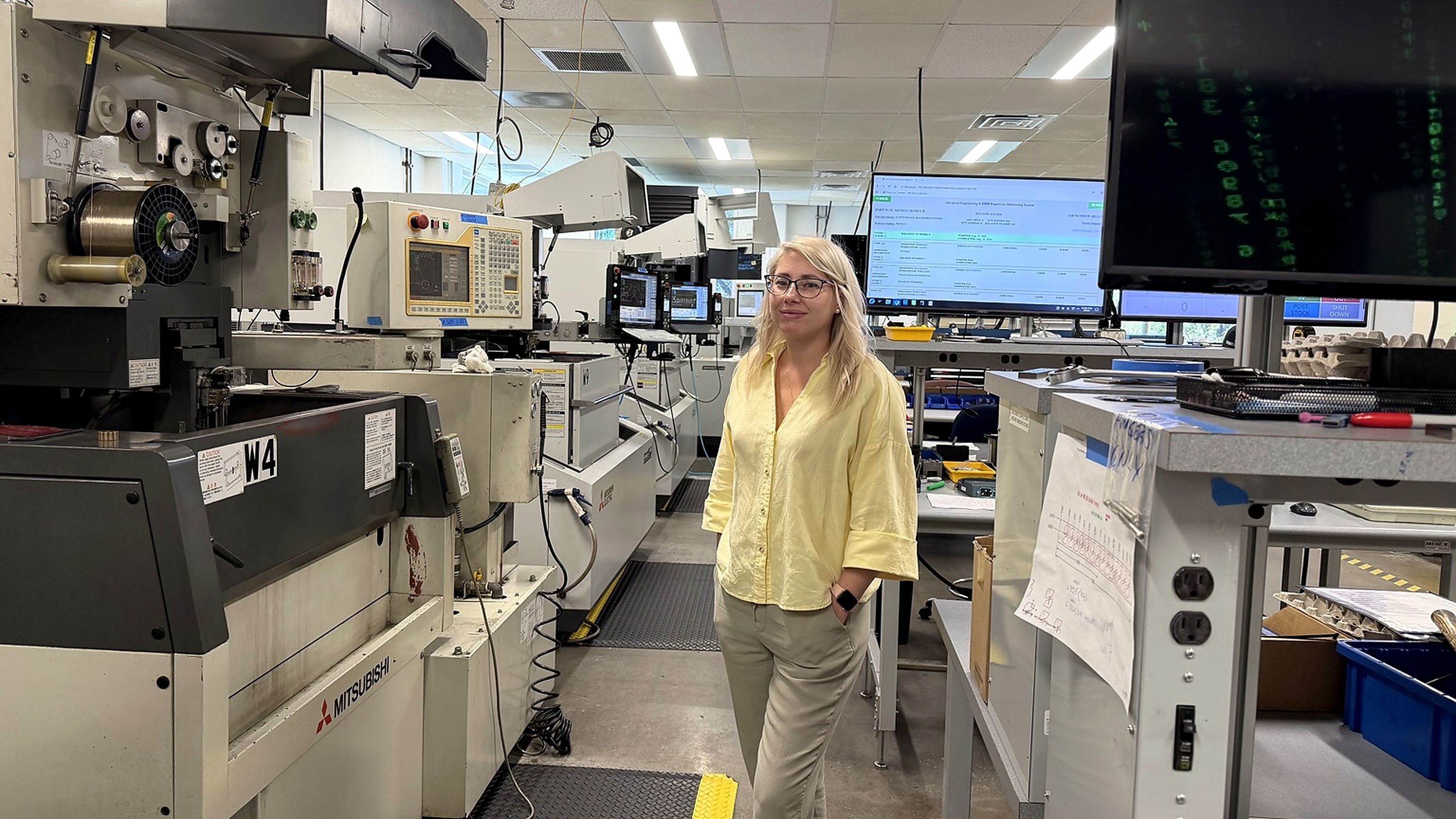
Iryna Honcharuk, a researcher and precision-manufacturing specialist based in California, works directly on this challenge: making components smaller without losing the precision they depend on. When standard machining methods proved insufficient for producing especially small, geometrically complex parts, she worked with equipment manufacturer Mitsubishi EDM Systems to adjust the process parameters, achieving a stable, repeatable result and making it possible to produce parts that had previously been out of reach due to limitations in the process itself – work that earned formal recognition from the company. In 2025, Honcharuk brought her findings together in a published paper on optimizing low-current electrical discharge machining for micro-components. We spoke with Honcharuk about why shrinking a part takes more than just turning down the machine's settings, and what miniaturization means for the future of space technology.
Iryna, satellites and other spacecraft keep getting more compact, which means the requirements for their components keep getting tighter. How much of that trend comes from advances in technology, and how much is being driven by the economics of launch?
The two reinforce each other. Launches have gotten cheaper, so missions that simply wouldn't have paid for themselves before – small-satellite missions, for instance – are becoming viable. But for a miniature spacecraft to be worth launching, it has to pack in enough capability. That pushes electronics and components to do more work while taking up less space. So economics opens the door, and technology is what lets you walk through it.
What are the main technical challenges that come with shrinking a part's scale, and why isn't it enough to just adjust the processing settings proportionally?
The problem is that the process physics itself changes at smaller scales. Heat, mechanical stress, the ratio of surface area to volume – none of that scales down in a straight line. A deviation that would be minor and harmless on a large part becomes a critical defect on a miniature one: a microcrack, a warped surface, or a geometry shift that pushes the part outside tolerance. Scaling the settings down proportionally isn't enough. Moving to a smaller scale means rethinking the entire process.
You worked on this exact problem in 2023 and 2024 on a project with Mitsubishi EDM Systems, when standard processing settings couldn't deliver the precision and surface quality required for miniature parts. What approach got you to a solution?
That project involved electrical discharge machining, a method that removes material through electrical discharges between the tool and the part rather than mechanical force. There's no direct mechanical contact, which makes it well suited to hard, difficult-to-machine materials. But on miniature parts, the standard settings calibrated for larger components delivered too much heat per unit of volume. That damaged the surface and made it impossible to hit the required precision. Instead of hunting for one "correct" setting, we reworked the processing parameters as a whole and analyzed how the different modes interacted. The result was a predictable process, one that repeats reliably from part to part.
That's the same systems-level approach you describe in your 2025 paper, one that involves managing not a single machine parameter but the whole system at once: discharge energy, pulses, cooling, and how the material itself behaves. How exactly does that principle lead to a better result?
If you lower the current, each discharge delivers less energy to the part. That means less heat and a lower risk of microcracks and surface damage. But if you just lower the current and leave everything else alone, the process becomes unstable. Between discharges, you need to clear eroded material from the gap between the tool and the part fast enough; otherwise, you get short circuits. Along with lowering the current, you also have to work out the right pulse duration and the right flushing pressure for the coolant. The whole set of parameters has to be tuned together – that's the only way you get a stable result.
How universal is this approach? Does it hold up across different materials, or does each one need its own processing model? Which materials are giving engineers the most trouble right now when it comes to producing micro-components?
The general principle, coordinating the whole system of parameters rather than tuning one at a time, is universal. The specific settings are not. Different materials distribute heat differently. Titanium alloys are sensitive to how energy is distributed at the moment of discharge. Shape-memory alloys shift phase as they heat up, and their properties shift right along with it. How a composite behaves depends on how its reinforcing material is distributed inside it. That's why every new material still requires recalibrating the system around its own thermal behavior.
Once the precision problem in machining itself is solved, what problems are left?
The next major problem is quality control. Confirming that a miniature part meets its specifications is often no less difficult than making it in the first place. The standard approach – removing the part from the machine and checking it on a coordinate measuring machine – creates a problem of its own: every time the part is repositioned, the coordinate system has to be reestablished from scratch, and for miniature parts, the precision lost in that process can be substantial, sometimes on the same order as the tolerance itself. The logical next step, then, is to build quality control directly into the machining process rather than treating it as a separate stage after production, without ever removing the part from the machine.
In your view, what's being underestimated right now when people talk about the future of micro-machining?
I think people too often expect the answer to come from raw power – building more advanced equipment. In my experience, a reliable solution depends on accumulated knowledge of how a specific material and part geometry behave during processing. That knowledge comes only from iterative testing, and you can't just buy it with a new machine. When people try to automate or speed up a process without that knowledge, the uncertainty doesn't go away–it just moves into the new system.
Is there a limit to how small and how precise we can actually make parts, especially in fields where the cost of a mistake runs highest – space technology, medical devices, and robotics?
A physical limit obviously exists, set by the material's structure and the physics of the process itself. But in practice, we rarely get close to that limit. What constrains us is how well we understand the process at the scale we need, more than the physics itself. In that sense, the boundary today is more methodological than physical. On top of that, the cost of a mistake varies a lot by field. In robotics, the consequences are often reversible – a faulty part or assembly can be replaced. In space technology, a component that's already in orbit can't be replaced or repaired. And with medical devices, a person's health depends directly on how precisely the device works. So, wherever the cost of error is higher, the acceptable margin for risk narrows well before we ever get near that physical limit.