
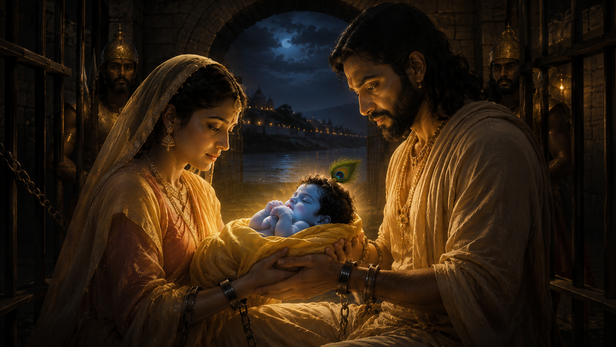
The birth of Lord Krishna inside a prison cell in Mathura is one of the most dramatic and symbolically powerful moments in Hindu tradition. It is not just a story of captivity and escape, but a carefully layered narrative that carries spiritual, psychological, and philosophical meaning. According to the Bhagavata Purana and related texts, Krishna was born to Devaki and Vasudeva while they were imprisoned by Kamsa, who feared a prophecy that Devaki’s eighth child would be his destroyer. But behind this extraordinary setting lies a deeper question that has fascinated scholars and devotees for centuries: why would a divine incarnation choose a prison as the place of birth?
The answer, within traditional interpretation, is often understood as “divine strategy,” where every detail of the incarnation serves a symbolic and cosmic purpose rather than a random circumstance.