Get all your news in one place.
100's of premium titles.
One app.
Start reading
Euronews
Euronews

Why is the EU looking for associate members? Ask the Euronews AI chatbot

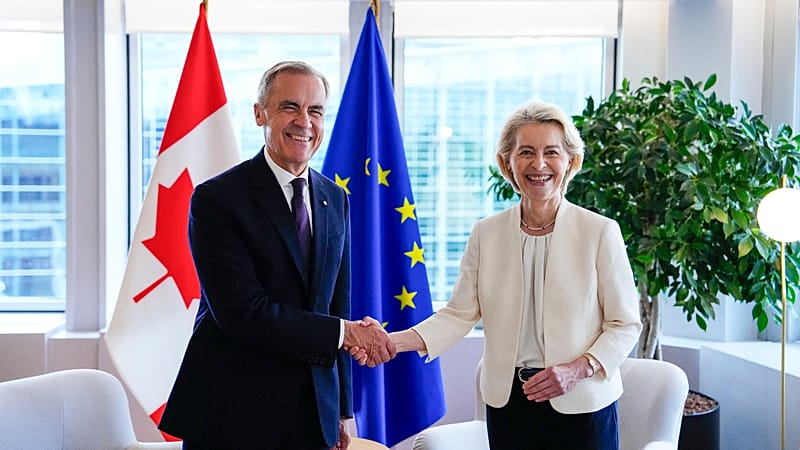
EU Commission President Ursula von der Leyen said Canada might become Europe’s first "associate member” during her State of the Union address in Strasbourg, France, on 16 September.


Will the new alliance between the EU and Canada strengthen them both? Or will it bring unnecessary pressure from threatening international actors? Our poll is anonymous and takes only a few seconds to complete. The results will be featured across XL's EU-wide coverage, including videos, articles and newsletters, and will help shape our reporting as we examine how Europe can secure its position in the age of artificial intelligence.

Leticia Batista CabanasCanada,EU-Canada Comprehensive Economic and Trade Agreement (CETA),membership,EU membershipEurope Today: EU ministers meet on Ukraine aid as Trump rejects Iran's Hormuz dealMon, 28 Sep 2026 06:23:19 GMTEU defence ministers meet in Brussels on Ukraine aid and Russia's sanctions-busting "shadow fleet," as Moscow escalates missile and drone strikes. Elsewhere,Trump rejects Iran's Hormuz offer, claiming the US is "winning tremendously," and Pope Leo XIV heads to Metz for his final day in France.https://www.euronews.com/2026/09/28/europe-today-eu-ministers-meet-on-ukraine-aid-as-trump-rejects-irans-hormuz-deal?utm_source=inkl&utm_campaign=feeds_allthemes_2025&utm_medium=referraleuronews-9928601Europe TodayAP Photo

On today's show:

As aerial threats continue to breach Europe’s skies, and Russia continues its full-scale invasion of Ukraine, Europe is scrambling for solutions. Angela Skujins breaks down how foreign affairs and defense ministers are set to talk about options as they meet today in Brussels.

Sasha Vakulina reports from Kyiv, where repeated attacks and air-raid alerts are stretching through the day and night, putting growing pressure on Ukraine’s air defences and on millions of civilians.

Interviews with former Lithuanian foreign minister Gabrielius Landsbergis and Polish deputy defence minister Pawel Zalewski.

Aadel Haleem reports on the latest developments of the war in the Middle East, as a top Iranian general warns Gulf neighbours that the Strait of Hormuz will remain closed until US economic warfare ends.

Pope Leo found in France a country where faith, tradition and secularism continue to collide — but where thousands were eager to listen to his message. Estelle Nilsson-Julien breaks it down from Paris.

When and where to watch Europe Today?

You can join Euronews’ anchors Méabh Mc Mahon and Stefan Grobe live on TV and Euronews' website, as well as digital platforms (YouTube, Facebook, X, and Instagram), every weekday at 8 am Brussels time.

In just 20 minutes, we bring you the day's key events plus crucial analysis of all the stories shaping the EU and beyond. Also available as a newsletter and podcast.

Adnan LealWar in Ukraine,Kyiv,Pope Leo XIV,Iran warEurope Today: EU ministers meet on Ukraine aid as Trump rejects Iran's Hormuz dealEU defence ministers meet in Brussels on Ukraine aid and Russia's sanctions-busting "shadow fleet," as Moscow escalates missile and drone strikes. Elsewhere,Trump rejects Iran's Hormuz offer, claiming the US is "winning tremendously," and Pope Leo XIV heads to Metz for his final day in France.euronews
France's far-right National Rally gains ground in Senate and forms group for first timeMon, 28 Sep 2026 06:47:57 GMTRN presidential candidate Marine Le Pen hailed a "historic victory" after the results were announced.https://www.euronews.com/2026/09/28/french-senate-election-national-rally-secures-group-france-unbowed-wins-first-seat?utm_source=inkl&utm_campaign=feeds_allthemes_2025&utm_medium=referraleuronews-9930012France's Senate interior view of the assembly room at the French Senate in Paris, 11 December, 2014AP Photo

France's far-right National Rally (RN) party and its allies secured a record 14 seats in the right-wing dominated Senate in polls on Sunday, effectively quadrupling its number in the 348-seat chamber just months before a presidential election.

RN presidential candidate Marine Le Pen hailed a "historic victory" after the results were announced.

Local elected officials vote for new senators for half the upper chamber every three years, each to serve a six-year term.

The far-right party entered the Senate for the first time with two seats in 2014, when it was known as the National Front, and won three seats in 2023.

Le Pen is eyeing her best chance yet at power in elections next year when centrist President Emmanuel Macron steps down.

"This is a historic victory, and a major milestone with the formation for the first time of a group in the Senate," she said on X.

Nine RN senators were elected on Sunday, according to an AFP tally of results, on top of the three who won seats in 2023.

A further two were elected from RN ally Eric Ciotti's Union of the Right for the Republic (UDR) party.

RN president Jordan Bardella said the party's senators would form a group with UDR allies.

Ciotti quit the right-wing Republicans (LR) party in 2024 after calling for an alliance with the far right.

The upper chamber's LR president of more than a decade, 77-year-old Gerard Larcher, is expected to be re-elected next week.

The right, centre and left-wing Socialists looked set to remain the three major forces in the upper house, according to initial results.

The hard-left France Unbowed (LFI) party won its first-ever seat.

Le Pen's anti-immigration party emerged as the single largest party in the lower-house National Assembly after Macron called snap polls in 2024, though it fell well short of a majority.

Gavin BlackburnFrance,French politics,National Rally (France),France Insoumise,2027 French presidential election
Ukraine funding gap looms over Brussels defence talksMon, 28 Sep 2026 06:30:51 GMTGood morning. This is Mared Gwyn with your Monday newsletter from Brussels. Today: the question of Ukraine's funding gap looms over EU defence talks, and the bloc's energy chief cautions over low energy storage. Let’s dive in.https://www.euronews.com/2026/09/28/ukraine-funding-gap-looms-over-brussels-defence-talks?utm_source=inkl&utm_campaign=feeds_allthemes_2025&utm_medium=referraleuronews-9929815A rescuer works on a site of Russian drone strike on the central market of Zaporizhzhia, Ukraine, on Saturday, Sept. 26, 2026Kateryna Klochko/Copyright 2026 The AP. All rights reserved

Hold the fort: European defence ministers are meeting in Brussels this morning to discuss more support for Ukraine as well as fortifying the bloc’s own skies and seas, my colleague Angela Skujins reports from down the road at the European Council. It comes as Russia continues to pound Ukraine, with the impact also bleeding out across Europe’s borders.

The effects of Moscow’s aggression continues to be felt around the continent, through rogue aircraft and drones. Ministers will be tasked on Monday to start putting flesh on the bone to European Commission President Ursula von der Leyen’s bold pitch for the bloc’s own emergency protocol for hybrid threats, as unveiled at her agenda-setting State of the European Union speech in Strasbourg.

An EU official close to the security file told reporters, including our own Angela Skujins, that there is space for dialogue between the bloc and the North Atlantic Treaty Organisation (NATO) particularly when it comes to these unwanted incursions – and how to step up defences. But avoiding duplication is the big question.

Speaking to Euronews, Lithuania’s former foreign minister, Gabrielius Landsbergis, acknowledged the d-word is the biggest concern, but he admitted allies need to be more forceful with tools to counter these threats, particularly when it comes to Europe’s eastern flank.

The Kyiv funding gap: Landsbergis also said, however, that the biggest challenge facing Europe over the next 12 months will be how it steps up financial support for Ukraine, which is naturally experiencing the brunt of Russia’s aggression.

Ukrainian President Volodymyr Zelenskyy has made it quite clear he needs €23.5 billion to prop up his military to continue this defence, with Prime Minister Serhii Koretskyi saying on Sunday that some €6 billion will be covered through strict cost-cutting measures, while international partners are expected to step in to cover the rest of the gap.

The delicate conversation that needs to occur now is whether Europe should continue to apply pressure on Kyiv to implement necessary reforms to unlock more cash, or give unfettered access to its coffers.

“We can argue that they need to do reforms and they will do that maybe slowly, slower than we would like to, but then the question is: Do we allow Ukraine to just stop defending themselves if they lack the money?” Landsbergis told Europe Today.

“And I believe that that will be the most important question of the next year.”

Under pressure to provide relief, EU countries on Friday agreed to release a €6.6 billion programme of military aid for Ukraine that had stalled since spring 2023, when Hungary imposed a controversial veto that paralysed the initiative. Jorge Liboreiro has the details.

Diplomatic delegations' fight for survival: My colleague Luca Bertuzzi reports this morning that the EU is unlikely to slash its delegations across the world, despite the network being eyed as part of sweeping budget cuts.

European governments are locked in tense negotiations over the bloc's next long-term budget, with the administrative costs of EU institutions abroad and the global programme the most likely casualties.

But one official told Luca that the idea that the next long-term budget might cut the delegations is politically unlikely, and stems from an ongoing power play by the Commission to take fuller control of the EU's diplomatic service. Luca has the full read.

Pope makes a mark: Meanwhile, Pope Leo XIV concludes his four-day visit to France today in Metz, after travelling from Paris to the major Catholic pilgrimage site of Lourdes over the weekend.

In Lourdes, Pope Leo entered France’s divisive debate over assisted dying, warning against “the temptation to cause death under the guise of false compassion” and invoking the “inalienable dignity of the human person”.

France’s aid-in-dying law, which grants a right to assisted dying under strict conditions, came into force in August following years of fierce political and public debate. “What is legal is not necessarily moral,” Pope Leo told crowds.

Popemobile frenzy: Earlier this weekend in the French capital, the pontiff drew crowds totalling around 800,000, where hundreds of babies and young children were lifted towards the Popemobile to receive his blessing.

EU tells countries to curb energy demand as gas prices face winter squeeze

European Energy Commissioner Dan Jørgensen has urged EU governments to continue curbing energy demand to reduce gas and electricity consumption amid "exceptionally low" storage levels, according to a letter seen by Euronews.

"I invite you to consider taking or continuing to take measures that can sustain injections or reduce gas and electricity demand for as long as necessary," reads the letter, noting that the situation "has not improved" since Jørgensen's first warning in March.

The warning comes as EU gas storage is around 70% full, roughly 12 percentage points below the same point last year, according to the latest figures from the trade association Gas Infrastructure Europe. Continued disruption in the Middle East and fierce competition from Asia for liquefied natural gas (LNG) cargoes are pushing prices up, threatening a supply crisis.

Marta Pacheco has the full story.

More from our newsrooms

Collateral damage: How Cognac is paying the price for Europe’s trade wars. French Cognac producers are battling falling sales as trade disputes with China and the US squeeze the export-dependent industry and leave growers seeking EU support. Peggy Corlin hasthe details.

Seoul seeks apology after Ukraine 'breached' confidentiality agreement over transfer of North Korean POWs. South Korea's President Lee Jae Myung’s office demanded an apology from Ukraine for denying an agreement to keep the transfer of two North Korean prisoners of war from its territory to Seoul confidential. Zelenskyy disclosed last week that his country had sent two North Korean soldiers to the South, adding that they were "not easy to capture alive". Malek Fouda has more.

How Russia recruits Belarusians to fight in Ukraine. Russia's recruitment drive targeting Belarusians has become a key tool to boost manpower on the battlefield and exploits economic hardship and isolation, as Anka Kirexplains.

We're also keeping an eye on

  • EU defence ministers gather in Brussels
  • EU agriculture ministers also meet, and are joined by their Ukrainian counterpart Taras Vysotskyi
  • European Central Bank (ECB) President Christine Lagarde speaks to the European Parliament’s Economy Committee at 15.30 CET

That’s it for today. Angela Skujins contributed to this newsletter.

Mared Gwyn JonesEuropean Union,Ukraine,War in Ukraine,Defence
La Rábida monastery: where Columbus won Castile's backing to discover AmericaMon, 28 Sep 2026 06:22:46 GMTThe discovery of America remains one of history's great feats, where two cultures met. Before setting sail, Columbus found vital backing at La Rábida from Franciscan friars and the Pinzón brothers, making the voyage possible.https://www.euronews.com/2026/09/28/la-rabida-monastery-where-columbus-won-castiles-backing-to-discover-america?utm_source=inkl&utm_campaign=feeds_allthemes_2025&utm_medium=referraleuronews-9921137La Rábida Monastery, in Huelva.Wikimedia Commons

In a small hillock in Huelva, at the point where the Tinto River meets the Odiel before they reach the Atlantic, stands one of the most decisive sites in world history: the monastery of Santa María de La Rábida. Without its walls, its friars and the faith invested there, it is likely that Christopher Columbus's enterprise would never have set sail from the nearby shores of Palos de la Frontera bound for the New World.

The Franciscan presence on the site dates back to the early 13th century, when the first friars settled in this primitive hermitage on the Huelva estuary. For decades, La Rábida was a place of retreat and prayer, far from the bustle, until fate, and the persistence of a navigator, turned it into the epicentre of one of the most momentous episodes ever experienced: the encounter between two worlds that until then knew nothing of each other.

Today, we can tread the same soil on which the navigator walked and pass through the doorway that sealed his destiny. There, in La Rábida, the friars welcome visitors just as they welcomed Christopher Columbus more than 500 years ago.

Monastery of La Rábida, in Huelva, photographed at sunset on 16 September 2026. (María Muñoz Morillo)

The refuge of a navigator down on his luck

By the time Columbus reached these lands, he had spent years trying to persuade a European crown to trust his project: a westward trade route to the Indies which, unbeknown to him, would lead him to a continent unknown to Europeans. Before stopping in Huelva, the navigator had sought support in Portugal, France and Italy, without success. He had also tried to strike an agreement with Castile and Aragon, but the monarchs were then focused on the campaign in Granada to reconquer the last Muslim stronghold in the Iberian Peninsula after more than 770 years of Reconquista.

Statue of Christopher Columbus in La Rábida, Huelva. (María Muñoz Morillo)

It was in the convent of La Rábida that he found more than accommodation: he found allies willing to believe in him and support him before Queen Isabella I of Castile, the great champion of Columbus's project and defender of the Indigenous peoples who inhabited the newly discovered lands. She herself demanded that they be treated as Castilian citizens, free subjects, protected from all abuse or enslavement. Even at her death she did not forget these new Castilian subjects: the will of Isabella of Castile is considered a key legal milestone that anticipated the modern concept of human rights, by establishing the protection and freedom of Indigenous Americans.

The Franciscan friars, especially Friar Juan Pérez, who had been the queen's confessor, listened to Columbus's plan and decided to intercede at the court of the Catholic Monarchs. Thanks to that mediation, the pioneering navigator finally obtained an audience that would lead to the support of Isabella I of Castile, the visionary monarch who agreed to fund the expedition that would change the course of history.

The Virgin who 'witnessed' the start of the journey

Within the walls of this hermitage, the image of Santa María de La Rábida, also known as Our Lady of Miracles, is still preserved today. According to tradition, it was before this statue that Columbus himself prayed moments before setting off into the unknown, on a voyage many considered madness and which would ultimately redraw the map of the world.

Visiting today the chapel where this image is kept is, in a way, to stand at the very spot where the journey was conceived: a place where silence can be heard, a vantage point that bore direct witness to a decision that would shape the destiny of two continents.

The Pinzón brothers, the key to setting sail for the New World

Winning over the Crown was not enough: Columbus needed a crew willing to embark on a voyage into the unknown that many sailors of the time saw as a journey with no return. That is where one of the most influential seafaring families in Palos de la Frontera came in: the Pinzón brothers.

Martín Alonso Pinzón, an experienced mariner and a respected figure in the town, put his reputation at the service of the project and helped to recruit much of the crew, overcoming the reluctance of those who distrusted the navigator's plan. His involvement was so crucial that he ended up commanding the caravel La Pinta, while his brother Vicente Yáñez Pinzón took command of La Niña. The third brother, Francisco Martín Pinzón, sailed as master (second-in-command) on La Pinta, completing a family presence that proved decisive on the three ships of the expedition, alongside the nao Santa María, captained by Columbus himself.

Without the human and nautical backing of the Pinzón family, the project would hardly have set sail from the port of Palos on that 3 August 1492.

Today, replicas of these three vessels can be visited at the Muelle de las Carabelas. There, the three ships offer a glimpse into the exploratory past of what was once Castile.

Recreation of one of the caravels that sailed to America on Columbus's 1492 expedition. (María Muñoz Morillo)

A legacy of light and shade

The discovery of America, driven from this small monastery in Huelva, brought about the greatest cultural, economic and biological exchange in modern history. From that encounter, foods now considered essential arrived in Europe, such as the potato – crucial, centuries later, for example during the Irish famine – the tomato, sugar cane and coveted cocoa. At the same time, that feat was marked by episodes of violence and subjugation towards Indigenous peoples, a reality that today is analysed with a critical gaze, but one that is difficult to project onto the 15th century.

La Rábida is not just a religious building: it is the symbolic starting point of a complex historical process, capable of explaining both the flowering of a new relationship between cultures and the shadows that this very process cast.

Cloister of the monastery of La Rábida, in Huelva. (María Muñoz Morillo)

Today, the Franciscan Convent of Santa María de La Rábida has become a major tourist and cultural landmark for those who wish to retrace the steps leading up to the discovery of America. Its rooms preserve documents, models and objects that recreate convent life in the 15th century, as well as the atmosphere in which Columbus worked out the final details of his expedition.

To stroll through its cloister under the sky lit by the Moon that inspired the navigator to venture beyond the seas, to contemplate the image of Our Lady of Miracles or to gaze out over the same landscape from which the caravels departed, is to travel directly back to the origins of modern history. It is a place of pilgrimage not only religious but also historical, for anyone who wants to understand how a small monastery in Huelva ended up changing the course of the world.

This text was translated with the help of artificial intelligence. Report a problem : [[email protected]].

Maria Muñoz MorilloLatin America,History,Navigation,Christopher Columbus
Mystery death of Catalan architect Josep Juanpere: partner held, key witness in comaMon, 28 Sep 2026 06:05:28 GMTNine months after architect Josep Juanpere died in Baqueira, police have arrested his partner; the nephew who found the body is in a coma and the first autopsy showed no signs of violence.https://www.euronews.com/2026/09/24/mystery-death-of-catalan-architect-josep-juanpere-partner-held-key-witness-in-coma?utm_source=inkl&utm_campaign=feeds_allthemes_2025&utm_medium=referraleuronews-9926845Image by Josep Juanpere.Cortesía: gcaarchitects

A new and mysterious case has shaken Catalan society. Nine months after the death of renowned architect Josep Juanpere at his home in Baqueira, what initially appeared to be a death from natural causes has taken an unexpected turn: the Catalan police have arrested his partner over her alleged involvement in his death.

Juanpere, 72, had gone to Vielha hospital just two days before he died, after feeling unwell. The first autopsy found no signs of violence, but doubts about the circumstances of his death led to an investigation which, months later, has resulted this week in the arrest of the woman who was with him during his final hours.

The architect died on 26 December 2025 at his second home in Baqueira, in the Val d'Aran (Lleida), where he was spending the Christmas holidays with his partner. Two days earlier, on Christmas Eve, he had gone to Vielha hospital after feeling unwell and remained there for several hours under observation.

Initially, everything pointed to a natural death. The first forensic examination found no signs of violence and attributed the death to a coronary problem. However, the circumstances of his death ended up under investigation by the court in Vielha, which is keeping proceedings under seal.

The case has taken a turn this week with the arrest in Madrid of Juanpere's partner, a woman of around 63, over her alleged connection to the architect's death. According to 'El Mundo', she comes from a family that made its fortune in the property and hotel sectors and maintains close links with prominent social and business circles.

Investigators have also carried out searches and other procedural steps while the detainee awaits her appearance before the court handling the case.

Another development has now added to concern around the investigation: Juanpere's nephew, regarded as a key witness because he was the one who found the architect's body, is in a coma, according to 'El Confidencial'. He has been in a private clinic for weeks with a lung condition, the newspaper reports.

From Vielha hospital to his death in Baqueira

The last 48 hours of Juanpere's life are one of the key elements in the case. The architect began to feel unwell on 24 December and went to Vielha hospital, where he was treated and kept under observation for several hours, according to local media. He later returned to the house in Baqueira where he was spending Christmas.

Two days later, on 26 December, he was found dead in the property. According to reports on the investigation, members of Juanpere's family had tried to contact him without success. Eventually, one of his nephews went to the house and spent nearly an hour at the door, ringing without getting an answer, until the architect's partner let him in. Once inside, he found Juanpere dead and the woman apparently in a state of shock, according to 'El Periódico'.

At that point, nothing obviously pointed to a violent death, although one detail raised questions: Juanpere's partner had not previously called the emergency services. The body showed no external signs of violence and the first forensic conclusions pointed to death from natural causes.

However, the case did not close. The circumstances surrounding the death led investigators to continue their inquiries, and the court in Vielha eventually opened an investigation that has been conducted for months with great discretion.

The nephew who found Juanpere, in a coma

Josep Juanpere's nephew, a key figure in reconstructing the circumstances in which the architect was found, is currently in a coma, according to 'El Confidencial'.

He was the one who went to the house in Baqueira on 26 December after the family had been unable to contact Juanpere. His account is particularly important to investigators because he was one of the first people to enter the house after Juanpere's death and was able to see directly the state of the property and of those present.

A first autopsy that found no signs of violence

One of the main unanswered questions lies precisely in the initial forensic findings. The first autopsy found no indication of violence and pointed to a coronary problem as the cause of death. Those conclusions explain why Juanpere's death was initially treated as a natural one.

Subsequent investigations, however, led to the widening of inquiries into what happened during his final hours. Nine months on, investigators believe that there is sufficient evidence to investigate a possible criminal death and to arrest the person who was with the architect during those days.

The secrecy surrounding the proceedings makes it impossible for now to know exactly what evidence has prompted this change of course, or what investigators' precise theory is on how the death may have occurred. Nor have all the results of the later forensic tests, or the element that proved decisive in turning a death initially deemed natural into one now being investigated as a possible homicide, been made public.

Juanpere's partner arrested

The woman who was with Juanpere that Christmas is now at the centre of the investigation. The Catalan police have arrested her in Madrid over her alleged involvement in the architect's death, after roughly nine months of inquiries.

Investigators have tried to reconstruct what happened between Juanpere's visit to hospital on 24 December and his death two days later, a period considered crucial to clarifying the case.

The detainee must appear before the judicial authorities, and it will be for the judge to determine her legal status and decide on any precautionary measures. Her arrest does not amount to a declaration of guilt and, as the proceedings move forward, she continues to be protected by the presumption of innocence.

Searches and an investigation under seal

The arrest has been accompanied by new police actions linked to the investigation. The case remains under seal, so very few details have emerged about the evidence gathered over these nine months or about the elements investigators consider important for clarifying the death.

This lack of information helps explain why some of the main questions in the case remain open: what happened after Juanpere returned from hospital, what took place during his final hours and what investigators have discovered to move from an apparently natural death to looking into a possible criminal killing.

The answers will now depend on the progress of the judicial investigation and on the outcome of the measures carried out.

Who was Josep Juanpere?

Josep Juanpere i Miret was co-founder of GCA Architects, one of Spain's architecture and interior design firms with the strongest presence in corporate, hotel and residential projects. Juanpere set up the practice in Barcelona in 1986 together with Antonio Puig. Over the years, GCA took part in numerous projects for major national and international companies and brands.

Juanpere also had a close friendship with Isak Andic, founder of Mango, whose death likewise ended up under judicial investigation. Andic died in December 2024 after falling down a ravine during an excursion in Montserrat. The case, initially closed and later reopened, ultimately placed his son Jonathan Andic under investigation; he was arrested in May 2026 over his alleged involvement in his father's death.

The relationship between Juanpere and Andic went beyond the personal sphere. GCA Architects worked for Mango on various projects, and Juanpere was responsible for the interior design of the 'Nirvana Formentera', Andic's sailing yacht. After the businessman's death, Juanpere penned an emotional farewell in which he described him as a "great friend".

This text was translated with the help of artificial intelligence. Report a problem : [[email protected]].

Christina ThykjaerSpain,Death,Justice,Catalonia
Where are salaries and job opportunities highest in Portugal?Mon, 28 Sep 2026 06:02:42 GMTInformation technology remains one of the most attractive fields in the Portuguese job market, offering high average salaries and strong job creation, according to Randstad's latest Salary Trends Study.https://www.euronews.com/2026/09/28/where-are-salaries-and-job-opportunities-highest-in-portugal?utm_source=inkl&utm_campaign=feeds_allthemes_2025&utm_medium=referraleuronews-9927413The information technology sector continues to record the highest average pay level in PortugalAP Photo

Portugal’s technology sector is adding jobs fast and paying some of the country’s highest salaries. Employment in information and communication rose by 27,600 year-on-year in the second quarter of 2026, while annual salaries for the IT roles surveyed range from €40,000 to €55,000, according to Randstad’s 2026/2027 Salary Trends Study.

According to the report, which cross-references Randstad’s recruitment database with official statistics from INE and Eurostat, the number of people employed in the information and communication sector in the second quarter of 2026 stood at 237,200, representing around 4.4% of the total workforce in Portugal.

Year-on-year, there was an increase of 27,600 jobs (+13.2%). According to Randstad, the five areas most in demand by companies in this sector are cloud and security, data analytics, BI and AI, software development, business applications (CRM/ERP) and IT management and strategy.

Close behind is the life sciences and healthcare sector, which, according to data from INE’s Employment Survey for the second quarter of 2026, cited in a Randstad press release, employs 567,700 people in human health and social care, representing around 10.5% of the total workforce in Portugal.

Year-on-year, there was an increase of 43,200 jobs (+8.2%), “consolidating healthcare as one of the biggest drivers of skilled job creation in the country”, Randstad said in the same press release.

In pharmaceuticals and research, the average gross annual salary ranges from €35,000 to €60,000, according to Randstad’s survey, “with strong demand for sales representatives, quality assurance roles, regulatory affairs, market access and medical affairs”.

In healthcare, the average stands at between €30,000 and €46,000 gross per annum, with organisations focusing on recruiting nurses, doctors, multi-therapy technicians, pharmacy technicians and pharmacists.

Another sector emerging as a driving force for change in the Portuguese market, according to Randstad, is engineering and industry, “a highly skilled sector characterised by a high level of job stability in the Portuguese market”.

According to data from INE for the second quarter of 2026, cited by the Dutch human resources firm, the workforce in the industrial sector (which includes extractive industries, manufacturing, electricity, gas, water and construction) stood at 1,333,700 people, representing around 24.7% of the total workforce in Portugal.

Year-on-year, there was an increase of 43,000 jobs (+3.3%). With average salaries estimated by Randstad at between €33,500 and €49,500 gross per annum, “companies are actively seeking site managers, automation and robotics engineers, product development engineers, production supervisors and supply chain or logistics technicians.”

In banking and insurance, where average salaries range from €35,000 to €50,000 gross per annum, the workforce stood at 118,700 people in the second quarter of 2026, representing around 2.2% of the total workforce in Portugal.

Year-on-year, there was an increase of 8,400 jobs (+7.6%), which, according to Randstad, reflects “an ongoing restructuring of branches and gains in operational efficiency through digitalisation in traditional banking”. “With an ever-increasing focus on risk and compliance, the most in-demand roles are business manager, compliance officer, corporate finance analyst, underwriter and private banker,” the company said.

As regards marketing and sales, sales roles have average salaries of between €23,000 and €39,500, whilst marketing roles range from €26,000 to €36,500 gross per annum.

“Demand is centred on roles such as CRM specialist, performance marketing manager, customer experience manager, technical sales representative and sales engineer.”

INE does not break down figures for marketing and sales, but according to Eurostat, the number of people employed in marketing totalled 37,200 in the first quarter of 2026 (0.7% of total employment in the country). Compared with the previous quarter, there was a decrease of 13.3% (a loss of 5,700 jobs); however, year-on-year there was an increase of 1,400 people (+3.9%).

Finally, in the broad sector of finance, HR and legal services, according to data from INE, the number of people employed stood at 488,100, representing around 9% of the national total.

Year-on-year, there was an increase of 6,800 jobs (+1.4%). With an average gross annual salary ranging from €24,000 to €33,500, this sector “leads the demand for controllers, reporting/statutory specialists, chartered accountants, talent specialising in HR analytics and compliance officers”.

Joana Mourão CarvalhoTechnology,Jobs,The world of work,employment,job opportunity
Euronews Travel & Tourism Summit 2026: Headline speakers, key topics and how to watchMon, 28 Sep 2026 06:00:17 GMTThe Euronews Travel & Tourism Summit on 29 September brings together policymakers and industry experts to debate the biggest issues shaping the future of travel.https://www.euronews.com/2026/09/28/euronews-travel-tourism-summit-2026-headline-speakers-key-topics-and-how-to-watch?utm_source=inkl&utm_campaign=feeds_allthemes_2025&utm_medium=referraleuronews-9927777The Euronews Travel & Tourism Summit will be live from the Albert Hall in BrusselsEuronews

Europe’s travel industry will take centre stage as political leaders and industry experts gather for the Euronews Travel & Tourism Summit.

Live on Tuesday 29 September from the Albert Hall in Brussels, the one-day summit will examine how the industry is changing amid shifting traveller expectations, economic pressures and a complex geopolitical landscape.

It comes after an eventful year for global tourism. Conflict in the Middle East has disrupted air routes, pushed up fuel costs and influenced where people travel, while extreme weather, overtourism and the rollout of new border controls have presented further challenges for the industry.

Despite the disruption, demand has proved resilient. Europe recorded its busiest-ever summer for air traffic in 2026, averaging 35,959 flights a day across July and August. Those developments will provide an important backdrop to the summit.

Live on Euronews.com, the Euronews app and on YouTube, doors open at 9am, with sessions running throughout the day.

Albanian Prime Minister Edi Rama (AP Photo/Hameraldi Agolli)

Programmes and speakers

Bringing together policymakers and senior figures from the tourism, aviation and hospitality sectors, discussions will range from managing overtourism and creating more sustainable destinations to improving connectivity between Europe and Asia.

Two of Euronews’ flagship programmes – The Ring and The Big Question – will also be part of the agenda, bringing their popular formats to some of the industry's biggest debates.

Among the headline speakers is Albanian Prime Minister Edi Rama, who will sit down with Maria Tadeo for a one-on-one interview. Albania has become one of Europe’s fastest-growing travel destinations, with international arrivals reaching 11.9 million in 2025 – up 93.6% compared with 2019, according to UN Tourism. Improved air connectivity, affordable prices and growing interest in the Albanian Riviera, Tirana and the country’s mountains have all helped fuel the tourism boom.

Other confirmed guests include Bill White, the US Ambassador to Belgium; Eduardo Santander, Chief Executive Officer and Executive Director of the European Travel Commission (ETC); and Florian Sengstschmid, the Chief Executive Officer of the Azerbaijan Tourism Board (ATB).

What are the big topics on the agenda?

One of the opening conversations at the summit will look back at the European summer travel season, with Santander examining the trends, challenges and successes that have defined 2026, before looking ahead to the industry's prospects.

Sustainability will be another major theme with panellists discussing how Europe can reduce tourism's environmental impact without compromising accessibility, affordability and mobility.

Overtourism will also be high on the agenda and the summit will explore how popular destinations can cope with growing visitor numbers, including the potential of “second cities” and strategies to encourage travellers towards less-visited neighbourhoods and regions.

Meanwhile, The Big Question will turn its attention to the blue economy. MSC Cruises CEO Gianni Onorato will discuss whether Europe's cruise industry can chart a greener course, looking at cleaner fuels, next-generation ships, smarter ports and emerging “blue corridors”.

Later in the day, The Ring, hosted by Euronews' Méabh Mc Mahon, will bring its head-to-head political debate format to the summit.

Follow the latest stories on Euronews Travel via the website, newsletter and social media platforms.

Mike StarlingTravel trends,Travel destinations,Summit,Travel,Tourism
Pope joins pilgrims in Lourdes candlelit rosary as 150,000 attend massMon, 28 Sep 2026 05:51:35 GMTThousands of pilgrims filled Lourdes on Sunday evening for a candlelit procession with Pope Leo XIV, as he brought his four-day visit to France to a close.https://www.euronews.com/2026/09/28/pope-joins-pilgrims-in-lourdes-candlelit-rosary-as-150000-attend-mass?utm_source=inkl&utm_campaign=feeds_allthemes_2025&utm_medium=referraleuronews-9930039Pope Leo XIV holds a candle during a prayer of Holy Rosary and torchlight procession at the Sanctuary of Our Lady of Lourdes.Copyright 2026 The Associated Press. All rights reserved

Holding a candle and a rosary, the pope walked behind a statue of the Virgin Mary through the sanctuary, describing himself as a “pilgrim among pilgrims”. The procession began at the Grotto of Massabielle, where Bernadette Soubirous is said to have seen the Virgin Mary in 1858.

The Rosary is a series of Catholic prayers traditionally divided into five decades, with worshippers reflecting on events from the lives of Jesus and Mary. The prayers were recited in several languages, including French, English, Italian and Spanish, accompanied by the “Ave Maria” of Lourdes.

More than 150,000 candles were lit across the sanctuary, creating one of Lourdes’ most recognisable evening ceremonies.

Earlier, Leo had celebrated an outdoor Mass attended by around 150,000 people, met French bishops and visited sick and disabled pilgrims. He also held private meetings with survivors of clergy sexual abuse.

The visit was the first official papal state visit to France in 18 years.

Alexis CaracoPope Leo XIV,France,Pilgrimage,catholic churchPope joins pilgrims in Lourdes candlelit rosary as 150,000 attend massThousands of pilgrims filled Lourdes on Sunday evening for a candlelit procession with Pope Leo XIV, as he brought his four-day visit to France to a close.euronews
Trump offered to sell arms to China during Xi visit, US ambassador tells Fox NewsMon, 28 Sep 2026 05:16:34 GMTThe United States is required by law to supply Taiwan, which has a democratically elected president and legislature, with weapons for its defence under the 1979 Taiwan Relations Act.https://www.euronews.com/2026/09/28/trump-offered-to-sell-arms-to-china-during-xi-visit-us-ambassador-tells-fox-news?utm_source=inkl&utm_campaign=feeds_allthemes_2025&utm_medium=referraleuronews-9930006Military personnel take part in a parade to commemorate the 80th anniversary of the end of World War II in Beijing, 3 September, 2025AP Photo

US President Donald Trump offered to sell arms to Beijing in response to concerns over weapons sales to Taiwan, the US ambassador to China said in a Fox News interview that aired on Sunday.

China claims Taiwan is part of its territory and US arms sales to the self-ruled island have long been a thorny issue between Washington and Beijing.

The United States is required by law to supply Taiwan, which has a democratically elected president and legislature, with weapons for its defence under the 1979 Taiwan Relations Act.

US Ambassador to China David Perdue said the issue was raised again when Chinese President Xi Jinping visited the United States last week.

"President Trump continues to say, 'Hey, we sell arms to other people around the world.' He actually asked President Xi would he like to buy some at one point," Perdue said in the interview that aired on Sunday.

US President Donald Trump speaks with China's President Xi Jinping on the steps of the National Archives Museum in Washington, 25 September, 2026 (AP Photo)

"There are continuing conversations about other sales, (Trump) and President Xi talk about that every time they get together," Perdue said, adding the US position has not changed.

In June, China warned Taiwan that seeking independence "by relying on the United States or through military means is a dead end."

Washington had already approved a $11.1 billion (€9.7 billion) arms sale to Taiwan in December, which Perdue said was a sale of "more arms to Taiwan than any other president since 1979."

During his Washington trip, Xi repeated his warning that Trump should show "prudence" over Taiwan, and went further to urge the United States to oppose Taiwan independence explicitly.

In May, Trump suggested an upcoming arms package to Taipei could be used as a negotiating chip with China, raising fears Taiwan's security could be traded away.

Gavin BlackburnUnited States ,Donald Trump,China,Xi Jinping,Taiwan
Latest news bulletin | September 28th, 2026 – MorningMon, 28 Sep 2026 05:00:33 GMTCatch up with the most important stories from around Europe and beyond this September 28th, 2026 - latest news, breaking news, World, Business, Entertainment, Politics, Culture, Travel.https://www.euronews.com/2026/09/28/latest-news-bulletin-september-28th-2026-morning?utm_source=inkl&utm_campaign=feeds_allthemes_2025&utm_medium=referraleuronews-9930001Euronews

Catch up with the most important stories from around Europe and beyond in this Euronews news bulletin. In just a few minutes, our newsroom brings you the latest news and breaking news across world affairs, business, politics, culture, entertainment and travel, with the context you need to make sense of a fast-moving day. Reported with the independence and the European perspective that define Euronews, this regular round-up gives you a clear and reliable overview of the stories shaping our world right now, wherever you are watching from.

Euronewsnews,World News,Latest News,euronews liveLatest news bulletin | September 28th, 2026 – MorningCatch up with the most important stories from around Europe and beyond this September 28th, 2026 - latest news, breaking news, World, Business, Entertainment, Politics, Culture, Travel.euronews
‘A gold mine’: How old EV batteries could help prevent Europe from wasting solar and wind energyMon, 28 Sep 2026 05:02:27 GMTRepurposing retired EV batteries could lower Europeans’ energy bills and prevent wind and solar farms from being switched off.https://www.euronews.com/2026/09/28/a-gold-mine-how-old-ev-batteries-could-help-prevent-europe-from-wasting-solar-and-wind-ene?utm_source=inkl&utm_campaign=feeds_allthemes_2025&utm_medium=referraleuronews-9927900A BYD electric vehicle charges at a dealership in Camacari, Bahia state, Brazil, Friday, March 7, 2025. Copyright 2025 The Associated Press. All rights reserved

Retired electric vehicle (EV) batteries could transform Europe’s outdated energy grid – preventing billions of euros wasted on electricity annually.

While the renewables boom helped the EU save €51 billion last year by lowering oil and gas imports, the continent's infrastructure is struggling to keep up with the clean energy transition.

According to a 2026 report by consulting group AFRY, commissioned by non-profit Beyond Fossil Fuels, 375 gigawatts (GW) of clean energy projects and 455 GW of battery storage projects are currently trapped in distribution grid queues across the continent.

That leaves more than €100 billion of renewables effectively waiting to connect to the grid, delaying access to solar panels and heat pumps for Europeans grappling with skyrocketing energy bills. But there’s a solution waiting in what many think of as waste.

Why Europe’s energy grid is struggling

Europe’s energy grid was originally built around coal, and later gas, which tends to operate from centrally located plants.

However, green energy projects such as wind and solar farms tend to be located in remote areas – including offshore – making it harder to transport the electricity being produced to residential homes and businesses.

Renewables such as solar and wind also rely on certain weather conditions to generate electricity rather than responding directly to demand.

When supply outstrips demand, as it often does, electricity prices can fall below zero and operators may be forced to turn off wind and solar farms or put them on a reduced output – a practice known as curtailment.

In 2024, 10 TWh of renewable energy was curtailed in the EU alone – enough to power three million homes for an entire year. This represents a whopping €4.3 billion in wasted electricity.

While battery energy storage systems (BESS) have been identified as a key factor in reducing curtailment across Europe, investment is far from where it needs to be. Experts say that retired EVs could easily fill the gap.

Could retired EVs save Europe’s power grid?

Just because an EV battery is second-hand doesn’t mean it is of no use.

In fact, most EV batteries are retired with as much as 70 to 80 per cent of their original capacity remaining. While this is not enough to meet automotive requirements, it could help provide power for homes, businesses or even smaller vehicles.

“Old EV batteries really are a gold mine,” Adrian Hiel, director of Electrification Alliance, tells Euronews Earth.

“Even if their performance has degraded to the point that they aren’t great for a car anymore they can easily have a second life, measured in decades, as storage for the grid, for businesses or domestically.”

Currently, Europe is reliant on getting batteries from EVs that are more than 10 years old, or from vehicles that have been in accidents.

The problem with this is that Europe wasn’t buying many EVs a decade ago and cars back then had much smaller batteries, many of them just 22kWh or 24kWh.

According to the International Energy Agency (IEA), only 215,000 EVs were sold in Europe in 2016 – compared to the 4.2 million sold last year. This marks a staggering 1,853 per cent increase.

“In contrast, modern cars can have anything from a 50kWh to a 100kWh battery,” Hiel explains.

“So we are looking at two different trends that could radically change the grid in 10 to 15 years."

There will be many, many more EV batteries available to use as grid storage and each one of those batteries is going to be much bigger.
Adrian Hiel Director of Electrification Alliance

Last year, the EU added 27GWh of batteries to the grid. At the same time, the bloc added around four or five times as much battery storage in the form of EVs.

“When those EVs eventually retire and their batteries become standalone storage, it will transform how the grid is run and operated,” Hiel adds.

“With each year as those storage levels increase we should see bigger and bigger price decreases in electricity - it is a very exciting virtuous circle.”

Europe risks becoming an EV battery graveyard

More than a million EV batteries could reach end-of-life by 2030, according to the IEA. If they aren’t efficiently repurposed into the grid, experts warn that they will become one of the world’s “fastest-growing waste streams”.

While EV batteries can be recycled, it is notoriously difficult and costly to do so. Before a battery can even start the recycling process, it must undergo a time-consuming preparation phase that involves discharging, dismantling and separating its components.

There are also safety risks associated with chemical reactions used to recycle batteries, which can release toxic substances such as hydrofluoric acid. These compounds pose serious risks to worker health and safety, and can even damage recycling plant equipment.

While experts are calling for an expansion of recycling infrastructure to recover critical minerals from EV batteries, placing them in the grid could be more useful.

Solar panels produce electricity during the day (when it is sunny), but this is when electricity consumption in domestic households is at their lowest, as people are often out of their homes for work or school. Instead of being wasted, this excess power could be stored in second-life EV batteries and used later in the evening, when household demand peaks.

“This is the famous duck curve where grid consumption lowers during the day and then ramps up very quickly as the sun goes down and people return home from work,” Hiel says.

“And it’s not just about solar but wind will also benefit. The batteries will move solar from midday to the evening peak in summer and they will move wind from overnight to daytime peaks in the winter.”

The idea is already being deployed around the world.

In California, for example, a 12 megawatt-hour (MWh) facility from energy system developer B2U, uses hundreds of second-life Honda EV batteries that are charged by 1.5 MW of solar generation. The project sells electricity and grid services into the California Independent System Operator market.

And in more remote regions, second-life EV batteries can help provide a much more affordable supply source for communities. The World Bank estimates that more than 160,000 mini-grids are needed to address power accessibility needs in Sub-Saharan Africa – connecting 380 million people with reliable energy.

Liam GilliverElectric cars,clean energy,Renewable energies,Fossil fuels,Cars,battery
Why the EU is unlikely to slash its diplomatic delegationsMon, 28 Sep 2026 05:00:45 GMTThe EU is unlikely to cut its diplomatic delegations despite budget pressure. The network, already being restructured, is vital for smaller member states and European companies.https://www.euronews.com/2026/09/28/why-the-eu-is-unlikely-to-slash-its-diplomatic-delegations?utm_source=inkl&utm_campaign=feeds_allthemes_2025&utm_medium=referraleuronews-9831891Kaja Kallas, High Representative of the Union for Foreign Affairs and Security Policy and Vice-President of the European Commission.EC - Audiovisual Service Cooperators/Johanna Leguerre

Sensitive budget talks are eyeing the EU's administrative machinery and global funding as the most likely targets for deep cuts. But the delegation network is already being reorganised, and small European countries, as well as companies, rely on it heavily.

European governments are locked in tense negotiations over the bloc's next long-term budget, with the administrative costs of EU institutions abroad and the global programme the most likely casualties. But small countries have much to lose if the EU's global diplomatic network shrinks.

A coalition of so-called "frugal" countries, including Germany, the Netherlands and Sweden, is pushing to cut the proposed size of the next Multiannual Financial Framework, the EU's budget for 2028-2034, by several hundred billion euros.

According to the ongoing discussions, there is broad consensus among member states on cutting spending dedicated to the EU institutions, while the Global Europe Fund also faces significant reductions from the levels the European Commission proposed.

These cuts are raising the prospect of scaling back the network of EU delegations worldwide, which would be highly problematic for small EU countries, according to four EU officials who spoke to Euronews on condition of anonymity.

"Small member states with few embassies rely heavily on the network of EU delegations," an EU diplomat from one of the smaller member states concerned said, speaking anonymously to discuss sensitive issues freely.

Global diplomatic network

According to the European External Action Service's (EEAS) 2025 report, the EU's diplomatic arm, the bloc runs 145 delegations and offices, employing almost 6,000 people for a budget of around €1bn a year.

The delegations aren't staffed by the EEAS alone: they also work with the Commission departments for international partnerships and for civil protection and humanitarian aid, while hosting seconded diplomats from national ministries and employing local agents.

Supporters of the network point out that its cost is relatively modest given the global reach it offers smaller EU member states that have no diplomatic presence of their own in many countries.

"Most costs for delegations do not come from staff but from security and facilities, which is the same reason why some member states cannot afford a diplomatic presence there," a second EU official told Euronews.

According to this official, the idea that the next budget might cut the delegations, politically unlikely, stems from an ongoing power play by the Commission to take fuller control of the EU's diplomatic service.

All the more so since the delegations are already undergoing a "modernisation" drive.

Ongoing modernisation

Since 1 September, the delegations have been undergoing a modernisation reform that has already brought significant cuts to administrative staff, prompting opposition from several EU civil service unions.

The plan centralises administrative tasks, finance management and contracts at headquarters and at regional hubs overseeing clusters of countries. The hub in South Africa, for instance, also covers Botswana, Mauritius, Madagascar and Comoros.

Local delegations, meanwhile, have been left with smaller, sometimes minimal, diplomatic representation to maintain political dialogue with local authorities, companies and stakeholders.

"The result has been a centralisation of power, weakening delegations that in the past, especially when headed by a diplomat from a large member state, could act far more independently from Brussels," a third EU official said.

At the same time, officials point out that EU countries with their own diplomatic presence often duplicate the delegations' work, and are not always aligned with how Brussels is now engaging with third countries.

From development to partnerships

During Ursula von der Leyen's first term, the Commission renamed its directorate-general for international cooperation and development (DG DEVCO) as the directorate-general for international partnerships (DG INTPA).

The change was far more than a rebrand: it marked a wholesale shift in the bloc's engagement with third countries, away from development aid and towards backing European companies on major infrastructure projects in strategic areas such as critical raw materials, connectivity and energy.

The Australian mining company Viridis, for example, signed a letter of intent with the Belgian chemical company Solvay to supply Brazilian rare earths for processing at Solvay's plant in France.

In other words, in line with von der Leyen's "geopolitical" approach, the Commission has all but dropped development projects in favour of initiatives that help European companies compete abroad with their Chinese and American rivals.

According to EU officials, when these projects are successful, they manage to help Europe's private sector win contracts far larger than the EU's own contribution, to the point that several European companies have started collaborating with the Commission much more closely.

In the new budget, the intent is also to make global funding allocation more flexible, earmarking it by macro-region, such as Latin America and Africa, rather than by individual country, so the EU can better seize opportunities such as commercial contracts or trade agreements.

"The delegations are key to managing projects with local partners; there are certain tasks that simply cannot be moved to headquarters," a fourth EU official said.

Luca BertuzziEuropean Union,EU Foreign Policy,Diplomacy,Kaja Kallas,Ursula von der Leyen
Sign up to read this article
Read news from 100's of titles, curated specifically for you.
Already a member? Sign in here
Related Stories
Top stories on inkl right now
One subscription that gives you access to news from hundreds of sites
Already a member? Sign in here
Our Picks
Fourteen days free
Download the app
One app. One membership.
100+ trusted global sources.