Get all your news in one place.
100's of premium titles.
One app.
Start reading
MyLifeXP
MyLifeXP
Noopur Kumari

Why Is Ganesha Married in North India but Celibate in South India?

How can the same deity be worshipped in two completely different ways within the same country? In many parts of North India, Lord Ganesha is worshipped alongside Riddhi and Siddhi, who are considered his wives. Yet in several South Indian traditions, the same Ganesha is revered as a lifelong celibate. At first glance, this appears contradictory. But when we look deeper into the symbolism and regional traditions, a fascinating spiritual story begins to emerge. The answer is not about conflict between beliefs. It is about how different regions understood the same divine qualities in different ways.

One God, Two Different Traditions

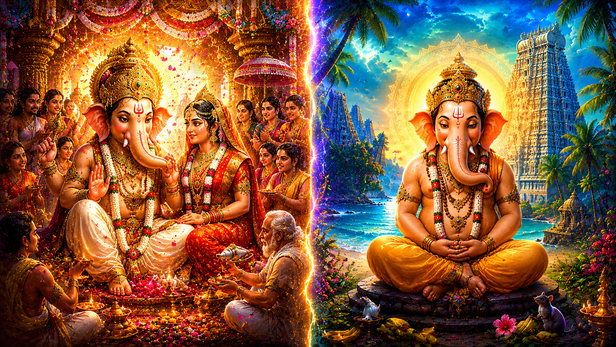
Two Visions of Lord Ganesha

Different traditions reveal different dimensions of the same deity.

Visitors traveling across India often notice something surprising. In many northern temples, Ganesha appears with Riddhi and Siddhi. In several southern traditions, however, he is worshipped alone as a brahmachari. This difference often creates confusion among devotees. Yet Hinduism has always embraced multiple perspectives. The same divine truth can be expressed through different stories, symbols, and traditions. Rather than contradicting each other, these forms reveal different aspects of Lord Ganesha's nature. The diversity itself becomes a reminder that spiritual wisdom can be understood through many paths.

The Symbolism Behind Riddhi and Siddhi

The Gifts of Success and Wisdom

Riddhi and Siddhi represent the blessings that follow wisdom.

In North Indian traditions, Riddhi and Siddhi are often described as Lord Ganesha's wives. Symbolically, however, they represent prosperity and spiritual accomplishment. Ganesha is known as the remover of obstacles. When obstacles disappear, success naturally follows. Wealth, knowledge, wisdom, and achievement begin to flourish. This is why Riddhi and Siddhi are closely associated with him. Rather than focusing solely on a literal marriage, many scholars interpret them as divine qualities that accompany a life guided by wisdom. The symbolism beautifully illustrates that success and fulfillment follow those who overcome life's challenges.

The Vow That Defined a Different Path

Several South Indian stories describe Lord Ganesha making a remarkable vow. According to these traditions, he declared that he would marry only someone possessing qualities equal to those of Goddess Parvati. Since no one could match the perfection of his mother, he remained unmarried. This story highlights devotion, purity, and self-discipline. Rather than focusing on worldly relationships, it presents Ganesha as a symbol of spiritual mastery. The narrative also emphasizes the extraordinary reverence he holds for Goddess Parvati, whose virtues become the benchmark for ideal character.

A Lesson Hidden in Both Stories

At first, the married and celibate forms appear impossible to reconcile. Yet both traditions point toward the same lesson. The North Indian tradition teaches that wisdom leads to prosperity and success. The South Indian tradition teaches that discipline and self-mastery lead to spiritual greatness. Both stories celebrate inner growth rather than external identity. Whether Ganesha is viewed with Riddhi and Siddhi or as a brahmachari, the focus remains on his role as the remover of obstacles and guide toward a higher life.

The Similar Mystery of Kartikeya

An equally fascinating contrast appears in the stories of Ganesha's elder brother, Kartikeya. In many North Indian traditions, Kartikeya is viewed as a celibate warrior devoted to spiritual discipline. Yet in South India, particularly in Tamil traditions, he is worshipped as a married deity with consorts Valli and Devasena. This reversal highlights a unique aspect of Hindu thought. Regional traditions often emphasize different qualities of the same deity. The goal is not historical uniformity but spiritual meaning, allowing communities to connect with divine principles in ways that resonate with their culture.

Why Hindu Traditions Embrace Diversity

Unlike many belief systems that insist on a single narrative, Hindu traditions often preserve multiple interpretations side by side. These variations are not seen as problems but as expressions of a deeper truth. Every story reflects a particular lesson, value, or spiritual insight. Whether it is Ganesha's marriage, Kartikeya's relationships, or countless other regional narratives, each version enriches the larger tradition. This flexibility allows spirituality to remain alive, meaningful, and relevant across different regions and generations.

Beyond the Story Lies the Real Teaching

The real purpose of these stories is not to settle debates about whether Lord Ganesha was married or celibate. Their purpose is to guide human life. Ganesha teaches wisdom, humility, discipline, and perseverance. Riddhi and Siddhi symbolize the rewards of overcoming obstacles. His celibate form symbolizes self-control and devotion to higher ideals. Both narratives encourage personal growth. When viewed through this lens, the apparent contradiction disappears, revealing a deeper spiritual harmony beneath the surface.

Unlock insightful tips and inspiration on personal growth, productivity, and well-being. Stay motivated and updated with the latest at My Life XP.

Frequently Asked Questions (FAQs)

1. Is Lord Ganesha married according to Hindu tradition?

Different traditions offer different perspectives. Some describe him as married to Riddhi and Siddhi, while others worship him as a celibate deity.

2. Who are Riddhi and Siddhi?

Riddhi symbolizes prosperity, while Siddhi represents spiritual accomplishment and success.

3. Why is Ganesha considered married in North India?

North Indian traditions often associate him with Riddhi and Siddhi as symbolic manifestations of the blessings that follow wisdom.

4. Why is Ganesha worshipped as a celibate in South India?

Some South Indian traditions describe him as remaining unmarried after vowing to marry only someone equal to Goddess Parvati.

5. Are these traditions contradictory?

Not necessarily. They emphasize different spiritual teachings and symbolic meanings.

Sign up to read this article
Read news from 100's of titles, curated specifically for you.
Already a member? Sign in here
Related Stories
Top stories on inkl right now
One subscription that gives you access to news from hundreds of sites
Already a member? Sign in here
Our Picks
Fourteen days free
Download the app
One app. One membership.
100+ trusted global sources.