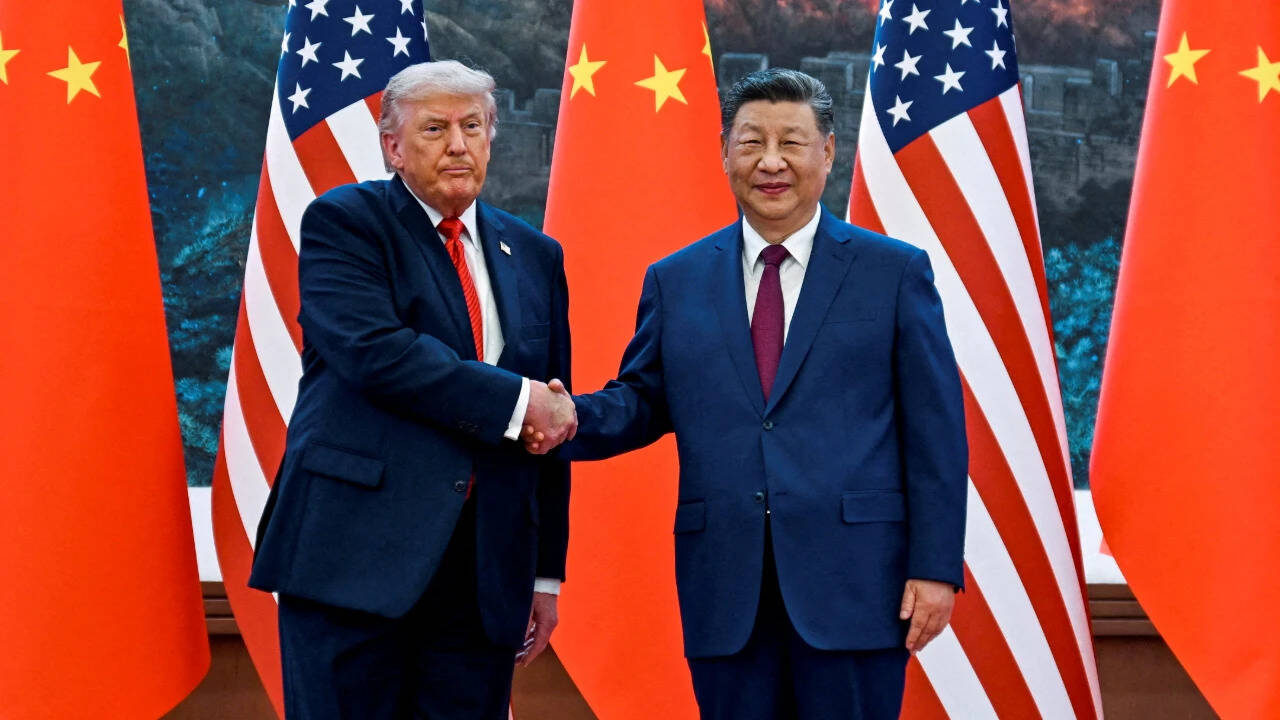
Iran could emerge as a sensitive issue when US President Donald Trump meets Chinese President Xi Jinping in Washington on Thursday, amid a report that Chinese entities provided Tehran with high-resolution satellite imagery before an Iranian missile strike that killed three US troops in Jordan.
Get breaking news anytime, anywhere. Download the TOI app now!
Trump is expected to "confront" Xi over Beijing's alleged support for Iran when the two leaders meet, after a report linked Chinese entities to satellite imagery provided to Tehran before the deadly Iranian strike on US troops, reported Fox News.
Satellite imagery linked to Iran strike
The reported imagery was allegedly obtained by Iran before its July 17 missile attack on Muwaffaq Salti Air Base in Jordan, where three US troops were killed and four others wounded. US officials have linked the imagery to the attack, according to The Wall Street Journal, describing it as the clearest evidence so far that Chinese support for Iran had lethal consequences for US forces.
The US officials did not identify the Chinese entities involved and did not accuse Beijing of directly participating in the attack. China has also rejected US concerns over Chinese companies providing satellite imagery to Iran.
Trump on Sunday had also acknowledged the broader intelligence rivalry between Washington and Beijing when asked about the report. "You know what they say? That China spies on us. I say you're right, and we spy on them, too," Trump said.
Asked whether he planned to raise the issue with Xi, Trump said the Chinese president had "behaved reasonably well" and that "we behave reasonably well."
The latest report comes after months of US warnings to Beijing over Chinese companies allegedly providing satellite imagery that Iran could use to target US forces. In May, the Trump administration sanctioned three Chinese companies, accusing them of providing, collecting or publishing imagery that could help Iran target American personnel.
US officials had also raised the issue with their Chinese counterparts before the latest report emerged. Beijing has denied that Chinese companies were involved in supplying imagery for attacks on US forces.
The July 17 strike marked a major escalation in attacks on US forces. Iranian ballistic missiles struck a housing area at the Jordanian base where American troops were staying, killing three soldiers and wounding four others. Iran also targeted aircraft at the base, according to US officials.
The reported Chinese imagery is part of broader US concerns about Chinese technology and data being used by Iran, including satellite imagery, navigation services and components for drones and missiles. US officials and analysts say such assistance could improve Iran's ability to identify and strike American military targets.
The issue had also come up in US-China diplomatic exchanges. Secretary of State Marco Rubio met Chinese Foreign Minister Wang Yi days after the July 17 attack. Asked whether China was providing Iran with targeting information, Rubio declined to answer directly, saying "nothing that China has done has in any way changed the trajectory of the conflict."
Also read: China warns Trump not to cross 4 ‘red lines’ as Xi heads to US
Trade, AI and Taiwan also on table
Xi's visit to Washington from September 23 to 25 is expected to cover a wide range of issues beyond Iran, with trade, artificial intelligence, rare earths and Taiwan among the key areas of discussion. The two sides are also seeking to maintain stability in their economic relationship, with the existing trade truce set to expire in November.
Trump is expected to personally greet Xi at Joint Base Andrews when the Chinese president arrives in the Washington area, before the two leaders hold formal talks at the White House on Thursday.
The summit comes as Washington and Beijing seek to manage tensions over tariffs, technology restrictions and Taiwan, while also competing over artificial intelligence and critical minerals.
The reported satellite support could therefore add another point of tension to the Trump-Xi meeting, even as both sides seek to keep their broader relationship stable and prevent disputes from escalating.