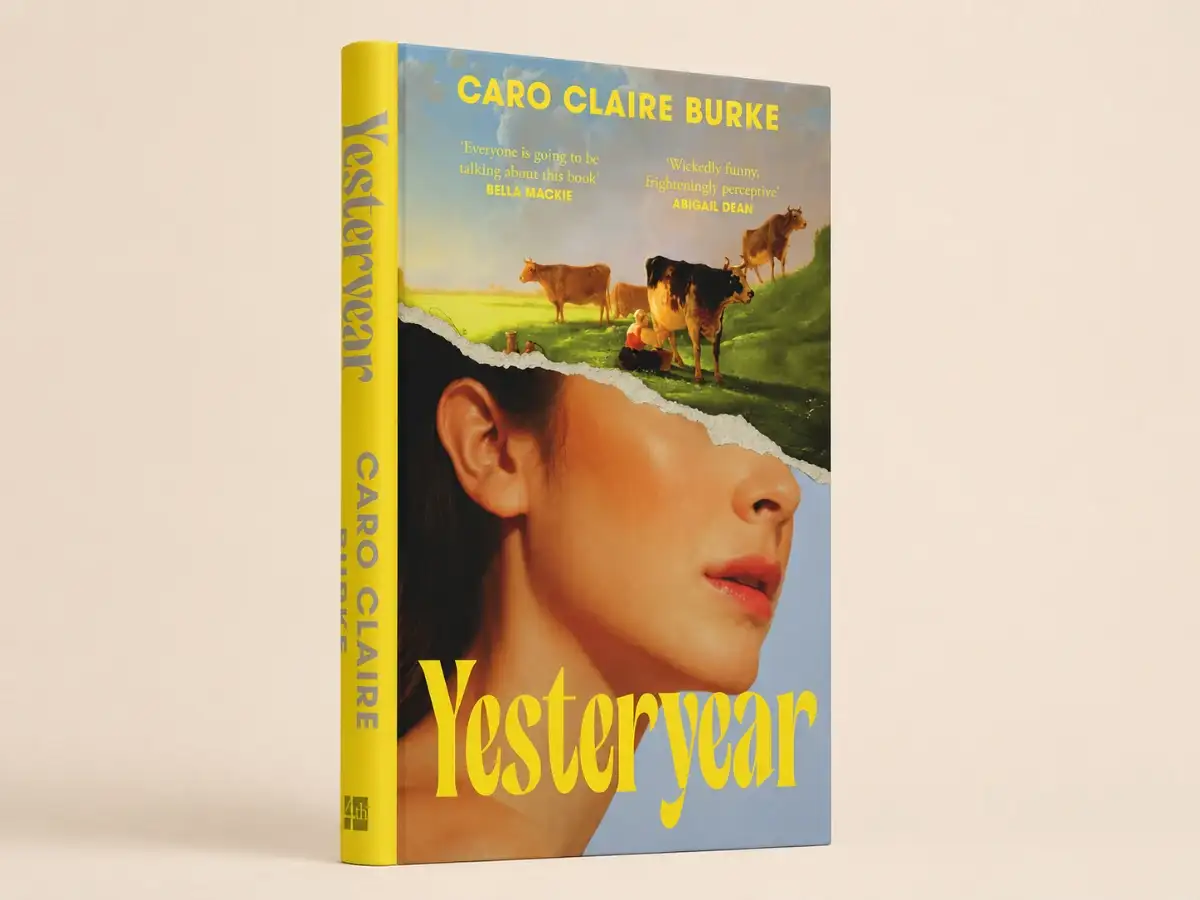
If you've read even one book in your life — or, more realistically, accidentally liked one book reel on Instagram — there is a very good chance Yesteryear has popped up on your social media feed.
More than once.

And chances are, the review you saw was either “you NEED to read this” or “I genuinely do not understand why everyone is obsessed with this book.”
There doesn't seem to be much of a middle ground when it comes to Caro Claire Burke's debut novel.
Published in April, Yesteryear has somehow managed to become one of those books that exists far beyond the pages. It has spent 17 consecutive weeks on the New York Times bestseller list, peaking at No. 1, and Burke told The New Yorker that the book has now sold around 1.4 million copies.
It has also become a fixture on social media, with readers arguing over whether it is a brilliant satire of modern womanhood or a book that doesn't quite know what it wants to say.
And then there is Anne Hathaway.
Because perhaps the most interesting part of the Yesteryear story is that Hathaway had already seen something in the book before most of us had even heard of it.
Anne Hathaway bought the rights before Yesteryear was even published
According to The New Yorker , Burke sold the novel to Knopf in a 12-way auction in 2024 for a reported low-seven-figure sum. Amazon MGM then acquired the film rights, reportedly for between $450,000 and $2 million, with Hathaway attached to star and produce the adaptation.
And this was all happening before Yesteryear landed in bookstores.
Hathaway has since revealed that she read an early draft of the novel roughly two years ago and was deeply moved by it, according to The Hollywood Reporter .
So what exactly is Yesteryear about?
At the centre of the book is Natalie Heller Mills, a wealthy “tradwife” influencer who has built an entire online empire around her supposedly perfect domestic life.
Think farmhouse. Husband. Children. Chickens. Homemade bread. Homeschooling. The whole thing.
Natalie has millions of followers watching her live out what looks like an idyllic, traditional life on an Idaho ranch. But, of course, there is a catch.
The life isn't quite as organic as Instagram makes it look.
There are nannies. There are employees. There are producers. There is a social-media business sitting behind the supposedly simple existence.
Then Natalie suddenly wakes up in 1855. The woman who has made a career out of romanticising traditional womanhood has to actually live it.
No electricity. No luxury kitchen. No carefully curated Instagram feed.
Just the reality of the life she has been selling as a fantasy.
And that is probably the best part of the pitch: what if someone who spends her life romanticising the past was actually forced to live in it?
Why is everyone suddenly obsessed with the past?
Yesteryear is more interesting than just another viral book because the past has been having a moment.
The internet is full of people selling versions of a simpler life — cooking from scratch, raising children, living on farms, rejecting corporate careers, going back to “traditional” gender roles.
At the same time, we are living through perhaps one of the most technologically overwhelming periods imaginable.
AI is everywhere. Social media never switches off. Everyone is performing some version of themselves online. And the pressure to have the perfect career, relationship, body, home and family is increasingly being documented in real time.
But Yesteryear isn't really just about tradwives
This is also where Burke seems keen to push back against the way her book has been categorised.
In her interview with The New Yorker , Burke said she doesn't consider herself to be on the “trad-wife beat” and doesn't think Yesteryear is fully a novel about tradwives.
Instead, she described the book as being about American fantasy and misinformation — and the ways people construct versions of reality and then confidently live inside them.
There is also the idea of what Burke's editor called “the grand performance of womanhood.”
And honestly, that might be the bigger reason the book has travelled so far.
Because Natalie isn't just performing being a good wife and mother. She's performing it for an audience.
Her marriage is content. Her motherhood is content. Her home is content. Her beliefs are content. Even her rebellion against modern feminism becomes part of the product.
Which makes Yesteryear a rather clever book to have become a social-media phenomenon itself.
A novel about a woman performing her life for an audience has become a book millions of people are discovering because other people are performing their opinions about it online.
Very 2026.