
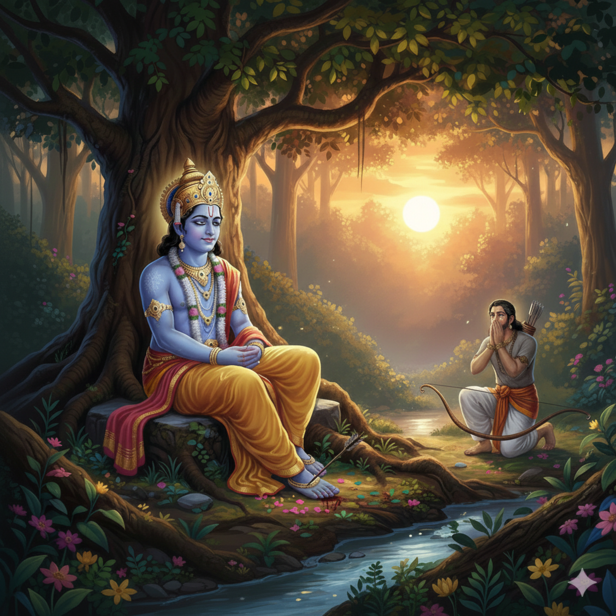
One of the most cryptic and tragic scenes in Indian mythology is the tale of Lord Krishna's departure from Earth. Why didn't Krishna, the supreme strategist of the Mahabharata and the guide of the Bhagavad Gita, block a mere hunter's arrow if He was God Himself? For what reason did the All Powerful decide not to defend Himself? Weakness is not at issue here. It has to do with purpose. It has to do with fate, karma, and fulfilling a divine purpose.

The Curse That Had to Be Fulfilled
Gandhari's curse is connected to Krishna's demise in numerous Puranic stories. Grieving over the death of her boys, Gandhari cursed Krishna that his tribe will die the same way hers did after the Mahabharata war. Knowing that the curse was a necessary component of cosmic balance, Krishna accepted it coolly. Later, the Yadavas' disaster came to pass precisely as predicted. The last strand in a tapestry created by fate itself, the hunter's arrow was not a chance find. Since the result had already been determined by divine will, Krishna did not object.
The End of a Divine Mission
Restoring Dharma and guiding humanity through one of its deadliest battles was Krishna's mission on Earth. His objective was accomplished after the Mahabharata war concluded and Dharma was restored. Avatars, in contrast to regular creatures, descend with a specific goal. Departure comes easily after that goal is accomplished. Since there was nothing left for Krishna to do in His earthly position, He did not save Himself. The arrow represented completion rather than loss.
Karma Even for the Divine
According to certain legends, Krishna's death was related to His past life as Lord Rama. Fairness was questioned when Rama killed Vali in the Ramayana while hiding. In order to make up for that karmic act, it is thought that Krishna accepted death in a similar way throughout his lifetime. This perspective highlights a crucial idea: even the divine respects the laws of the universe. Krishna maintained the idea that karma controls everything by taking the hunter's arrow.
The Beginning of Kali Yuga
Krishna's departure marked a cosmic shift rather than just a personal experience. Scriptures describe that Kali Yuga began immediately after He left the Earth. Dharma remained steadfast as long as Krishna was around. His departure made room for a new period of moral decay and spiritual trials. The universe itself was prepared to change a page, therefore he did not stop the arrow. A new era was marked by his silence.
Krishna made the decision not to save himself, but he did not fail. The hunter's arrow was a part of God's own design and was not more powerful than God. Action, intelligence, and commitment are lessons learned from his life. His leaving serves as a lesson in time's inevitable nature, acceptance, and surrender.
Sometimes calm completion, rather than opposition, is the most powerful act.
And maybe that's why, even after all these centuries, people are still moved by this moment.
Explore the latest trends and tips in Health & Fitness, Spiritual, Travel, Life Hacks, Trending, Fashion & Beauty, and Relationships at Times Life!