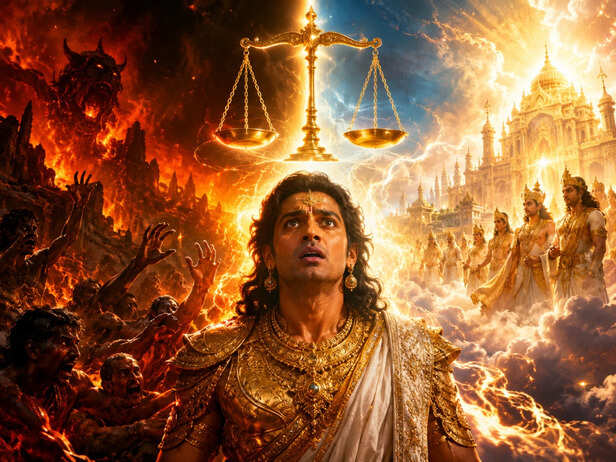
Yudhishthira, the eldest of the Pandavas, is often remembered as the embodiment of truth and virtue in the Mahabharata. Throughout his life, he struggled to uphold dharma even in the face of betrayal, war, and personal loss. After the great Kurukshetra War and the eventual end of his earthly journey, many would expect him to enter heaven immediately. Yet the epic presents an unexpected twist. Before reaching heaven, Yudhishthira is shown the horrors of hell. More shockingly, he hears the voices of his brothers, Draupadi, and other loved ones suffering there. Confused and heartbroken, he refuses to abandon them. This remarkable episode carries a deeper spiritual message about karma, humility, and the ultimate test of righteousness.
The Final Journey of the Pandavas
After ruling Hastinapura for many years, the Pandavas renounced their kingdom and began their final pilgrimage toward the Himalayas. One by one, Draupadi and the brothers fell along the path due to their human flaws. Only Yudhishthira continued onward, accompanied by a faithful dog. When he finally reached the gates of heaven, Indra invited him to enter. However, Yudhishthira refused to abandon the dog that had remained loyal throughout the journey. This act of compassion became his first great test. The dog was later revealed to be Dharma, the divine personification of righteousness and Yudhishthira's celestial father. Even at heaven's gates, Yudhishthira demonstrated that loyalty and kindness mattered more to him than personal reward.
Why Was Yudhishthira Shown Hell?
Upon entering the celestial realm, Yudhishthira was disturbed to find certain warriors who had committed questionable deeds enjoying heavenly pleasures. Meanwhile, he could not find his brothers or Draupadi. The gods then guided him toward a dark and dreadful region. There he encountered unbearable suffering and heard the voices of those he loved. The sight shocked him deeply. According to the Mahabharata, this experience was linked to the law of karma. Although Yudhishthira was among the most virtuous people to ever live, he had committed one morally complicated act during the Kurukshetra War. To defeat Drona, he spoke the famous half-truth, "Ashwatthama is dead," while omitting the fact that the slain Ashwatthama was an elephant rather than Drona's son. Though spoken for a strategic purpose, this deviation from absolute truth carried karmic consequences. His brief encounter with hell symbolized the result of that action.
The Greatest Test of Compassion
The most important lesson of this episode lies not in punishment but in choice. When Yudhishthira heard the cries of his loved ones, he was told he could proceed to heaven and leave them behind. Instead, he chose to remain with those who were suffering. He declared that heaven held no meaning if his brothers and Draupadi were not there with him. He preferred to share their pain rather than enjoy paradise alone. This decision revealed the depth of his character. True righteousness was not merely about following rules. It was about empathy, loyalty, and selflessness. Yudhishthira's willingness to sacrifice his own happiness for others became the ultimate proof of his virtue. At that moment, the illusion disappeared.
The Illusion Created by the Gods
The horrifying vision of hell was not entirely what it seemed. The gods revealed that Yudhishthira's experience had been a final examination. His loved ones were not truly condemned there. The suffering he witnessed was part of a divine test designed to evaluate whether he would remain compassionate even when faced with personal reward. Once he passed this test, the darkness vanished. The foul smells, pain, and despair disappeared, replaced by the splendor of heaven. The episode emphasizes a recurring theme in Hindu philosophy. External appearances can be deceptive, and true spiritual growth often emerges through difficult trials.
The Deeper Meaning of Karma and Dharma
Yudhishthira's journey teaches that no action is completely free from consequences. Even a righteous person may have to account for moments of moral compromise. At the same time, the story highlights that dharma is not simply about strict obedience to rules. It involves wisdom, compassion, integrity, and concern for others. His brief visit to hell reminds readers that justice in the cosmic order is impartial. However, his refusal to abandon his loved ones demonstrates that love and selflessness are among the highest expressions of dharma. The Mahabharata does not portray morality as simple or black and white. Instead, it presents ethical dilemmas where even noble individuals must navigate difficult choices and accept their outcomes.
The Last Lesson of a Righteous King
Yudhishthira's visit to hell before heaven remains one of the most powerful and symbolic episodes in the Mahabharata. It was not merely a punishment for a single half-truth but a final examination of his soul. By choosing loyalty over comfort and compassion over personal gain, he proved that true righteousness extends beyond rules and rewards. His story reminds us that greatness is measured not by perfection but by the ability to remain humane, truthful, and selfless even in the most challenging circumstances. In the end, Yudhishthira entered heaven not because he was flawless, but because he never stopped choosing dharma when it mattered most.
Unlock insightful tips and inspiration on personal growth, productivity, and well-being. Stay motivated and updated with the latest at My Life XP.