Get all your news in one place.
100's of premium titles.
One app.
Start reading
The Conversation
The Conversation
Laurie Letertre, Chercheuse en philosophie de la physique au Munich Center for Mathematical Philosophy, Ludwig Maximilian University of Munich

Why did Louis de Broglie, Nobel laureate in physics, abandon his own pilot wave theory?

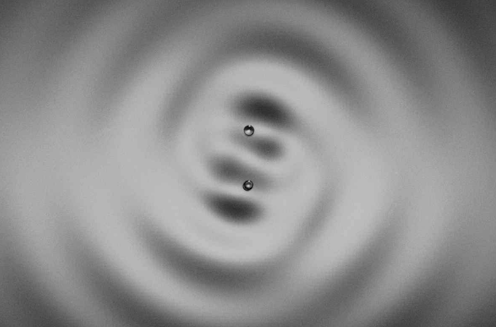
Recently, scientists have been working on concepts similar to those developed by French physicist Louis de Broglie to interrogate the wave-particle duality at a macroscopic scale. Y. Couder et al. Europhysics News, EDP Sciences

This week marks the centenary of the French physicist Louis de Broglie’s doctoral thesis, which later earned him a Nobel prize for “his discovery of the wave nature of electrons”. This discovery constitutes a central aspect of quantum mechanics, and it led to his famous “pilot wave” theory, which provides an alternative way to formulate the theory of quantum mechanics itself. However, de Broglie quickly denied his own theory. But for what reasons?

The theory of quantum mechanics describes the behaviour of matter at small scales, such as that of atoms or electrons. Its discovery dates from the beginning of the 20th century, but many questions about it remain debated. This is largely due to the puzzling characteristics of the theory. For example, quantum particles such as electrons seem to behave sometimes like particles, sometimes like waves.

Sign up to read this article
Read news from 100's of titles, curated specifically for you.
Already a member? Sign in here
Related Stories
Top stories on inkl right now
One subscription that gives you access to news from hundreds of sites
Already a member? Sign in here
Our Picks
Fourteen days free
Download the app
One app. One membership.
100+ trusted global sources.