
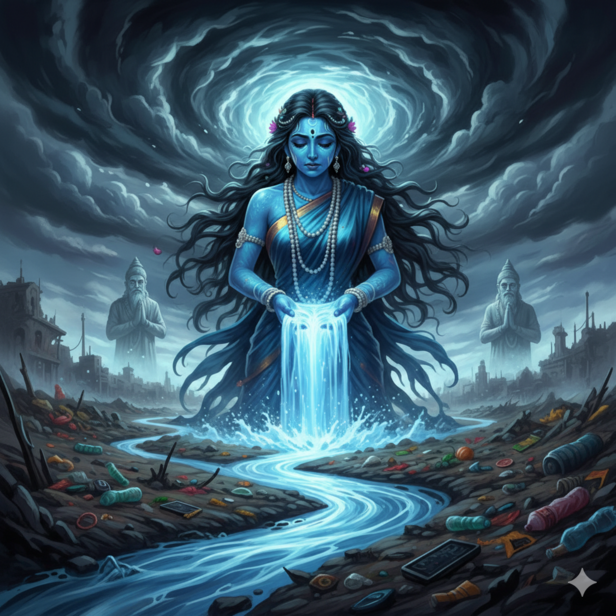
One of the most beloved and mysterious characters in Hindu mythology is the goddess Ganga. Her descent from the sky to Earth was not random; rather, it was molded by a curse and a larger cosmic purpose. She is revered as a mother, a purifier, and a celestial power. Why would a goddess of heaven consent to an ordinary destiny? Why would she decide to flow in a world where evil and human misery abound? The answer lies in a story of sacrifice, compassion, and redemption. Ganga's ability to endure a curse was not a sign of weakness, but rather a deliberate divine choice that made her a symbol of human spiritual freedom.

The Curse That Began It All
When Sage Vashistha criticized the eight Vasus for taking his precious cow, Ganga's destiny underwent a sea change. They hated the pain of worldly existence and were condemned to be mortals at birth. They went to Goddess Ganga in search of relief. She agreed to become their mother on Earth out of compassion and to spare them from a long human life. Ganga voluntarily entered the cycle of birth and death by taking up this job. In reality, what seemed to be a curse was her decision to lessen other people's pain.
A Divine Mother’s Difficult Duty
Ganga married King Shantanu on the condition that he never question her behavior in order to fulfill the curse. She released the cursed Vasus from mortal life by drowning the first seven offspring in the river as they were born. Her activities were liberating even though they appeared harsh. The remaining Vasu survived as Bhishma after Shantanu ultimately stopped her at the eighth kid. Ganga's tenacity in this situation was both spiritual and emotional; she endured miscommunication in order to keep her sacred vow.
The Second Descent for Redemption
Years later, Ganga's significance went beyond the curse of the Vasus. In order to bring her down from heaven and save his forefathers, King Bhagiratha underwent a great deal of devotion. Ganga consented to descend once more for the benefit of others. She threatened to destroy Earth with her strong energy, but Lord Shiva held her in his matted hair and then gently let her go. With the promise of freedom for innumerable lives, this moment turned her into a river of redemption.
A River That Carries Human Burdens
Following her descent, the Ganga was revered as a river that was thought to atone for sins and provide spiritual freedom. Along her banks, people seek blessings, bathe in her waters, and bury the ashes of loved ones. She still flows with grace even after taking on the weight of humanity. Her ability to endure the curse is a representation of God's patience accepting suffering in order to provide cleansing. Through her waters, everyone, regardless of background or prior transgressions, was able to access the concept of redemption.
From Curse to Cosmic Compassion
The tale of Ganga shows that what appears to be punishment can actually be a road toward greater purpose. She became a river of salvation for humanity by bearing the curse and coming down to Earth. Her sacrifice serves as a reminder that genuine divinity is found in raising others, and that compassion occasionally necessitates suffering.
Ganga transformed into hope in motion, flowing endlessly between heaven and earth, rather than just being a river.
Explore the latest trends and tips in Health & Fitness, Spiritual, Travel, Life Hacks, Trending, Fashion & Beauty, and Relationships at Times Life!







