As my yearly Spotify Wrapped would attest, Bad Bunny and I have quite a long, winding history. I consider myself not only a superfan but a Bad Bunny expert: I’ve followed his career from humble SoundCloud beginnings through COVID-era Instagram Lives—and, of course, an obscene number of replays of that Calvin Klein ad.
All of that is to say, seeing the Puerto Rican artist headline the Super Bowl halftime show didn’t feel like a surprise, but rather a long-overdue win for the Latin community. A moment of global representation, what has now been dubbed the “Bad Bunny Bowl” was a cultural uplift that celebrated Puerto Rico and connected Latin communities through shared traditions and moments. From power outages to regular stops at street-food vendors—and lest we forget, sleeping in chairs during family gatherings—as a Mexican, I’d never felt so distinctly Latina.

That sense of recognition didn’t stop at the music or the setting; it extended to the fashion. Just a week after Bad Bunny made history at the Grammys by winning Album of the Year, the performer debuted a Schiaparelli men’s couture look, leaving us wondering what—and who—he would choose to wear for the Super Bowl.

While Bad Bunny is often spotted in Jacquemus and Gucci, for his historic performance, he instead opted for two custom looks from the high-street Spanish retailer, Zara. An incongruous choice for some, given his affinity for conceptual fashion, but—as is customary for Bad Bunny—one rich with symbolism.
For many Latinos, the high-street brand, part of the Inditex group, has long represented a first encounter with international fashion. As a child, I remember visiting various tianguis (Mexican street markets) with my mother in search of Zara pieces, and as a teenager living in Panama City, Panama, waiting in hour-long queues with friends for the opening of its first Zara store. It’s no surprise, then, that wearing Zara may have been an instinctive—and deeply attainable—choice.
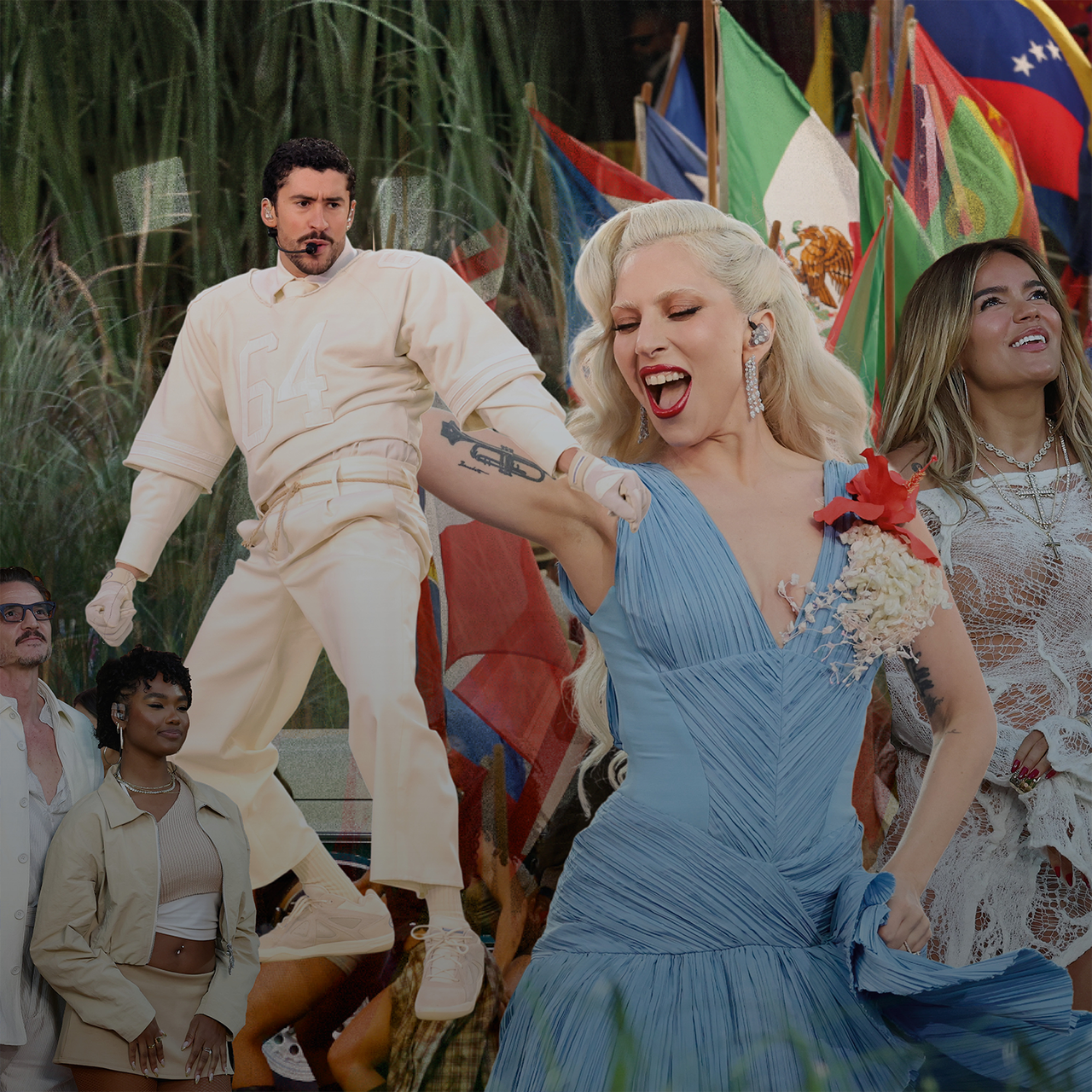
He opted for a cropped jersey with shoulder pads and trousers inspired by jíbaro farmers, often described as the backbone of Puerto Rico. The look also featured the artist’s maiden name and year of birth on the back, an homage to his mother. While some dancers were also seen wearing Zara, eagle-eyed fans would have spotted pieces from Puerto Rican brand Yomas. Founded by Jomary Segarra, the contemporary knitwear label focuses on responsible craftsmanship and local production.

For his second look, Bad Bunny added a double-breasted blazer and performed with surprise guest Lady Gaga, who executed what can only be described as a salsa-fied version of the hit song “Die With a Smile” in a custom blue pleated dress by the Dominican-American brand Luar.

The flamenco-inspired frock also featured a subtle yet powerful nod: a cherry-red Flor de Maga brooch—Puerto Rico’s national flower—which appeared to reference Bad Bunny’s own light-blue suit worn in the music video for “Baile Inolvidable.” The look was helmed by designer Raul Lopez, who wrote on social media of the historic moment: “For the culture and for all immigrants—this is how we come together.”
It was a reminder that in moments like these, every detail—from fashion to set—contributes to a larger conversation about representation, identity, and pride.