Nearly 50,000 immigrants were arrested by U.S. Immigration and Customs Enforcement in July, the highest monthly total of President Donald Trump's second term. But behind those arrests is another set of numbers receiving considerably less attention: the millions of dollars flowing to private companies that house, transport, monitor and help locate immigrants for the federal government.
One of the companies positioned closest to the center of that system is The GEO Group.

The Florida-based private prison and government services company is experiencing significant growth as the Trump administration expands immigration detention. GEO reported $732.1 million in total revenue during the second quarter of 2026, up 15% from $636.2 million a year earlier. Net income attributable to GEO operations jumped 63%, from $29.1 million to $47.5 million.
"We are very pleased with our strong second quarter results and improved full year outlook," GEO Chairman, CEO and founder George Zoley said when the company released its results Aug. 6.
"Our financial performance in the first half of 2026 has been driven by the new growth opportunities we captured in 2025 and are normalizing this year," he added. "Last year was the most successful period for new business wins in our company's history, and we expect 2026 to continue to be very active as well."
Those "growth opportunities" increasingly intersect with the government's immigration crackdown.
ICE made 49,571 arrests in July, up 15% from 43,021 in June and 70% from 29,241 in February, according to government data provided to the Deportation Data Project and analyzed by The Associated Press. More than half of the people arrested had neither criminal convictions nor pending criminal charges.
Separate ICE data compiled by Syracuse University's Transactional Records Access Clearinghouse showed 65,765 people in ICE detention as of July 11. Of those, 46,436, or 70.6%, had no criminal conviction.
For GEO, more people in detention can translate directly into more business.
GEO Was Housing About 24,000 ICE Detainees
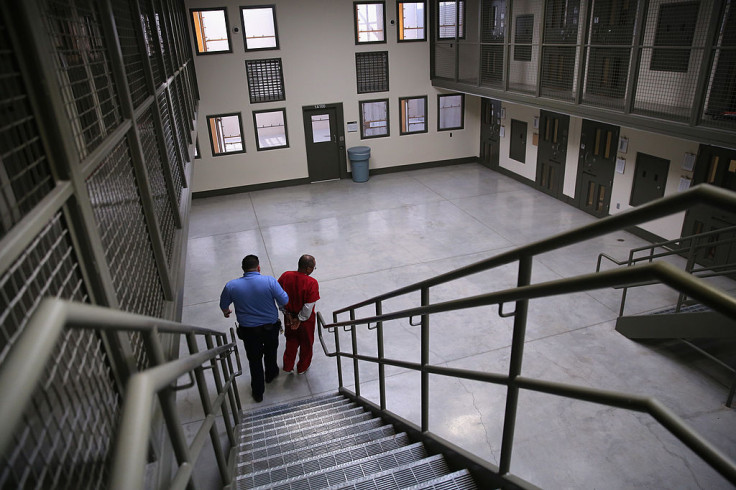
During its Aug. 6 earnings call, GEO said it had expanded its active ICE capacity to approximately 27,000 beds and was housing about 24,000 ICE detainees, representing more than one-third of the roughly 68,000 people the company said were then being held nationally.
"Over the last six weeks, we have experienced a 20% increase in ICE populations," company executives told investors.
GEO's own SEC filings provide perhaps the clearest connection between the immigration enforcement expansion and its financial results.
Revenue in its U.S. Secure Services division increased $78.8 million in the second quarter compared with a year earlier. GEO attributed $60.6 million of that increase to newly activated facilities and new transportation contracts. Another $35 million in additional revenue came from increases in "occupancies, transportation, rates and/or per diem amounts" connected to contract modifications. Those gains were partly offset by $16.8 million associated with terminated contracts.
In other words, GEO itself identifies higher occupancy, transportation activity and per-diem payments among the factors increasing its revenue.
The company's U.S. Secure Services facilities operated at approximately 91% occupancy during the second quarter.
What Is One ICE Detention Bed Worth?
There is no single nationwide amount that ICE pays GEO for every immigrant every day. Contracts differ by facility and can include staffing, security, food, medical services and other costs. Some arrangements can also include guaranteed minimum payments.
But GEO's newest contracts illustrate how valuable detention capacity has become.
On July 13, GEO announced a five-year ICE contract for the 1,188-bed Big Horn Facility in Hudson, Colorado. The company expects the facility to generate approximately $85 million in revenue during its first full year of operations, excluding transportation revenue.
That equals approximately $71,549 in annual contract revenue for every available bed, or roughly $5,962 per bed per month.
Broken down daily, the contract's annual value represents approximately $196 per available bed per day.
That calculation should not be interpreted as ICE literally paying GEO $196 every time a detainee spends a night there. The contract covers much more. GEO says its responsibilities include security, maintenance, food services and access to recreation, medical care and legal counsel. Still, the contract provides a useful window into the economics of detention.
At its expected $85 million annual value, Big Horn alone represents approximately $7.1 million in potential monthly revenue once fully operational.
And transportation is extra.
"We expect that our company-leased Big Horn Facility in Colorado will play an important role in helping meet the need for increased federal immigration processing center bedspace," Zoley said when announcing the agreement.
The contract became effective July 9, but GEO says Big Horn will not reach normalized operations and earnings contribution until early 2027. Therefore, its full $7.1 million monthly equivalent should not be counted as GEO revenue for July.