Get all your news in one place.
100's of premium titles.
One app.
Start reading
Bangkok Post
Bangkok Post
Comment

Who needs an energy crisis? Builders do

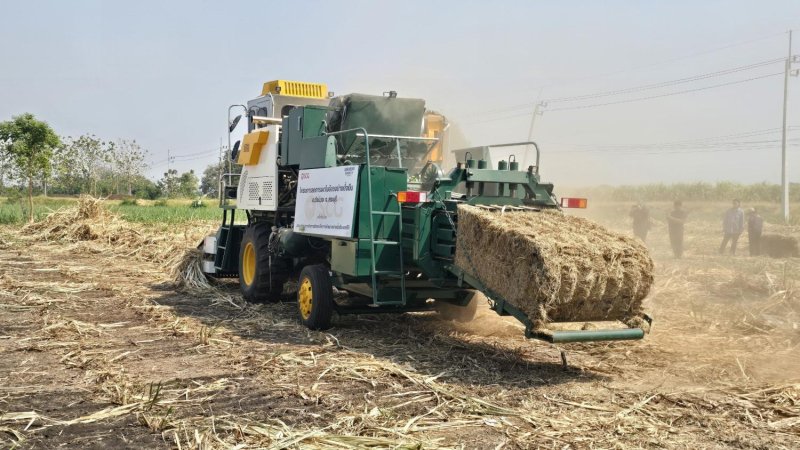
This photo, taken in February, shows a baling machine being put through its paces at a sugarcane farm in Ratchaburi province. (Photo courtesy of Waiyawut Thiamcharoen)

For decades, Thailand built its economy on the assumption that energy would remain cheap, stable, and someone else's responsibility.

That assumption is beginning to break.

Many see this as a threat. It may also be an opportunity.

When energy becomes expensive and uncertain, countries are forced to confront a deeper question: how they produce, how they consume, and how resilient their industries truly are. In moments like this, advantage does not go to the fastest talkers. It goes to the fastest builders.

Around the world, energy is increasingly produced locally, managed digitally, and treated as a strategic asset. Thailand already has many of the necessary pieces. What it lacks is integration.

And that -- not avoiding disruption -- is the real opportunity.

China offers an important lesson. Long before electric vehicles reached scale, it invested heavily in the foundations: power systems, battery supply chains, industrial capacity, and domestic demand.

What followed was not simply the rise of a new industry, but the alignment of three goals often treated as trade-offs: sustainability, energy security, and productivity.

Electric vehicles in China were never only about reducing emissions. They reduced dependence on imported fossil fuels while accelerating advances in batteries, electronics, software, and manufacturing. What elsewhere was framed as a costly transition became an industrial upgrade.

This is what makes companies like BYD difficult to compete with. Their advantage comes not from choosing between sustainability, security, or productivity, but from integrating all three into the same system. Once the foundations were built, scale reinforced itself through lower costs, faster innovation, and greater resilience.

Thailand does not need to replicate China. But it cannot remain only an assembler in someone else's system.

The question is no longer whether Thailand should embrace renewable energy. The question is how much of that system it can build, secure, and operate on its own.

That transition is already taking shape in places like the Saraburi Sandbox, an emerging low-carbon Public-Private-People Partnership model in a province responsible for much of Thailand's cement production.

What is emerging there is more than a pilot project. It is an early blueprint for a new industrial model--one where energy is no longer treated as a centralised utility, but as something industries actively manage.

Direct power purchase agreements (PPAs) can help companies secure renewable energy at source. Energy storage can turn intermittency into reliability. Grid-forming technologies can stabilise systems that rely less on traditional baseload power. Artificial intelligence can optimise supply and demand in real time.

Even waste -- once treated as a disposal problem -- is increasingly becoming an energy resource.

Agricultural residue, industrial byproducts, and organic waste can be converted into biomass, biogas, or alternative fuels. Once waste gains economic value, incentives shift--and behaviour follows.

The same principle applies to sugarcane burning. Farmers often burn leaves not by preference, but because viable alternatives remain limited. When agricultural residue becomes income, burning declines--not through enforcement, but through economics.

Yet none of this works without people capable of building it.

Some of the most practical solutions for agricultural waste management have not come from imported technology, but from Thai technicians, mechanics, and farmers.

In Ratchaburi province, a Thai farmer developed the country's first domestically built sugarcane leaf collection and shredding vehicle using locally manufactured parts at a cost of around 1.8 million baht--far below imported alternatives that can cost more than 10 million baht.

Rather than treating sugarcane leaves as waste to be burned, the machine converts them into biomass feedstock for electricity generation, helping reduce PM2.5 pollution while creating new economic value from agricultural residue. Outside sugarcane season, the same machine can process corn stalks, rice straw, and Napier grass for alternative energy use. This is what local innovation looks like: practical, cost-conscious, and built for scale.

That is not just innovation. It is an ability to deploy.

And deployment -- not a big goal -- is often where transformation succeeds or fails.

Thailand aspires to harness the power of AI, invest in digital infrastructure and modernise our industry. But without the ability to execute at scale, strategy remains aspiration.

The constraint is no longer vision. It is execution.

This is why Thailand's next phase of development should be understood as an integrated system -- Industrial Evolution 6.0.

It is not just a slogan or catchphrase. Industrial Evolution 6.0 is the convergence of six connected layers: energy, materials, digital systems, finance, logistics, and people.

Thailand already possesses all six. Yet they still do not operate as one. Energy remains disconnected from industrial demand. Waste remains disconnected from energy markets. Digital capability is not yet deeply embedded in infrastructure. Financing still struggles to support long-term transformation.

The opportunity lies in connecting them.

The Saraburi Sandbox could become that integration point: a place where energy systems, industrial demand, local resources, digital intelligence, and execution capability come together. Waste powers energy. Energy supports industry. Industry creates value that flows back into communities.

If successful, the impact would be structural rather than incremental. Costs could shift. Competitiveness could improve. New industries could emerge. Thailand could become less dependent on external systems.

Crises do not last forever. If stability returns too quickly, urgency fades. If supply chains normalise, incentives to localise weaken.

That is why this moment matters.

The winners of the energy transition will not be those who waited for certainty. They will be those who built through uncertainty -- using disruption to strengthen systems and create capabilities that endure.

Thailand does not lack technology, talent, or industrial capacity.

What it lacks is integration.

And that is why this crisis is not something to avoid, but something to build through.

Chana Poomee is Honorary President of the Thai Cement Manufacturers Association, President of the Asean Federation of Cement Manufacturers, and a Board Member of the Global Cement and Concrete Association. His contributions reinforce national policy objectives while enhancing Thailand's industrial competitiveness on the global stage.

Sign up to read this article
Read news from 100's of titles, curated specifically for you.
Already a member? Sign in here
Related Stories
Top stories on inkl right now
One subscription that gives you access to news from hundreds of sites
Already a member? Sign in here
Our Picks
Fourteen days free
Download the app
One app. One membership.
100+ trusted global sources.