Get all your news in one place.
100's of premium titles.
One app.
Start reading
The Times of India
The Times of India
World
Vivek Dubey

Who holds the leverage? Five cards Trump and Xi bring to the table

The handshake will last seconds. The bargaining could shape the next phase of the world's most consequential rivalry.

Get breaking news anytime, anywhere. Download the TOI app now!

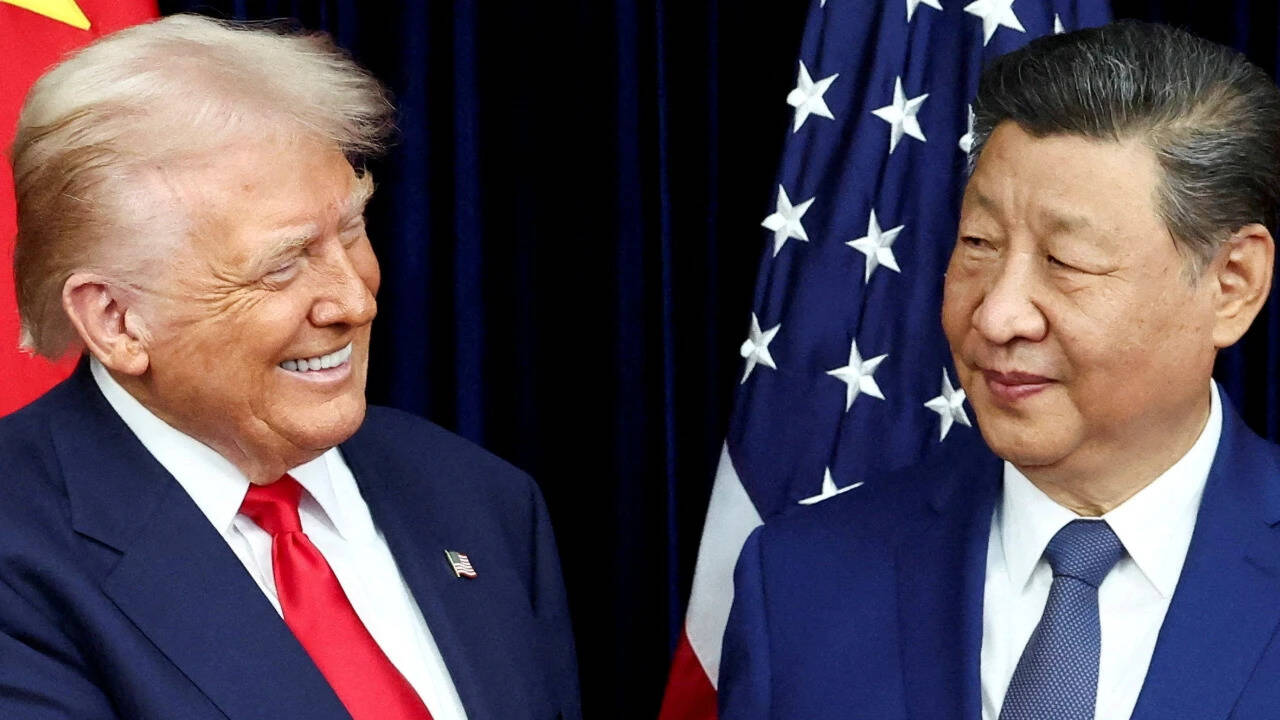
When Donald Trump and Xi Jinping sit down in Washington on September 24, neither man arrives empty-handed. Trump can threaten tariffs, restrict China's access to American technology and wield the world's dominant financial system. Xi can retaliate through China's vast manufacturing base, its grip on rare earths and its economic relationships with countries Washington wants to pressure.

Also read: Five reasons India should watch Trump-Xi handshake

There is a useful historical precedent for the idea that US-China summits are less about friendship than mutual necessity. When Richard Nixon travelled to Beijing in 1972, Washington and Beijing were still formally estranged after more than two decades of hostility. Yet both had strategic reasons to talk. The United States wanted to reshape the Cold War balance against the Soviet Union; China wanted to counter Moscow and break out of its diplomatic isolation. The resulting Shanghai Communiqué did not erase their disagreements, particularly over Taiwan. It created a framework for managing them. Seven years later, Washington and Beijing established formal diplomatic relations.

More than half a century later, the question is not who is stronger. It is who has the better cards on the issues that matter most.

Here are five cards Trump and Xi bring to the table:

A fragile truce, not a friendship

Trump's second term began with tariffs on Chinese goods justified partly by concerns over fentanyl trafficking. China retaliated, and the confrontation escalated through 2025 as both sides imposed tariffs and export restrictions. By the autumn, Trump was threatening tariffs as high as 100% on Chinese imports, while Beijing was tightening controls on critical minerals and rare earths.

The confrontation eventually produced a truce. At their meeting in Busan in October 2025, Trump and Xi agreed to reduce some tariffs and export restrictions, while China agreed to suspend expanded rare-earth controls and take measures against the export of fentanyl precursor chemicals. The arrangement eased immediate pressure without resolving the underlying disputes.

The May 2026 meeting in Beijing produced another round of commitments. The two sides agreed to establish Boards of Trade and Investment, while China committed to buying American agricultural products and 200 Boeing aircraft. But progress since then has been mixed. Chinese purchases of US farm goods have fallen short of the levels promised, the Boeing commitment has yet to materialise fully, and the investment board has moved slowly.

That is the backdrop to Washington: Not a new partnership, but a relationship that has stabilised just enough to keep functioning.

Trade: Trump's tariffs vs Xi's resilience

Trump's most obvious card remains the US market.

America is still one of the world's largest consumer economies, and Chinese exporters have a great deal to lose if access to it becomes significantly more expensive. Washington can therefore threaten to raise tariffs again if Beijing fails to deliver on existing commitments.

The November deadline gives Trump another lever. The current trade truce is due to expire then, creating a natural point at which tariffs and other restrictions could be revisited.

Xi's counter-card is resilience.

China has taken a substantial hit to direct trade with the US, but it has not responded by capitulating. Instead, Chinese exporters have increasingly looked to other markets, while Beijing has retained control over several products and supply chains that American industry still needs.

Even where China has offered concessions, they have not necessarily amounted to a complete surrender of leverage. Ahead of the summit, Chinese purchases of US soybeans increased, but the scale remained below the levels Washington has been seeking. The May agreement itself illustrates the problem: Beijing promised significant purchases, yet implementation has been slower than the US expected.

There is another reason Xi needs stability. China's economy is facing weak domestic demand and a prolonged property downturn, while Beijing has set a 2026 growth target of 4.5% to 5%. That gives Xi an incentive to prevent another tariff shock.

Trump can make access to America more expensive. Xi has demonstrated that China can absorb considerable pressure without simply giving Washington everything it wants.

Rare earths: China's chokehold vs America's alternatives

If trade is Trump's broadest economic weapon, rare earths may be Xi's sharpest.

China has used this leverage before. In 2010, during a diplomatic dispute with Japan over disputed islands in the East China Sea, Beijing restricted exports of rare earths to Japan. The episode jolted governments and manufacturers that had come to depend heavily on Chinese supplies. Japan responded by building stockpiles, finding alternative suppliers and investing in recycling and processing capacity. The lesson was straightforward: Even when China does not control every mine, its dominance of processing can give Beijing disproportionate influence over the supply chain.

China dominates the mining and, particularly, processing of rare earths used in electric vehicles, electronics, renewable-energy equipment and defence systems. Reuters reported this week that China controls up to 70% of global rare-earth mining and more than 85% of refining and production. That gives Beijing influence far beyond the amount of ore actually mined inside China.

The timing matters.

China's suspension of its expanded rare-earth export controls is tied to the broader trade truce, which is due for review in November. Washington therefore has an immediate interest in ensuring that Chinese exports continue without disruption. Recent Chinese shipments of rare-earth magnets to the US have already fallen, according to customs data, adding to concerns about supply security.

The US and its allies are trying to build alternative mines, processing facilities and supply chains. Washington has also been looking beyond traditional sources of critical minerals, including through efforts to secure supplies from partners.

But diversification takes years.

That is the imbalance. Trump can promise that America will become less dependent on China; Xi can influence a supply chain that American manufacturers need today.

China does not necessarily have to shut exports completely to exercise leverage. Delays, licensing requirements and uncertainty can be enough to force companies to rethink their supply chains.

That makes rare earths more than a trade issue. It is a test of whether the US can turn its long-term strategy of reducing dependence on China into something that gives it bargaining power in the short term.

AI and chips: America's edge vs China's catch-up

Technology should, at first glance, be Trump's strongest card.

The US still has major advantages in advanced chip design, leading AI companies and access to the most sophisticated semiconductor ecosystem. Washington can restrict China's access to advanced computing hardware and the technology needed to manufacture it.

But the relationship has become more complicated.

The US has recently shown that its chip controls are not necessarily absolute. Washington has allowed some Nvidia H200 chips to be sold to Chinese customers under conditions, while Beijing has simultaneously pushed Chinese companies towards domestic alternatives.

Sign up to read this article
Read news from 100's of titles, curated specifically for you.
Already a member? Sign in here
Related Stories
Top stories on inkl right now
One subscription that gives you access to news from hundreds of sites
Already a member? Sign in here
Our Picks
Fourteen days free
Download the app
One app. One membership.
100+ trusted global sources.