In 2025 Rory McIlroy won The Masters, completing the career Grand Slam in the process.
A year on, and the defending champion was firmly in contention to win it again in his bid to become only the fourth player to claim back-to-back titles.

Another rare achievement that would come McIlroy's way with victory would be joining the list of wire-to-wire Masters winners (inclusive of co-leads).
McIlroy co-led with Sam Burns after the opening round, with both players on five under, before a late birdie blitz on Friday saw him open up a six-shot advantage – the largest 36-hole lead in Masters history.
While that seemed all but unassailable, even at that relatively early stage, McIlroy was pegged back in the third round, partly as he faltered around Amen Corner and partly because of some low scores from his rivals.
At one point, McIlroy even fell to second, with Cameron Young briefly holding the outright lead, but by the end of the day, he had wrestled back a semblance of control to share the lead with Young at 11 under.
So, which other players was McIlroy bidding to emulate in 2026?
In total, there have been five wire-to-wire winners of The Masters where they had the solo lead after each round, and six where they co-led for at least one round. Here are the details.
Horton Smith (1934)

The very first Masters, then called the Augusta National Invitation Tournament, saw a wire-to-wire winner, with Horton Smith co-leading after the first round, before opening a one-shot gap on two players at the halfway stage.
A round of 70 maintained that advantage over Billy Burke after 54 holes, before he held off Craig Wood by one with a 72 in the final round.
Craig Wood (1941)

The eighth edition of The Masters saw the first wire-to-wire winner that didn't involve a co-lead, courtesy of Craig Wood.
The American made a flying start, leading four players by five after the first round, and though his lead was down to three at the halfway stage, he only had Byron Nelson breathing down his neck.
A 71 was enough for Wood to maintain that gap after the third round, this time with Sammy Byrd in second.
In the final round, Wood had a scare when Nelson caught him on the front nine, but he went two under over the back nine to beat him by three.
Jimmy Demaret (1947)

Demaret’s second Masters title began with a 69 as he co-led with Byron Nelson after the first round.
A 71 in the second round gave him a share of the lead with Cary Middlecoff, with a two-under 70 in the third round seeing him take the solo lead by three.
He won the title with a final round of 71 to finish on seven under, two better than Nelson and amateur Frank Stranahan.
Arnold Palmer (1960)

Arnold Palmer claimed his second Masters title in three years with a wire-to-wire win in 1960.
A five-under 67 in the first round gave him a lead of two over Fred Hawkins, Claude Harmon and Jay Hebert, and he still held the solo lead after the second round despite a one-over 73, with Walter Burkemo his nearest rival.
A 72 in the third round maintained his slender advantage with five players right behind him, before he carded a two-under 70 in the final round to beat Ken Venturi by two.
Arnold Palmer (1964)

Palmer won The Masters for the fourth time in 1964 when he beat Bruce Devlin.
On the way to getting the better of the Australian, he shared the lead with four after 18 holes, before a 68 in the second round gave him an advantage of four over Gary Player.
Palmer led Devlin by five after the third round, and that remained the gap after the winning putt went in.
Jack Nicklaus (1972)

Jack Nicklaus won The Masters for the fourth time in 1972, helped by a four-under 68 in the first round to set him on his way, as Sam Snead lurked one back.
There was still little room for error for Nicklaus at the halfway stage as he moved to five under with Paul Harney just one adrift.
It remained that tight with 18 holes to play as Nicklaus led Jim Jamieson by one.
In the final round, Nicklaus went two over, but, even though it brought his score back to two under, he was the only player to finish under par, with Bruce Crampton, Tom Weiskopf and Bobby Mitchell three back on one over.
Raymond Floyd (1976)

Raymond Floyd claimed his one Masters title in some style in 1976. His challenge could barely have started any better, with a seven-under 65 to lead Andy North by one after 18 holes.
A 66 in the second round gave him a five-shot advantage over Nicklaus, before the gap grew to eight over the Golden Bear with a two-under 70 in the third round.
He never looked like letting it slip in the final round, with another 70 seeing him home by eight ahead of Ben Crenshaw on 17 under.
Floyd's 270 set a new 72-hole scoring record, which was finally beaten by Tiger Woods by one 21 years later.
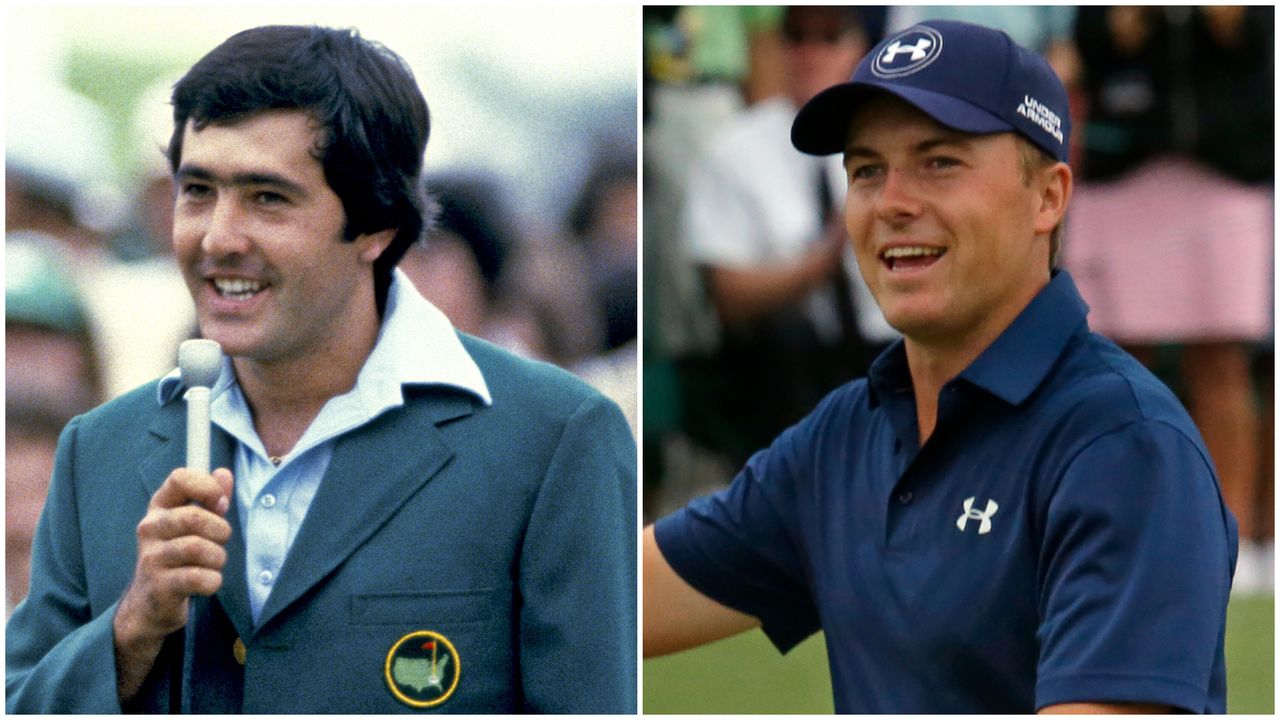
Seve Ballesteros (1980)

Europe’s first winner of The Masters was the Spaniard, who shared a first-round lead of two with David Graham and Jeff Mitchell.
By the end of the second round, he had the lead to himself, by four over Graham and Rex Caldwell.
His third sub-70 round moved him to 13 under, seven clear of Ed Fiori.
In the final round, Ballesteros’s lead was reduced to two after he found the water at 12 and 13, before he composed himself to beat Gibby Gilbert and Jack Newton by four.
Trever Immelman (2008)

Immelman and Justin Rose shot rounds of 68 to co-lead after the first round of the 2008 Masters, but another 68 meant the South African had the solo lead at the halfway stage, with Brandt Snedeker in second.
A three-under 68 in the third round increased Immelman’s lead over Snedeker to two, before he beat Tiger Woods by three, despite going three-over in the final round.
Jordan Spieth (2015)

The first of Spieth’s three Major titles came at the 2015 Masters.
He led by three after a first-round 64 that included nine birdies, with Jason Day, Ernie Els, Charley Hoffman and Justin Rose in pursuit.
A 66 in the second round meant his lead remained five, with Hoffman in solo second.
After the third round, Spieth’s lead was reduced to four with a 70 as Justin Rose’s 67 made him the closest challenger.
The following day, another 70 matched Woods’ 72-hole scoring record to finish on 18 under, with Phil Mickelson and Justin Rose four behind.
Dustin Johnson (2020)

The 2020 Masters was held in November because of the COVID-19 pandemic, where Dustin Johnson, Paul Casey and Dylan Frittelli all shot rounds of 65 to lead by one in the first round.
After the second round, five players – Johnson, Abraham Ancer, Jon Rahm, Justin Thomas and Cameron Smith – co-led, with Johnson carding a two-under round of 70.
The decisive move came from Johnson in the third round, with a bogey-free 65 to lead Ancer, Smith and Sungjae Im by four, with the winning margin over the two becoming five with a final round of 68 as Johnson finished on 20 under with a record score of 268.