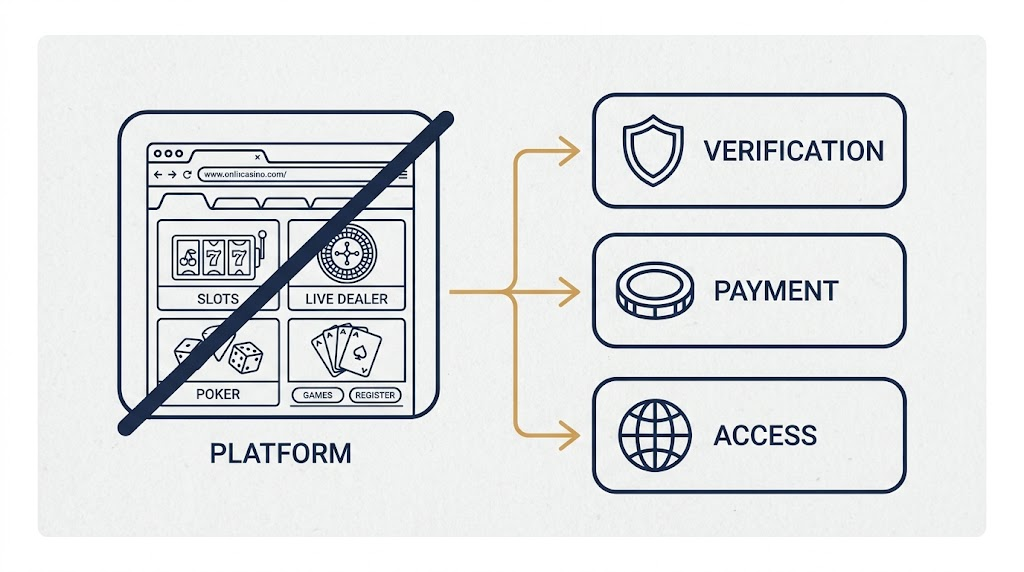
A legislature can strike a category of gambling site off its map in a single session. What happens to the people who used it is a much harder question, and it is the one the current wave of US state bans has not yet answered.
Since late 2025, a series of states have moved against sweepstakes casinos, the dual-currency platforms that issue one coin for free play and a second that can be redeemed for prizes. Montana was first, with Senate Bill 555 taking effect on 1 October 2025, the same day Connecticut's ban began. New Jersey's law was signed in August 2025 and New York's took effect on 5 December 2025. California's Assembly Bill 831, signed on 11 October 2025, applied from 1 January 2026. Indiana's House Bill 1052 followed on 1 July 2026 and Maine's in mid-July. Counting states that rely on regulator enforcement rather than a dedicated statute, industry trackers now put the number of closed markets at around a dozen, with roughly two thirds of states still open. Availability is therefore a state-by-state question rather than a national one: readers can Explore promotional-play casino options and the terms attached to them, but whether any given platform may lawfully accept a particular player depends entirely on where that player lives.
The industry's response to the bans has been consistent: close the front door and people walk around the back, into offshore sites with no local licence and no local accountability. That is a claim worth examining rather than repeating, partly because it comes from operators facing removal from a market, and partly because the evidence for it is weaker than either side tends to admit.
What the bans actually did
California's law is the one worth reading closely, because it went further than a simple prohibition. AB 831 made it unlawful not only to run a dual-currency online sweepstakes game in the state but also for payment processors, geolocation vendors, gaming content suppliers and media affiliates to knowingly support one. The bill text sets out that supply-chain reach in plain language, and it is the reason the industry treated California as a template rather than an outlier. Several later state bills borrowed its structure.
The practical effect was fast. Operators rarely wait for a test case. As each ban took effect, platforms updated their restricted-state lists and cut off play, in some instances on the day the law landed. Several mid-sized brands shut down entirely rather than restructure. From a consumer's point of view, an account with a balance in it can stop working with limited notice, which is not the wind-down most players assume they will get.
The displacement argument, and what supports it
Nobody has a clean measurement of where those users went afterwards, and that is the honest starting point. What the evidence does establish is that a substantial unlicensed market already exists in parallel with the legal one.
An August 2025 analysis from the American Gaming Association, an industry body, put annual US wagering with illegal and unregulated operators at $673.6 billion, a rise of 22% since its 2022 edition, with illegal operators accounting for 31.9% of the total US gaming market. The same analysis found offshore online casino revenue growing faster than any other illegal segment. Those are industry-commissioned estimates rather than regulator data, and they describe a market that existed long before the sweepstakes bans, so they establish the background rather than the consequence.
The relevant question is not whether an offshore market is waiting, but how attractive it looks relative to whatever remains legal in a given state.
|
Where play ends up |
Identity and age checks |
Recourse if a payout is refused |
Consumer protection rules |
State tax contribution |
|
Licensed real-money operator |
Verified against regulator standards |
Complaint to the state regulator |
Enforceable |
Yes |
|
Promotional-play sweepstakes site |
Platform's own checks, no purchase required to enter |
Platform terms, plus general consumer law |
Varies by state, and prohibited outright in some |
Indirect |
|
Unlicensed offshore site |
Often minimal |
None in practice |
None that a US player can invoke |
None |
The middle row is the one that resists summary. The dual-currency model is treated as lawful promotional activity in many states, has been explicitly banned in others, and sits under active review in several more, so any description of it as simply legal or simply illegal will be wrong somewhere.
The pattern regulators keep running into is that consumers do not sort themselves primarily by legal status. They sort by access, price and friction. A recent Australian research paper, reported by ASGAM in September 2026, argues this directly and makes a point that often gets lost in lobbying: regulation does not create a black market by itself. Players move offshore when licensed alternatives fail to match unlicensed ones on product range, cost and ease of signing up. Restrictive licensing and asymmetric advertising rules can widen that gap, and so can having no licensed alternative at all.
Why the evidence is thinner than the rhetoric
Both camps overstate what is known. Prohibition advocates rarely account for displacement at all. Operators cite displacement as though it were quantified, and mostly it is not.
The measurement problem is genuine. A scoping review published in PLOS One in January 2026, examining how Nordic regulators track offshore play, found that despite the political weight placed on channelling rates, it remains unclear how reliably the unregulated market can be measured at all. Estimates vary by method, and industry-funded studies and regulator estimates rarely agree. European offshore activity was put at around 17% of the total market in 2021 by the European Gaming and Betting Association, a figure that carries both wide error bars and a commercial interest.
So the defensible version of the claim is narrower than the headline. Bans reliably shrink the visible, addressable, semi-accountable market. Whether they shrink participation, or shift a portion of it somewhere with fewer protections, is not currently established by data in either direction.
What states control, and what they do not
The variable within reach of legislators is the quality of the legal alternative, and a handful of design choices decide it:
- Whether a regulated iGaming market exists at all, or only sports betting
- How quickly licensed operators can approve an account and process a withdrawal
- Whether marketing rules let the legal market stay visible next to unlicensed competitors
- Whether enforcement targets payment and hosting infrastructure rather than individual players
States that ban the grey product without opening a regulated one are betting that participation falls. States that pair prohibition with a licensed alternative are betting on channelling. As inkl has covered in its overview of the risks and rewards of internet gaming, the protections that matter to a player, identity checks, self-exclusion tools and a real complaints route, exist only where somebody has jurisdiction to require them.
More bans are likely in the 2027 sessions. The measure worth watching afterwards is not how many platforms disappeared. It is whether anyone can demonstrate, with data rather than assertion, where the people who used them ended up.
This article is provided for informational purposes only. Gambling laws and promotional availability vary by jurisdiction. Readers should confirm local requirements and only use gambling services where legally permitted. Gambling involves financial risk and is intended for adults of legal gambling age.