
Get all your news in one place.
100’s of premium titles.
One app.
Start reading
Space
Space
Science
Leonard David

Where are all the aliens? Maybe they just don't want to talk to us

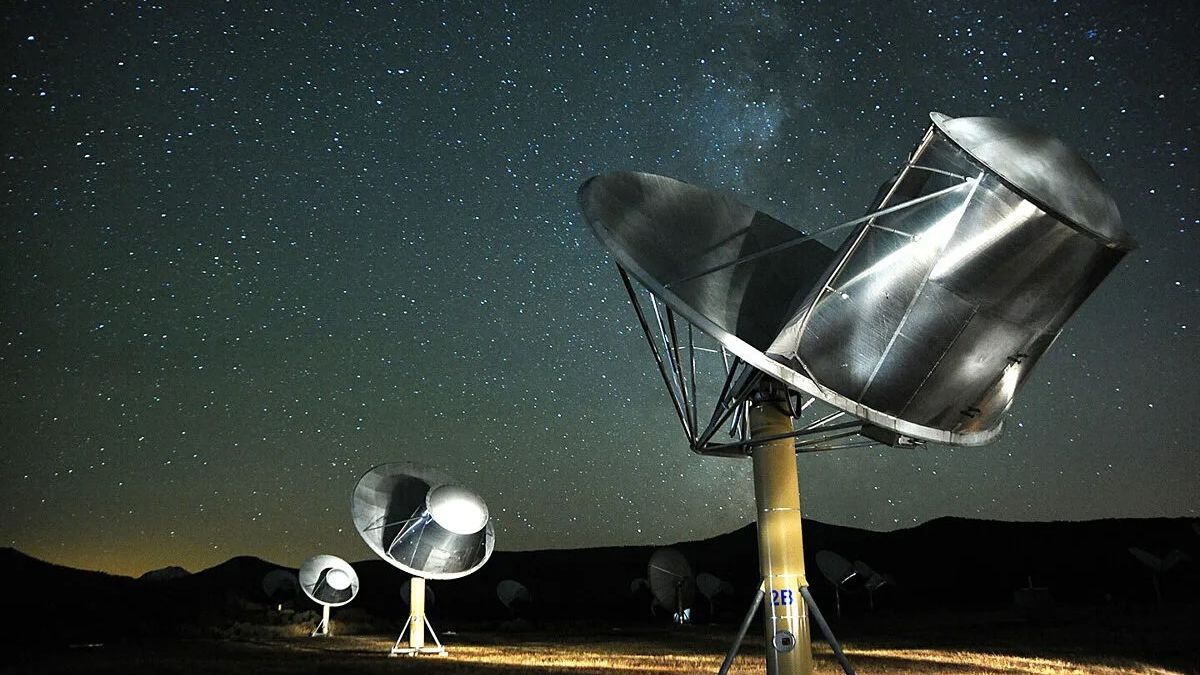
The SETI Institute's Allen Telescope Array in Northern California searches for radio signals that could have been generated by intelligent alien life.

Back in 1961, astronomer Frank Drake put chalk to board and devised a formula to estimate the number of communicative civilizations in the Milky Way. Just how many alien societies exist and are detectable?

And there's also the paradoxical query asked a decade earlier by physicist Enrico Fermi. It seems like ET should be out there, given the vast amount of cosmic real estate. So, where is everybody?

Over the decades, researchers have been trying to come up with answers to these questions. The search for extraterrestrial intelligence (SETI) is a mix of technology, super-smart software and patience, along with creative thinking. For example, maybe the problem isn't us or our methods. Perhaps ET is a party pooper, refusing to join in on any interstellar discourse.

Declining to speak?

In a new research paper, Erik Geslin notes that the Drake Equation asks how many civilizations beyond Earth might exist.

"My work asks whether they would actually want to speak with us," Geslin told Space.com. "What we call the 'Great Silence' may not reflect absence, but refusal."

In the view of Geslin, an associate professor of interactive media at Noroff University College in Norway, a civilization capable of interstellar travel may also be one that has moved beyond conquest, excess and ecological self-destruction.

Does that mean ET might be introverted as well, feeling no real urge to reach out to its cosmic neighbors?

"Advanced extraterrestrials may not be shy, they may simply be prudent," Geslin said. "If extraterrestrial civilizations are biocentric or ecocentric, humanity may not yet appear to them as a safe partner for contact. Such civilizations might simply be cautious."

Decades of listening for SETI signals suggest the existence of a "Great Silence." But maybe nobody wants to communicate with Earth. (Image credit: UCLA SETI)

Planetary prudence

Other starfolk may understand very well the potential risks involved in interacting with humanity, a species that is still strongly anthropocentric, heavily resource-driven and often conflict-prone, according to Geslin.

"What we interpret as silence might therefore not reflect fear, but prudence! Perhaps even a kind of ethical restraint. In that sense, their behavior could resemble a principle of non-interference," he said.

But as for us Earthlings, we've been busy beavers, in terms of broadcasting signals into space and putting an ear to the cosmos in the hope of making contact. We have even planted messages to "the others" out there on outward-bound spacecraft, like NASA's Pioneer and Voyager probes.

"But sending friendly messages does not necessarily mean that we appear as a friendly civilization when viewed from the outside. An advanced society would likely take its time to observe us before considering any form of interaction," Geslin said. "They might study our communications, our media, our films, simulations, games and social networks, all of which reveal something about who we are."

The nonprofit Search for Extraterrestrial Intelligence (SETI) Institute's Allen Telescope Array in California has been listening for signals from extraterrestrial civilizations. So far, no aliens have tried to get in touch. (Image credit: SETI Institute)

Line of thinking

Geslin said that it doesn't take much effort to simply observe the state of our planet and the way our civilization interacts with its biosphere.

"From that perspective," he said, "our signals might reveal a species that is inventive and technologically creative, but also ecologically unstable and often destructive toward both its environment and its own members."

This line of thinking led Geslin to introduce a "contact-willingness factor" into the Drake framework.

"My work explores a different question: Even if they do exist, would they actually want to communicate with us?" he said. "My hypothesis is that the answer may depend not only on technological capability, but also on the cognitive, ethical and ecological maturity of those civilizations, and on our own."

The Allen Telescope Array in Northern California is dedicated to astronomical observations and a simultaneous search for extraterrestrial intelligence (SETI). (Image credit: Seth Shostak/SETI Institute)

Curiosity: a powerful force

That said, curiosity is a powerful force. Technological evolution is closely linked to creativity, exploration and the desire to understand the unknown.

"It is therefore possible that some civilizations might eventually decide that the potential benefits of contact outweigh the risks. Exploration always involves some degree of uncertainty," Geslin explained.

"Personally, however, I suspect that civilizations capable of sustaining themselves long enough to achieve interstellar travel may also have developed a very deep awareness of ecological balance and systemic fragility," he added. "If so, they might be extremely selective about whom they choose to engage with."

Geslin's paper, "Incorporating an exopsychological biocentric contact-willingness factor into the Drake Equation," will appear in the August issue of the journal Acta Astronautica. You can find it online here.

Sign up to read this article
Read news from 100’s of titles, curated specifically for you.
Already a member? Sign in here
Related Stories
Top stories on inkl right now
One subscription that gives you access to news from hundreds of sites
Already a member? Sign in here
Our Picks
Fourteen days free
Download the app
One app. One membership.
100+ trusted global sources.