
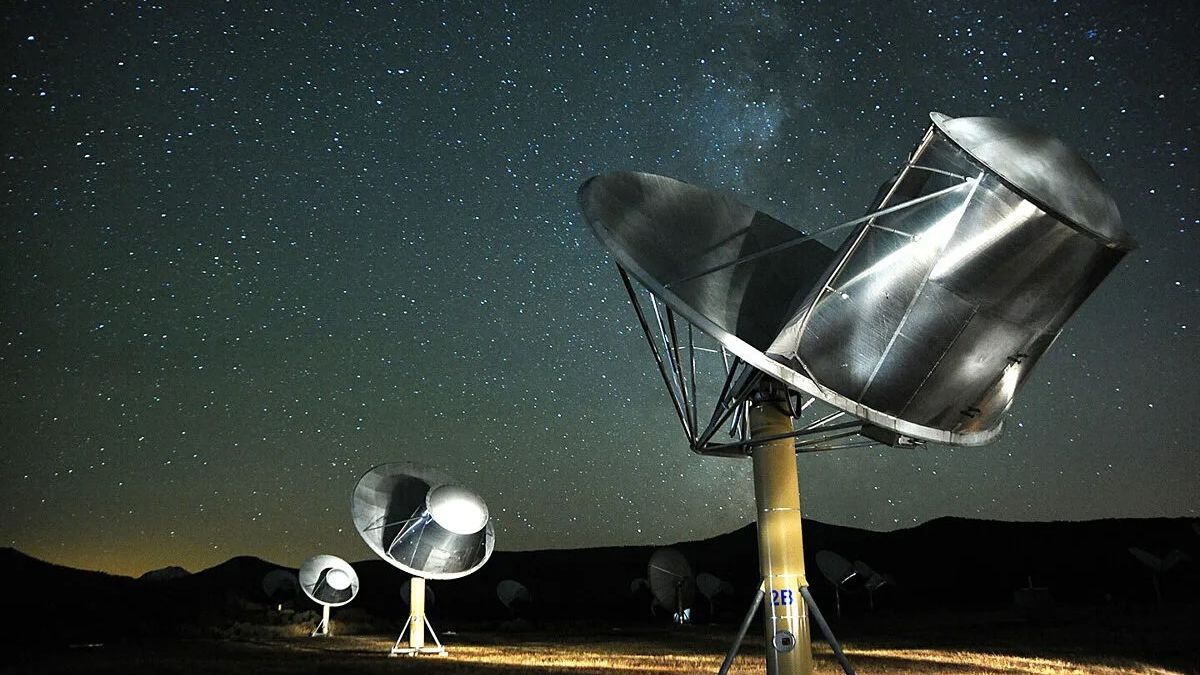
SETI might not have succeeded in finding alien life yet because space weather around other stars could be disrupting aliens' attempts to send radio messages out, according to a new study that tries to make sense of why the universe seems so quiet."Space weather" describes the electromagnetic disturbances produced by gusts of radiation in a stellar wind or coronal mass ejections (CMEs) from a star. These events spew a lot of plasma and electrons into interplanetary space around a star, and plasma and electrons are like kryptonite to coherent radio signals.Various deleterious effects occur when radio waves interact with a dense patch of charged particles. For example, scientists working in SETI, the search for extraterrestrial intelligence, already factor in the consequences of electron dispersion in the interstellar medium between stars. When a radio wave encounters an electron in interstellar space, lower radio frequencies interact more strongly than higher frequencies, causing the lower frequencies to be delayed and arrive at their destination later than higher frequencies. A broadband signal stuffed with many frequencies would be seriously affected by this dispersion, which is why SETI scientists expect that aliens would be transmitting narrowband signals of fewer frequencies instead.