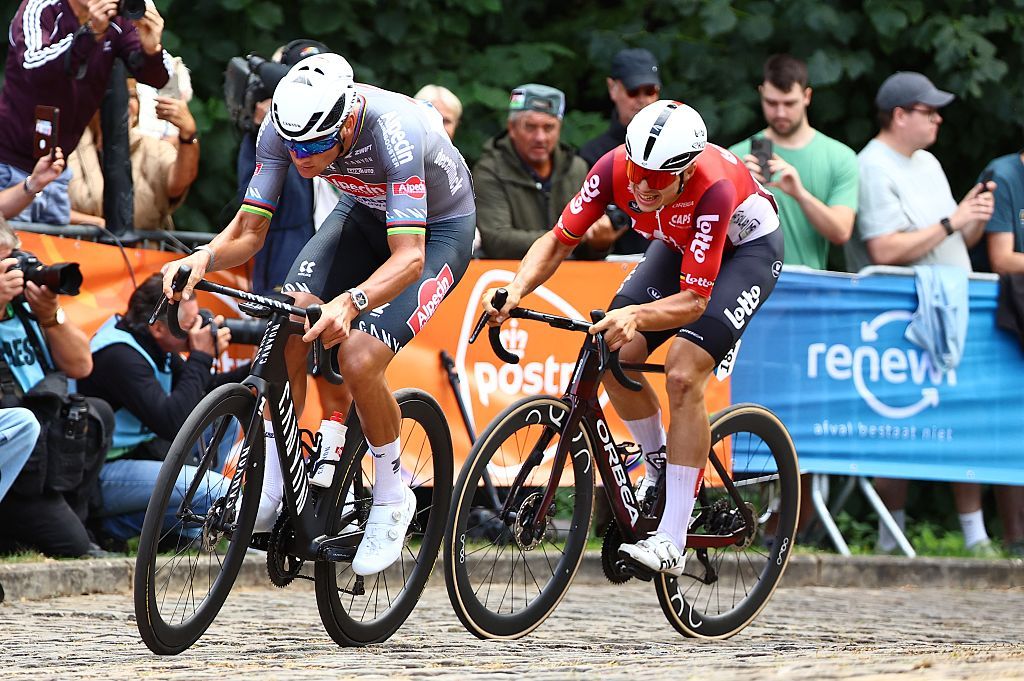
Mathieu van der Poel's bombshell announcement that he will be racing Omloop Het Nieuwsblad not only means there is a standout favourite for Saturday's season opener. As leading Belgian contender Arnaud De Lie (Lotto-Intermarché) pointed out in his pre-race press conference, the Dutch star's presence will likely reshape the shape of the entire race.
While the combination of a headwind and a lack of aggressivity in the peloton saw virtually no major attacks go clear, with perennial Classics contender Stefan Küng's late charge off the front one of the very few attempts to fight against the fast-rising tide of probability that the race would end in a bunch sprint.
But if King Küng's Canute-like effort to beat off the inevitable proved in vain 12 months ago, De Lie is more optimistic that with Van der Poel on the start-line, the odds of riders chancing their arm rather than waiting for the all-but-inevitable onslaught by the Alpecin-Premier Tech racer are much higher.
"It could all kick off at 100km to go," De Lie told reporters in the Lotto-Intermarché pre-Omloop press conference. "Before it was more possible for more people to reach the finale together," – as happened in 2025, with the win going to outsider Søren Wærenskjold – "this time around it's more possible that there will be a much more open race.
"You never know when Mathieu will attack, so why not try yourself?"
It's often been pointed out that, given Omloop is 'only' 200km long, as opposed to the longer-distance Monuments, and riders are fresher in the early season and keen to make an impact, too, the race can be a much more unpredictable affair than later Classics.
As Visma-Lease a Bike directeur sportif, Grischa Niermann, succinctly put it in his own team's press conference on Thursday, "Anything can happen in Omloop."
But in his own meeting with the Belgian media in a plush rural hotel in central Flanders, De Lie added another factor that will feature in 2026 to reinforce that singular ability of Omloop to write its own narrative in a way that arguably no other Classic ever can. The changed route, he said, reinforced the odds of a more uncertain race, with breaks able to go almost anywhere.
"There are many options," he explained."The section between the Berendries and the Muur is a bit easier, so anything is possible. So I will have to stay alert up front with my teammates.
"The Molenberg will be the most important point of the day, so it's possible to organise a break there, because the road changes direction. We'll need to be in a good position there."
The dream scenario for many riders would be to follow Van der Poel up the road, and De Lie was asked if he would be happy to make it into the finale in a two-man move with the star rider.
"To follow Mathieu, I'm still lacking 50 watts," De Lie said to appreciative laughter. "On the other hand, a day on the attack with Mathieu and snatching a podium spot wouldn't be bad either."
"With him, you never know where the finale will break loose. It could very well be on the Molenberg. Will I follow him? Maybe I should be a bit smarter. Like last year during the Renewi Tour" – won overall by De Lie against Van der Poel – "where I opted for a lower gear on the Muur and raced defensively."
Memorably second in the 2023 Omloop as a young pro – "it shaped the next part of my career" – despite a bad crash and then a comparatively disappointing tenth in 2024, De Lie's best option might yet end up being a small bunch sprint. But he's not pessimistic about his chances in that, either.

Recently, De Lie has been unable to train much specifically on his accelerations following his domestic accident over the winter, in which he injured his ankle.
But the Belgian pointed out that the toughness of the race and the unusual nature of the final kilometre, with a slight downhill and then a drag to the line, should normally render that potential disadvantage he had much less relevant.
"I'm not so worried because Saturday's sprint would be more about resistance than anything else, rather than a pure turn of three or four-second speed. Then there's the profile of the last part of the course itself. Both mean that it's timing that matters the most," he said.
The data backed him up, De Lie said. He even pointed out that his former teammate Brent Van Moer (Pinarello-Q36.5) had finished fourth last year and showed him in his power output afterwards, "and they weren't exceptional at all."
As he concluded, "You can also have a good sprint in Ninove without having the best legs."
As for whether that also meant he could beat the top fastmen like Paul Magnier (Soudal-QuickStep) and Jasper Philipsen (Alpecin-Premier Tech) in a repeat scenario of 20225, Le Taureau de Lescheret [the Bull of Lescheret] was as sure of himself as his nickname suggests he can be. This was despite only having minor placings to date in the sprints, his best a fifth in one stage of the Volta ao Algarve so far this year, too.
"Can I beat Magnier and Philipsen?" he asked rhetorically. "Why not? It's the kind of sprint that you win with your head as much as anything - and in my head I'm good."
De Lie is in a much better place than he was 12 months ago, in any case, when an 86th place in Omloop morphed into a very underwhelming Classics campaign in general. Apart from feeling physically stronger, psychologically, he's far more upbeat about himself and "a hundred times happier, which gives me more confidence."
He even went so far as to say that if he won on Saturday, it wouldn't automatically mean his 2026 Classics season was a success. Rather, it'd onlymake him more ambitious for the racing to come.
"Before this, it was the preparation," he concluded. "Now it's the real stuff."
Get unlimited access to our unrivalled 2026 Spring Classics coverage with a Cyclingnews subscription. We'll bring you breaking news, reports, and analysis from some of the biggest races on the calendar, including Milan-San Remo, Paris-Roubaix and the Tour of Flanders. Find out more.