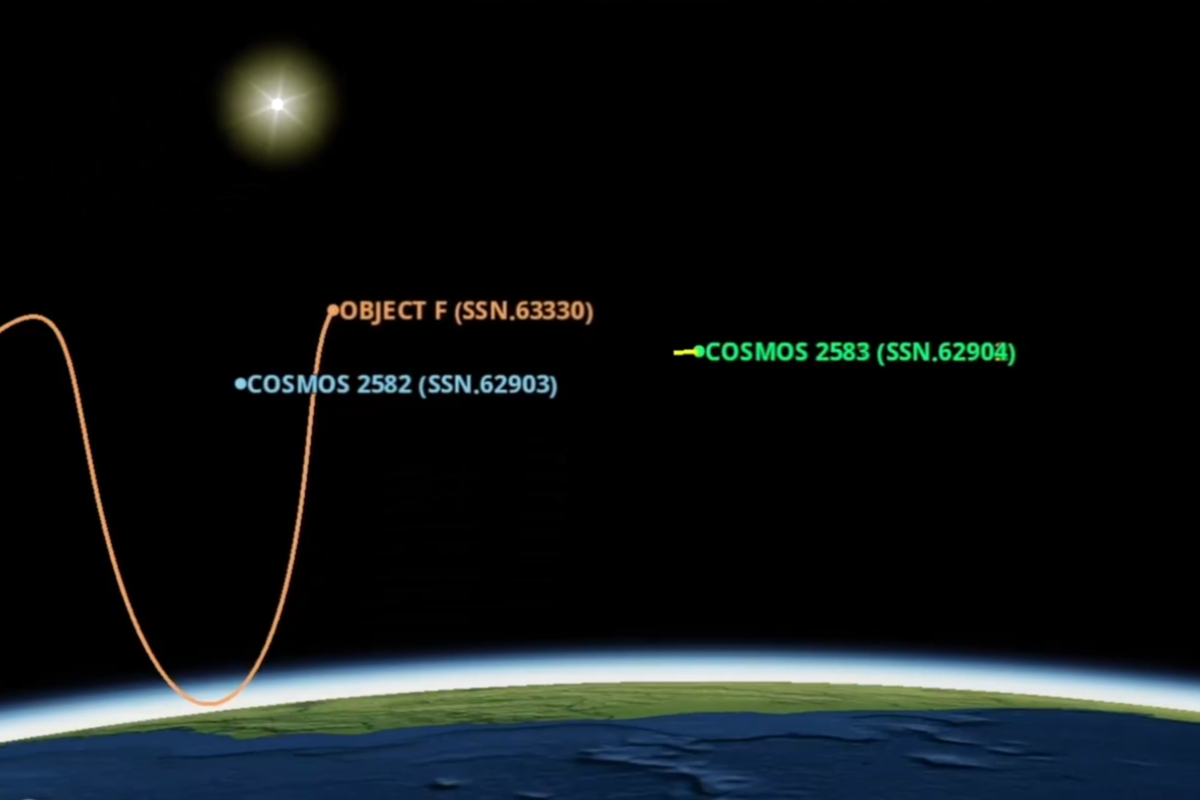
Astronomers have observed two Russian military satellites passing within 3 metres (10 feet) of each other in an unexplained manoeuvre.
The COSMOS 2581 and COSMOS 2583 satellites, launched by Russia’s space agency Roscosmos in February 2025, performed the operation last week while orbiting at an altitude of around 585 kilometres.
The incident, which was tracked by US-based space situational awareness firm COMSPOC, has raised concerns about space-based surveillance and orbital collisions.
“This week we observed a complex proximity event involving Russian satellites,” COMSPOC wrote in a post to X, alongside a simulation of the event.
“This wasn’t a coincidental pass – COSMOS 2583 performed several fine manoeuvres to maintain this tight configuration... Whatever Russia is testing, it’s sophisticated.”
🛰️Russian satellites multi-object proximity event in LEO
— COMSPOC_OPS (@COMSPOC_OPS) May 1, 2026
Radar tracking data via @LeoLabs_Space, processed through COMSPOC SSA Suite.
This week we observed a complex proximity event involving Russian satellites: COSMOS 2581, 2582, 2583, and Object F (a subsatellite released by… pic.twitter.com/3nDkcOmTuD
Russia has not disclosed the specific purpose of the satellites, though space analysts noted that one of them released a “sub-satellite” referred to as Object F.
They are believed to be part of a program involving “inspector satellites”, designed to test or perform surveillance operations of other spacecraft in orbit.
“From a precision-engineering perspective, this is genuinely impressive, but close-proximity operations are not unusual,” Dean Sladen, an aerospace engineer at precision engineering components supplier Accu Components, told The Independent.
“Every crewed and cargo vehicle bound for the International Space Station carries out similar manoeuvres, with spacecraft far larger than these satellites docking within metres of the station on a monthly basis.
“The difference is [the COSMOS manoeuvre] took place between two free-flying satellites without docking mechanisms or cooperative protocols, and the closing rates were likely higher.”
The manoeuvre is concerning from the perspective of space debris in low Earth orbit, with Accu Components’ recent space debris report revealing that nearly half of all tracked objects in Earth’s orbit are space junk.
A collision between two satellites can lead to what is known as the Kessler syndrome, whereby pieces of debris cause knock-on collisions that create an impenetrable layer of debris that blocks any future rocket launches from Earth.
“Satellites in low Earth orbit typically travel at roughly 8 kilometres per second. Everything has to be handled by onboard guidance systems running thousands of calculations a second, with manoeuvre decisions made autonomously inside tight time windows,” Mr Sladen said.
“When that control loop works, the precision and granularity are extraordinary. That said, when it doesn't, a single miscalculation can turn two intact spacecraft into thousands of high-velocity fragments capable of disabling anything they strike.”
Explosion at SpaceX launch site, days before critical rocket mission
NASA testing telescope that could help astronomers detect city-killing asteroids
Stargazing in May: Once in a blue moon...
New shortcut found to Mars that could cut travel time by half
Dozens of new Star Wars Tatooine-like planets discovered
How to witness the Eta Aquarid meteor shower reaching its peak tonight