
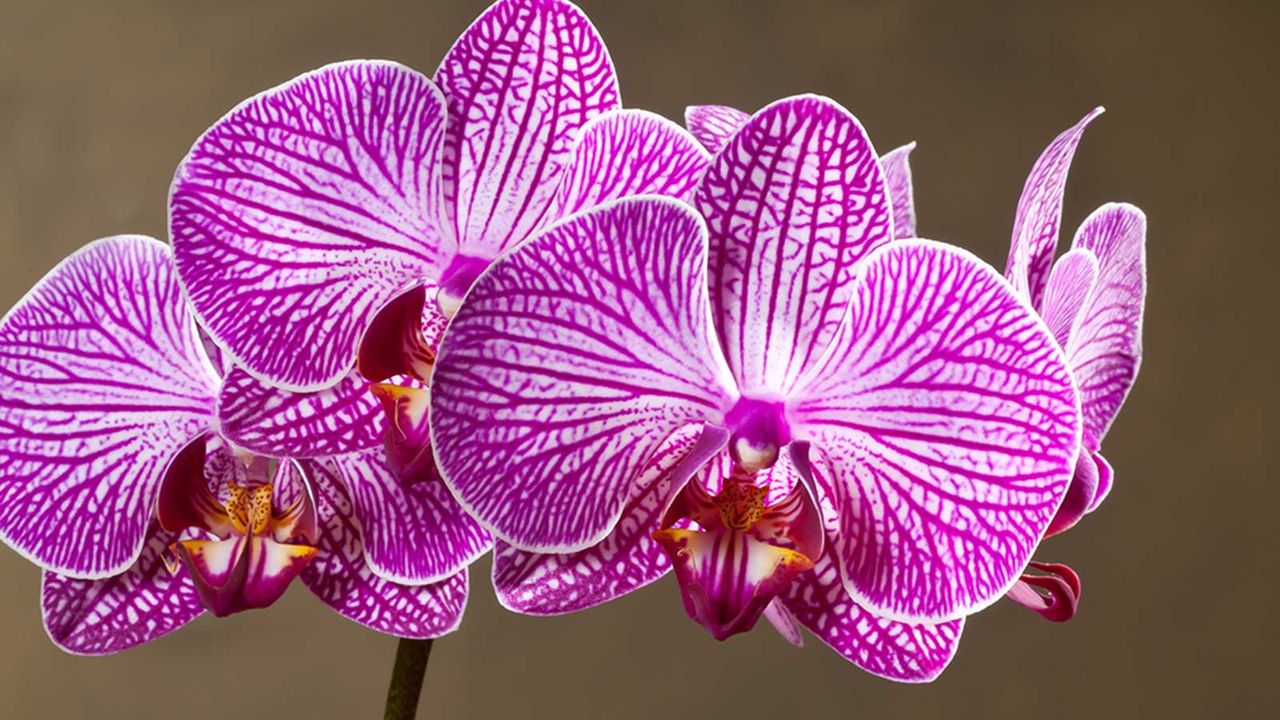
June marks peak flowering season for most orchids, and there are some key care tasks to ensure yours stays in the peak of health. You'll need to water more frequently, apply a balanced fertilizer, and provide sufficient air circulation to prevent diseases this month. You can also prune your orchid's stem to encourage more blooms.
Orchids are often perceived as tricky plants to grow, but they can thrive with just a few careful considerations. Consistent moisture, high humidity, and bright but indirect sunlight is key, though regular feeding and watering is, of course, vital in the summertime.

Understanding how to care for orchids is all about adjusting your focus as the seasons change, and now is the time to check a few essential tasks off your list to ensure strong growth and even more blooms in the weeks ahead. (And if you're on the hunt for one, you can pick up a classic purple orchid from The Sill.)
1. Water More Regularly
It isn't easy to master the art of watering orchids, but one thing is for certain: you'll need to start watering yours more frequently in June.
As temperatures rise, the soil will dry out far quicker than you might expect, so it's important to pay particular attention to moisture. (Although balance is key, since overwatering can cause orchid root rot.)
'Orchids need much more water during summer than previous seasons,' confirms Tenielle Jordison, Gardens Content Editor at Homes & Gardens. 'Of course, watering orchids is a tricky task as it is, so it can be a struggle to know how much more water your orchid needs right now.'
While you can use a soil moisture meter (like this one from Walmart) to monitor the soil conditions for many houseplants, orchids are a little different – and it's worth examining the roots instead.
'My top tip is to observe orchid roots when thinking about watering,' explains Tenielle. 'If they appear silver, they need a top-up of water. If they appear green, your orchid is well-hydrated and doesn’t need more water just yet.'
2. Fertilize Regularly
Fertilizing orchids is an essential task both before and during their active season – which means it's particularly important in June.
Whether you make your own orchid fertilizer or choose a ready-made option (like the Miracle-Gro indoor plant mist for orchids, which you can find at Amazon), it's best to fertilize orchids every 2-4 weeks throughout the spring and summer.
You can also use general-purpose indoor plant food, which is available at Walmart.
3. Prune Carefully to Encourage New Blooms
Knowing how to prune orchids is another tricky task, since different types of orchids need to be pruned in specific ways – and some shouldn't be pruned at all.
In June, however, phalaenopsis orchids (commonly known as a moth orchids) can be carefully trimmed to encourage even more blooms.
'By June, your moth orchids may start to look a little tired after several weeks of flowering,' explains Tenielle. 'It’s common for flowers to drop off at the start of summer and for orchid stems to turn yellow, but there’s one trick you can do to encourage another flush of blooms.'
Using sharp scissors (like these micro-tip pruning shears from Walmart), you'll need to make a few careful cuts along the flower stem.
'Look along the stem until you find the part that is still firm and green,' says Tenielle. 'Then, cut half an inch above a dormant "eye" (the triangular bumps along the stem). This will encourage new growth with brand new flower buds.'
4. Improve Air Circulation
Like many tropical plants, orchids thrive in humid conditions, but they still require sufficient airflow.
It's always worth creating the right humidity levels to ensure that your orchid is happy – you can use a plant mister, like this one from Wayfair, or invest in a pebble humidity tray, like this one from Amazon – but it's also crucial to provide enough air circulation to regulate leaf temperature and prevent fungal diseases.
With this in mind, orchids are best placed near a window to guarantee consistent airflow. Bathroom windowsills are particularly ideal, since there are higher levels of moisture in the air.
5. Check For Heat Damage
Though orchids love a warm spot, bright but indirect light is crucial to ensure that they don't suffer from heat damage and leaf scorch.
'If you’ve left your orchid on a particularly sunny windowsill during the temperature spikes this month, it may look a little crispy from heat stress,' warns Tenielle. 'The first thing you'll need to do is to give it a good prune and remove damaged stems and leaves.'
Once your orchid is looking neat and healthy, you might want to re-evaluate its position – and give it more water for an extra boost.
'Move it to a cooler spot, water well, and it should recover in no time,' advises Tenielle.
If you're in need of more advice, we asked experts to debunk popular orchid myths that might be making you feel apprehensive about growing these beautiful plants.
And if you love inspiring garden ideas, outdoor advice, and the latest news, sign up for our newsletter and get the latest features delivered straight to your inbox.