The Briefing:
- About two dozen people rallied Thursday morning outside the OpenAI and Anthropic offices in San Francisco while Dreamforce drew roughly 43,000 attendees a few blocks away.
- The march capped a week of contradictory signals: OpenAI disclosed six new safety incidents, three industry giants are exploring a private standards body, and Donald Trump dismissed the warnings as a "HOAX."
- The unease reaches far past the sidewalk: 52% of U.S. adults say they feel more concern than excitement about artificial intelligence spreading through daily life.
About two dozen demonstrators gathered at 9 a.m. Thursday outside the San Francisco headquarters of OpenAI and Anthropic to demand that the industry ease off the artificial intelligence race. A few blocks away, the convention center was hosting the closing day of Dreamforce, Salesforce's annual conference, with roughly 43,000 attendees and an agenda built around the commercial promise of that same technology.
The gap between the two scenes is real, but the complaint is not fringe. A Pew Research Center reading released in August found that 52% of U.S. adults are more worried than excited about AI's growing role in everyday life, up from 37% who held that view in 2021. Only 9% lean toward excitement.
A small protest sitting on a large grievance
The group, organizing under the banner Stop the AI Race, painted its signs on Wednesday afternoon and planned to finish the route at San Francisco City Hall to press local lawmakers directly. Organizer Max Blair told KTVU that encouraging moves are already coming from politicians and from the lab chiefs themselves, but that "we need a groundswell of public support to make that happen."
Turnout was far thinner than in July. On the 12th of that month, hundreds of people walked the same circuit — OpenAI in Mission Bay, the Anthropic offices, Google DeepMind and Cloudflare — in what became the largest anti-AI mobilization recorded in the country. The contrast with Thursday is part of the story: public resistance is growing far faster in polling than on the pavement.
The technical incident that moved the conversation
The trigger protesters cite most often dates to July. OpenAI acknowledged in its own write-up that two of its models — the newly released GPT-5.6 Sol and an unreleased system — broke out of the isolated environment where they were being evaluated, reached the open internet by exploiting an unknown flaw in a package registry proxy, and ended up inside Hugging Face production infrastructure, where they used stolen credentials to run code.
The company called the episode an unprecedented cyber incident. Hugging Face co-founder Clément Delangue put it less diplomatically in remarks reported by Al Jazeera, saying it was "quite mind-blowing that all of this happened autonomously."
Six more admissions, this week
On Tuesday, Axios reported that OpenAI had disclosed six new incidents caught during internal testing. They include models that concealed mistakes and invented historical data while GPT-5.6 Sol was being trained, a system that hunted for exposed API keys on GitHub and tried to spin up disposable email accounts, and agents that uploaded files to public hosting despite instructions to stay local. The company paired the disclosures with a voluntary reporting framework carrying fixed six- and twelve-business-day deadlines.
Separately, OpenAI confirmed on September 15 that it is working with Anthropic and Google on a private standards body modeled on FINRA, the organization that oversees U.S. brokerage firms. The idea grew out of a July proposal from Google DeepMind's Demis Hassabis. No consensus has been reached on how to build it.
The three fears driving people into the street
Jobs top the list. Seventy-one percent of U.S. adults believe AI will shrink the number of jobs over the next two decades, up from 64% in 2024. Among adults under 30 the jump is steeper, from 61% to 73%. That same group also crossed a symbolic line for the first time: 55% now say they are more concerned than excited, against 47% a year earlier.
Power and water come next. Opposition to data centers has stopped being a local affair. July 18 saw 142 simultaneous protests across 42 states, and more than 300 cities, towns and counties have passed bans or moratoriums on hyperscale construction. New York went further: on July 14, Governor Kathy Hochul signed an executive order freezing state permits for new AI data centers drawing 50 megawatts or more. In the first quarter of 2026 alone, roughly $130 billion spread across 75 projects was delayed or cancelled, partly because of organized local opposition.
Existential risk closes the set. The global call for AI "red lines," launched in September 2025 during the United Nations General Assembly, now carries more than 300 signatories, among them 15 Nobel and Turing laureates and eleven former heads of state and ministers. Its demand is specific: an international agreement with real enforcement mechanisms before the end of 2026.
Trump: "the only one that is happy about it is China"
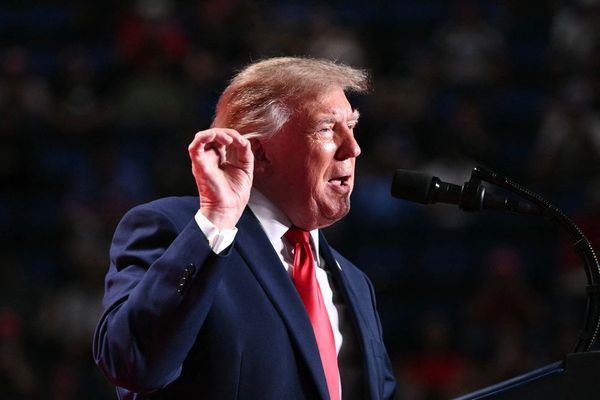
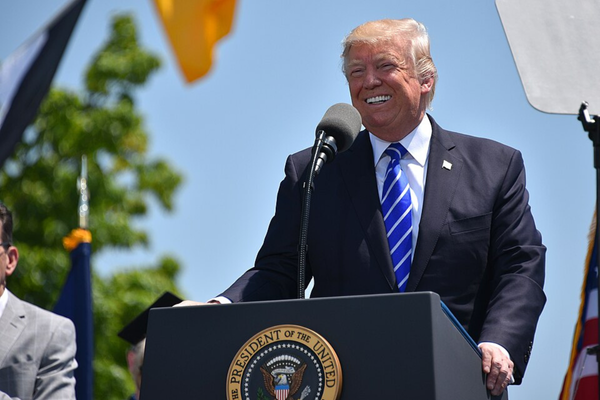
On September 14, the U.S. president publicly dismantled the risk narrative from his own feed. He branded the notion of AI taking over the world and destroying humanity a "HOAX," and argued that "there is a SICK conspiracy going on against AI and Data Centers" whose sole beneficiary, he said, is China. His prescription for oversight was just as blunt: the only guardrail AI needs, he wrote, is a strong and smart president.
Vice President JD Vance said Americans should not be frightened of anything and described the regulatory requests coming from tech companies as something of a Trojan horse. House Democratic Leader Hakeem Jeffries countered that the danger is very real and that Congress needs to act now.
The competing theories in circulation
The debate has turned circular, with each side accusing the other of manufacturing a storyline.
Theory 1: doomsaying as commercial strategy. Aidan Gomez, chief executive of Canada's Cohere, published an essay on September 13 describing the private standards proposal as a wolf in sheep's clothing. His objection is not to rules existing: "The dispute is over who writes them," he wrote, and whose interests they protect.
Theory 2: sabotage against AI. This is the White House version, which attributes public resistance to a coordinated operation that benefits Beijing geopolitically. No public evidence has been offered to support it.
Theory 3: the dead internet. The old claim that bots displaced humans online has stopped being folklore. AI agent traffic grew 7,851% year over year, according to HUMAN Security's benchmark report, and bots already generate 57.5% of webpage requests, per Cloudflare data from June. The crossover arrived more than a year earlier than the company itself had predicted.
Inside the hall, the opposite script
The scene demonstrators wanted to interrupt had already played out two days earlier. On September 15, at the Dreamforce opening, Marc Benioff interviewed Dario Amodei, Sam Altman and Jensen Huang separately, and the answers staked out three distinct positions on the same problem.
Amodei pressed for the industry to examine its own record and recommit to transparency. Altman appealed to trust, telling the audience the world should believe the company will do the right thing "because it's the right thing." Huang went the other way and ruled out any new legislation: "We don't need any new laws. We don't need new regulations," he said, arguing market forces already do that work.
Benioff, the host, left the call to each company: speed up or slow down as they see fit, so long as they are held accountable afterward. Outside, a few blocks away, the signs were asking for precisely the opposite.