Get all your news in one place.
100’s of premium titles.
One app.
Start reading
Sports Illustrated
Sports Illustrated
Sport
Bryan Fischer

What the 2026 NFL Combine Revealed About College Football’s Power Shift

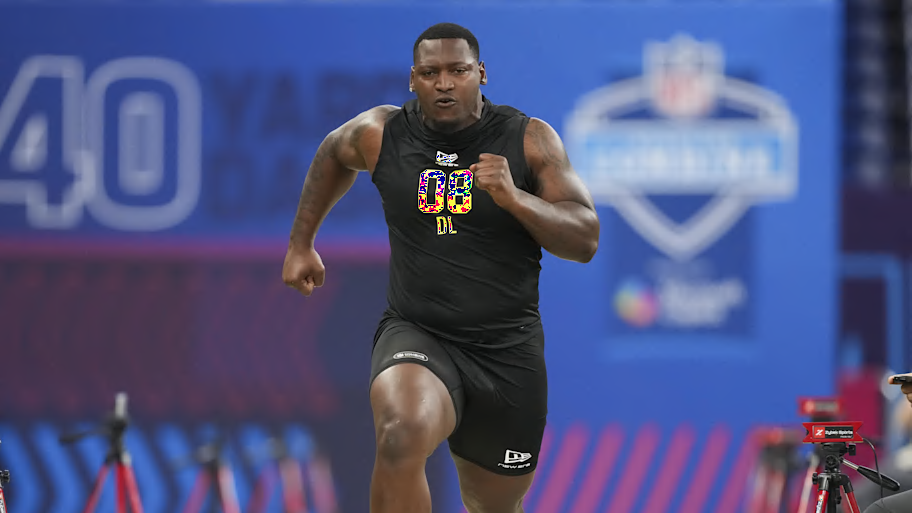
The 2026 NFL combine wrapped up on Sunday from Indianapolis, the official handoff of college football players transitioning to the NFL. 

While much of the attention at Lucas Oil Stadium—and in the various hotels and restaurants around the city where information was really exchanged—focused on the impact many of the testing numbers will have on the path to the NFL draft in Pittsburgh later this spring, there were plenty of notable nuggets from a college football perspective.
Here are six takeaways that draw on both sides of the football divide.

1. Several underperforming teams can’t blame lack of talent

It happens every year where a team tumbles from being highly ranked in the preseason polls to unranked and the most recent college football campaign had no shortage of programs that traveled such a path. Perhaps the two most notable programs which fit this bill in 2025 were Penn State and Clemson, which had national title hopes with a slew of returning starters in the fold, but needed late wins in November to even flirt with bowl eligibility. 

Based on what we saw in Indy, the root cause for the disappointment for the Tigers and Nittany Lions can’t be traced to a lack of talent because players from both teams flashed plenty for NFL scouts. Penn State defensive tackle Zane Durant was the fastest player at his position and posted the third-highest vertical jump among the big men in the trenches. Teammate Dani Dennis-Sutton tested well, too, and could see his stock on the rise, while the nine different Clemson players all showed flashes of what they can do. It’s not a stretch to think that Avieon Terrell, Peter Woods and T.J. Parker can all be top-100 picks (like many thought they would be over the summer). Receiver Antonio Williams and QB Cade Klubnik had some nice showings during drills as well. Even DT DeMonte Capehart, who didn’t have a ton of college production with the Tigers, turned a number of heads with the show he put on.

Florida is another one to circle. The Gators had nine players at the combine (two were kickers) and defensive lineman Caleb Banks might wind up as one of the more intriguing guys at the back half of the first round after running a 5.04 40-yard dash to confirm his athleticism in the trenches. 

Two of the three aforementioned programs made a coaching change during the season, and it sure seems like the combine was yet another data point that on-field underperformance did not lay solely at the feet of the players in uniform. 

2. High-end talent dispersal in college football shows up at the combine 

There are a handful of usual suspects when it comes to being factories for NFL players (Ohio State, Alabama, Georgia, etc.), but we also got a bit of confirmation bias for the theory that talent is being more spread out in the sport since the arrival of NIL and the transfer portal. Texas A&M notably led the way with 13 players taken and had several very impressive efforts on the turf from receiver KC Concepcion to edge Cashius Howell. Mississippi State laid claim to the fastest player (WR Brenen Thompson) in Indy, Arkansas had two big winners out of the backfield in RB Mike Washington Jr. and QB Taylen Green, and UConn was well represented by sure-handed wideout Skyler Bell. We also had head-turning performances from UCF’s Malachi Lawrence and TCU’s Kaleb Elarms-Orr, several more Iowa offensive linemen looking like 10-year veterans in the trenches and Cincinnati wideout Jeff Caldwell testing well enough to send many franchises to go back and rewatch his tape. 

That’s not even getting to the best tailback in the draft living up to that billing in Notre Dame’s Jeremiyah Love, the No. 1 overall pick being an Indiana quarterback who loomed large at the event despite not even doing anything, plus schools like Texas Tech, Utah, Arizona State and Tennessee potentially producing multiple first-round picks this year based on what we saw and heard the past few days. That’s not to say you won’t be hearing about a ton of Buckeyes getting their names called in Pittsburgh on the first few days of the draft, but there’s definitely far more variety on hand at places like the combine compared to five or 10 years ago when things were a tad more concentrated around a handful of logos.

3. College Football Playoff teams did not lack for athletic freaks

The combine is often a place that can reaffirm a bias or thought you might have about football, and in 2026 it might have added credence that to make the College Football Playoff, you better have some dudes. Consider that box checked by many of the 12 playoff teams who sent players to the combine and tested off the charts on what was truly the fastest combine on record. Ohio State LB Sonny Styles certainly stole the show with his workout numbers, running a 4.46 40-yard dash and jumping 43.5 inches (vertical) and 11 feet, two inches (broad) at a robust 6' 5" and 244 pounds. Brother Lorenzo Styles Jr. was the second-fastest player at the event in the dash (4.27) and future top-five pick Arvell Reese was the fastest player at his position in attendance. In fact, of the dozen edge players who ran under 4.7 in the 40-yard dash, half of them played in a playoff game. 

Elsewhere, Georgia defensive back Daylen Everette solidified his positioning on draft boards with a 4.38 40 to go along with some impressive field work, hard-hitting safeties Robert Spears-Jennings (Oklahoma) and Dillon Thieneman (Oregon) both ran under 4.35, Ducks tight end Kenyon Sadiq locked down a spot in the first round, Texas A&M offensive lineman Chase Bisontis tested closer to a skill position player than a guard and Sooners receiver Deion Burks reminded everyone about his speed and quickness. 

In an age where it seems like most records are falling with players getting ever more bigger, faster and stronger, it was notable how many guys turning heads also had CFP highlights to accompany them taking the field at Lucas Oil Stadium. 

4. Big Ten continues to close the gap with the SEC

In previewing the combine during an appearance on the Others Receiving Votes podcast last week, Texas A&M coach Mike Elko remarked that the NFL says the most talent in the country is spread out throughout the SEC—a point of conference pride that is largely true in terms of the overall number drafted and the amount of picks per school over the past decade or so. As college football has seen recently though, whatever gap there has been on the field has started to narrow significantly thanks to the strides made in the Big Ten of late. Not only is the latter league reigning atop of the sport with three national titles, it’s hot on the heels in terms of overall talent level, too.

During last year’s draft, the SEC only narrowly edged the Big Ten (79 to 71) in terms of total draft picks and had a similar lead if limited to the first round (15 to 11). Such a gap was much more pronounced earlier in the CFP era and can’t be explained simply by conference expansion—there’s a real increase in the quantity and quality of a player who wears a Big Ten patch nowadays. That was front and center at the home of the Big Ten title game as Reese and Styles were putting up ridiculous marks, the likes of Olaivavega Ioane solidified themselves in the first round and Denzel Boston and Omar Cooper Jr. proved there wasn’t much of a gap between them and the Makai Lemon/Carnell Tate duo at receiver. 

This is not to say there were not great players at the combine out of the area of the country where it just means more—there were 114 players invited from the SEC to the Big Ten’s 84—but it does seem like we’re trending toward another data point next month suggesting there’s actually far less of a difference between the Power 2 leagues than history would normally suggest in the eyes of the NFL.

5. The number of small-school players continues to fade 

It’s long been said that if you’re good enough to play in the league, they’ll find you. For much of the sport’s history, that’s been true no matter where you went to school as players were drafted from nearly every level of college football and pretty much every nook and cranny of the county. 

In this day and age though, it sure seems like the guy from outside the four major conferences (much less the FCS or below) making his way to the NFL is going to be about as rare as the Cleveland Browns finding a good option at quarterback. Setting aside Notre Dame players from the over 300 in attendance this past week, there were just 20 players from outside the Power 4 to test at the combine. Only five of those 20 hailed from an FCS school and neither the Pac-12 nor the entirety of Conference USA had a single representative. Even the typically strong Group of 6 leagues like the American (four) and Mountain West (three) had just barely more invites combined than a 5–7 team like Kentucky (six) did. 

Such a trend speaks to the ability for players to move up via the transfer portal to higher levels of competition (and money) but probably leaves more schools than ever taking a backseat to the draft process nowadays with so little representation. There were still several notable names who popped during the combine, like North Dakota State WR Bryce Lance and Georgia State’s Ted Hurst, but they’re increasingly the types who are the exception to the rule.

As much as schools have had to adapt to the massive changes to college football the last few years between NIL, revenue sharing, the portal, COVID seasons and changing eligibility standards, the NFL has seemingly been an even bigger winner from such changes to the player pool they’re having to deal with on a yearly basis. 

Players transferring to bigger and better schools (along with recent realignment) has simply produced many more opportunities for prospects to play in bigger games against top competition. Several general managers cited the increased prevalence of such games during their time with the media in Indianapolis, and you can tell they are having more success finding the right fits in the draft as a result. There’s far less guesswork over how a guy might translate to the next level if he’s playing in more games, against better talent, after all.

6. 2026 QB class has a high floor, but eyes keep turning toward 2027

To say it’s not the sexiest group of quarterbacks in the eyes of NFL evaluators this year might be an understatement. Heisman Trophy winner Fernando Mendoza continues to be talked about as a lock to go atop the draft but, after that, it might be few and far between for the position come draft weekend. 

As much as this group seems to not have the types of ceiling that you might have found with, say the 2024 NFL draft group (Caleb Williams, Jayden Daniels, etc.), it sure seems like they all have decently high floors where you can see them winning some games in the league if thrown into the fire. Alabama’s Ty Simpson had an excellent workout on Saturday and seems pretty solid as the second guy off the board while Carson Beck, Garrett Nussmeier, Klubnik and even Behren Morton have enough physical tools and ability to find a nice career in the NFL. 

Still, one can’t help but think that almost the entire lot of QBs this year are being held to a different standard—not just because of what they’ve shown on film this past season, but because of what looms for many in both college football and the NFL with the group of quarterbacks coming after them. 

Now, it’s been said before to wait until next year when it comes to signal-callers in the first round for needy franchises, but it sure felt like there was more open discussion coming out of Indy about teams trading picks for next year with Arch Manning, Dante Moore, Brendan Sorsby, Sam Leavitt, Trinidad Chambliss and several others likely in the mix for the 2027 draft. All of them have shown a pretty high ceiling and could have been the No. 2 QB taken behind Mendoza if they had come out, but instead will only add to the interest at the position going into the fall for NFL teams almost as much as there will be on the college football side.


More College Football from Sports Illustrated

Listen to SI’s college sports podcast, Others Receiving Votes, below or on Apple and Spotify. Watch the show on SI’s YouTube channel.


This article was originally published on www.si.com as What the 2026 NFL Combine Revealed About College Football’s Power Shift.

Sign up to read this article
Read news from 100’s of titles, curated specifically for you.
Already a member? Sign in here
Related Stories
Top stories on inkl right now
One subscription that gives you access to news from hundreds of sites
Already a member? Sign in here
Our Picks
Fourteen days free
Download the app
One app. One membership.
100+ trusted global sources.