How to pursue quality in an age of phone cameras
ChimneySweep asks: Could the Guardian commission more photographers to cover stories, and rely less on journalists taking portraits on their phones? Too often, the article is treated as the journalism and the photography as merely illustrative.
Fiona says:
We are currently going through a process of expanding our visual journalism so that we can provide different forms of reporting to cater for different appetites. So to answer your question, yes there will be more commissioned photography and bespoke photojournalism across the globe. That said we do have to balance our budgets and make savvy decisions about the impact of commissioned photography. I hope you find our photo essays, picture galleries and more elaborate multimedia forms of visual story telling are sharing in some of the heavy lifting that text alone used to do!
Thank you so much for all your thought provoking questions, it’s so important to keep reviewing our picture editing practice to make sure we’re appropriately reflecting the world we live in today.
What's your advice for young photographers?
PunCrock asks: It’s the summer and there’s more than a handful of brilliant photographers who have just graduated. Young or mature, they have developed their own unique vision and storytelling abilities. What advice would you give to those eager to make their first steps in this competitive world?
Fiona says:
Partly what I’ve mentioned in the previous answer: make sure you are agile in your photography disciplines. Keep an updated online portfolio which is your shop window and be sure to give your geographic location and immediate contact details. Do enter competitions with your work and take part in portfolio reviews as it’s a great way of meeting industry professionals who may lead you to paid commissions and if you’re working in photojournalism understand ethical practise and above all, be truthful.
Updated
Is there still a place for film in covering breaking news?
Exphotojournalist asks: Don McCullin walks into The Guardian newsroom in 2026, aged 40, carrying a Nikon film camera and four rolls of Tri-X. A major human tragedy is unfolding and you need someone there immediately.
Do you send him — or reject him because he isn’t shooting digital, filing instantly or producing video for social media?
Fiona says:
Given today’s context I honestly think it would be unwise for any news photographer, even the Don McCullins of today, to only work in film. The most successful photojournalists in the world in 2026 are agile, can work digitally and in film, make still images and an element of video. That said, Don McCullin is a giant in photojournalism and if he walked in to the Guardian offices with four rolls of Tri-X we would move heaven and earth to develop them for publication!
Is it over for black and white photography?
ndl4321 asks: Are we slowly seeing the end of use of black and white photography?
So little of what is seen these days seems to have been composed specifically for monochrome as opposed to being taken in colour and then effects added afterwards.
Fiona says:
I think the biggest leap away from black and white photography came when newspapers started printing in colour. This was definitely seen as a way of bringing the pages to life. Since then, it’s true, colour photography is much more usual but I think there is still a place for black and white images to give a particular sense of atmosphere, a timeless quality and often the absence of colour can help the viewer make sense of a complicated scene.
Is it possible to convey when a public figure's image has changed?
NiallKell1 asks: Here’s a tricky one. Before Jeffrey Donaldson was convicted, articles about him used to come with photographs of him where he was in control of his presentation, a suited, professional, with a suitcase, stepping out of a chauffeur driven car to meet his accusers. And as an innocent before guilty person, that was appropriate.
But after he was convicted for child abuse, I noticed that the same photos above articles reporting his appeal etc were being used. And to me they suddenly seemed inappropriate. We had known Donaldson one way, but since then something has changed. He is guilty. And having photos of him stepping out of chauffeur driven cars, suitcases, suited, seemed to serve his appeal. When in fact he is now guilty. Not innocent.
I thought the photos should show that change, but in general they didn’t. What would you say?
Fiona says:
I think the continued publication of him stepping out of cars, striding along with his briefcase has added to the context of the story - that this is a person with a high profile in public life. We have also published the artist’s impressions of him in court, but it seems we have no police “mugshot” of him on file which is the type of picture usually published when a guilty verdict is handed down so perhaps none was provided to the media.
Why always use mugshots for convicted people?
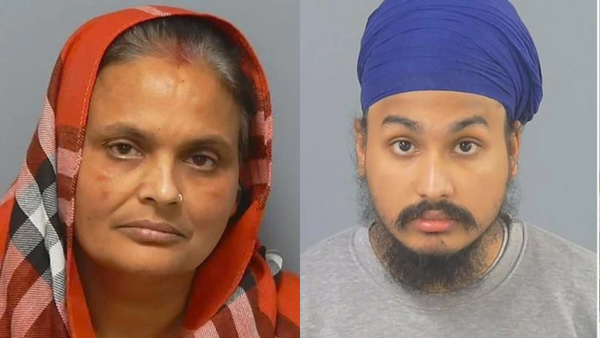
Notanauthority asks: Why is it seemingly the rule that any photo of a convicted murderer/terrorist/very bad person always has to be of them staring straight into the camera, extremely closely cropped, to make them seem like they are scarily looking straight at you, the reader.
We know murder is bad, we know the murderer is bad. Why use 1920s cinema techniques to try to create a boogeyman?
Fiona says:
More often than not these published pictures have been handed out to media by police or the authorities and so there is very little choice or room for a more expansive crop.
Politician snaps: interesting vs unflattering?
salamandertome asks: I love the way the Guardian usually selects pictures of Farage caught with his face at maximum froggy gurn. But also, perhaps that’s a bit adolescent of me? When you have someone with a face like that, it would be difficult to avoid unflattering images: and why go out of your way to show him in the best light?
Fiona says:
I think what’s difficult here is that we try to find animated images rather than just expressionless headshots simply because they are more energetic, interesting and engaging. Unfortunately for some subjects this can lead to an unflattering impression, as you say in the case of Nigel Farage, and so we have to be mindful of this and vary our approach in the interest of fairness.
How do you ensure images are real?
100suns asks: What do you do to ensure images are real? Both in terms of now-traditional manipulation techniques (how much image editing is too much?), but also now in terms of images which might be partly or completely extruded by a machine?
A stronger version of the same question is: how soon do you think you will lose the battle against machine-extruded images?
Fiona says:
Firstly our relationships with trusted photographers and agencies who hold the same ethical line as the Guardian around image manipulation is key. There is no sure way of proving an image is real or fake unless you have that trust in place. If a source can’t be proved we have to be alert to the fact that they may be AI generated images for example and these are coming across our desks with more frequency so we depend on our team to be curious, ask is this too good to be true? How can we be sure? When suspicions arise we have a verification process to follow but at the end of the day this only gives a balance of probability that an image is genuine so that trusted human relationship is more valuable than it has ever been to determine the truth.
Updated
How has digital news changed your profession?
Roger61 asks: How has the digital news agenda, where there is such inevitable churn, changed image selection compared with print? Has it made the job harder or just given you more opportunities to make an impression? And have you ever wanted to use an image but been overruled?’
Fiona says:
We work at an incredibly fast pace with digital photography these days compared to the slower form of film and print in the past. Each day we receive around 30-40,000 images in a 24 hour period and during an event like the World Cup this can double. It’s a huge daily task to sift through these for what really matters but we keep ourselves informed of the news agenda and select our edits as forensically as possible. What continues to astonish me is how often picture editors coalesce around the same images no matter where we are in the world. I think this is because our shared human nature leads us to be moved or feel the impact of a situation similarly. There is a commonality around what we find compelling.
To answer your final question, yes there have been occasions when an editor has not agreed with my preference and one instance that springs to mind when we published an image I thought we should not have: it was taken in the aftermath of the bombing of the airport in Brussels in 2016 and it showed a victim sitting in shock and some of her clothes were in such disarray the picture showed her underwear. I thought it was wrong not to consider her dignity and indeed she reported she had felt terribly embarrassed in later interviews. We should always consider the impact on the subject of what we publish.
Updated
How do you use child images responsibly?
CatherineRaynor74 asks: Do you have a policy on how you use images of children and will you be updating this in light of recent reports and warnings about AI manipulating children’s images into sexually explicit and abusive content? This is a current discussion at the moment amongst a number of children’s charities and we would be very interested to hear your take.
Fiona says:
We have a long held policy around photographing children who are the subject of our stories that we do so with parental or guardian permission and often children may be the subject of news events so appear alongside our reporting. I do share your concern however that once a photograph travels beyond our Guardian context it could conceivably fall into the hands of bad actors and I think we need to consider these perils of online publishing and be part of the conversation on best practice.
What are your iconic political photos?
ezra23 asks: As a photo editor, do you find a still image can tell a more compelling story than video footage? What are some photographs that have stuck with you and have become synonymous when you think of a politician?
Fiona says:
Yes there’s certainly a firm place for photography in our media landscape as it has a different and often more immediate impact. This is constantly played out in politics to land a message or establish character. Trump is a master of the photo opportunity, with choreographed events and fistpumping appearances that signal his style of strongman leadership. Kim Jong Un cements his dictatorship by surrounding himself with adoring crowds who are often moved to tears by being in his presence. By contrast Keir Starmer often came across as dull in photographs and this didn’t help his profile. By their very nature a political photo opportunity is a form of manipulation so we always prefer to send our own photographers but control over access is becoming increasingly restrictive. Not everything can be controlled however … for example Rishi Sunak getting soaked to the skin while making his resignation speech.
Fiona is live
Fiona is now answering your questions about news photography, the power of images, trust in the digital age and more.
Welcome to the Conversation
Join us as 3pm on Wednesday 29 July, as the Guardian’s Fiona Shields answers your questions about the art, sciences (and logistics) of covering the world through images.
Over the last few years Fiona has worked closely with photographers covering the wars in Ukraine, the Middle East and beyond; the seismic political shifts in the US and UK as well as thousands of daily events (captured brilliantly in our daily news photo galleries).
Please post your questions for Fiona now.
Sign in or create your Guardian account to join the discussion