In recent years, visitors to French churches and cathedrals may have come across Belarusian nuns selling matryoshka dolls, religious icons and honey. They come from the Saint Elisabeth Convent in Minsk and present these sales as a means of funding their charitable work. However, the convent openly supports Russia’s war in Ukraine and has taken part in collections of supplies for Russian soldiers.
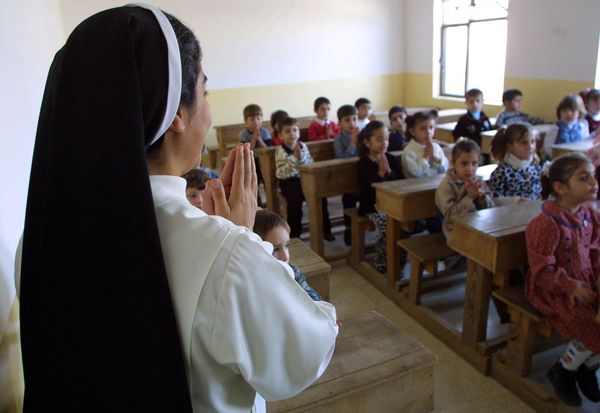
“The nuns at the convent look after orphaned children, who are usually abandoned because they have a physical or mental disability. The orphanage is home to 200 children. The sisters are involved in other social work – in particular, they look after the homeless, alcoholics and drug addicts at a shelter 30km from the convent," notes the announcement of a sale organised by the sisters of St Elisabeth’s Convent at the Sacred Heart parish in Val d’Or, central France, in July 2022.
In May 2023, the Diocese of Paris announced a similar "exhibition and sale" at the parish of Saint-Léon, featuring icons, handicrafts, honey and herbal teas. In May this year, the Belarusian nuns were selling their wares at the Celtic Orthodox Church in Saint-Dolay in Brittany.
During the summer, they ran a stall for several weeks in Les Sables-d’Olonne near Nantes on France's Atlantic coast – which was the subject of an investigation by the newspaper Ouest-France. Because since 2022, members of the convent have taken part in fundraising campaigns for the Russian army, financing vehicles and equipment.
Continent-wide network
Natallia Vassilevitch, a Belarusian theologian in exile, is the founder of the organisation Christian Vision – which has been documenting the monastery’s activities for several years.
She tells RFI the community carefully tailors its message to its audience. “On the Russian-language website, there are photos of children with automatic rifles. They know exactly who they’re addressing. They understand what can be said and what cannot be said."
She continued: "These contacts were first established [by the convent] in the late 1990s and early 2000s. [They] would simply load up a car rather haphazardly, the nuns would set off, arrive at the parishes and say hello, we’ve come from Belarus, we do good work, we help children, can we sell our goods here? At any Orthodox event, any religious festival, any Christmas market, wherever you go in Europe, the monastery sells its products."
According to Vassilevitch, over the years these nuns have built up a network across the continent. Between them, members of the convent speak several foreign languages and organisations linked to the community have been registered in Germany and Poland.
An investigation by the Belarusian media outlet Buro published in 2024 described St Elisabeth’s Convent as a veritable "Orthodox business conglomerate" around which several legal entities, dozens of retail outlets and numerous workshops are centred. Around 1,600 people are said to work in the various organisations linked to the monastery.
Vehicles and drones
The StopSEM project, set up by Christian Vision, tracks fundraising campaigns for Russian military personnel and has gathered publications from the convent and its partner groups documenting examples of these.
Some of these fundraising operations are channelled through a group called Aid to the Brothers, coordinated by the convent's Sister Alexandra, whose secular name is Liudmila Liakhova.
In 2023, Christian Vision identified at least seven vehicles whose purchase had been financed in whole or in part with the help of the convent's network, and which were intended for the transport of military personnel and the evacuation of the wounded. Drones were also supplied.
When questioned about these purchases at the time by Vot Tak, an independent, Russian-language media outlet operated by Poland's public broadcaster, Sister Alexandra confirmed that her group was assisting the military by purchasing requested equipment.
According to Vassilevitch, however, the convent's involvement goes beyond sending supplies. She reports that vulnerable men, notably former prisoners, are being encouraged by it to join the Russian army.
"They tell them these stories with great enthusiasm: look, our brother went off to fight, he died over there and became a hero, whereas he could have been a homeless alcoholic who died in a gutter."
A priest decorated by Putin
The convent's spiritual father, Archpriest Andrei Lemeshonok, has since 2022 made numerous statements justifying the Russian invasion. In May 2025, he declared that the convent itself was now “a combat unit”.
On 4 November, 2025, Lemeshonok was received at the Kremlin and presented by Vladimir Putin with the Pushkin Medal, a Russian state honour awarded, according to the presidential decree, for his contribution to the preservation and promotion of the Russian language and culture abroad.
During the ceremony, Lemeshonok thanked the Russian president for “the hope” he had restored to the people, comparing his commitment to a journey towards Golgotha, the hill outside Jerusalem where Jesus Christ was crucified according to the Christian gospels.
This ideological affinity was nothing new. During the 2020 mass protests against Belarus's President Alexander Lukashenko, Lemeshonok took a stand in favour of the Belarusian authorities. In January 2023, Lukashenko himself visited Saint Elisabeth's, where he too publicly defended his support for Russians fighting in the war.
Question over visas
Despite this, representatives from the convent continue to make fundraising trips to France.
In Les Sables-d’Olonne, Father Antoine Nouwavi, head of the parish, explained to Ouest-France that he had refused to welcome the nuns in 2023 and 2024 after discovering the allegations against their convent.
He finally agreed to their return after receiving a letter from the Mother Superior of Saint Elisabeth stating that reports of her support for the war were false and that the money raised in France was intended exclusively for charitable causes.
The priest acknowledged, however, that he did not have the means to verify the final destination of the funds raised.
Christian Vision says it has alerted church leaders in France to the group's activities. According to Vassilevitch, the number of communities willing to welcome the nuns has since fallen.
Other European countries have taken a stricter approach. In Sweden, the Church last year officially recommended that its parishes no longer host the nuns of Saint Elisabeth. Their stalls have also been banned or closed down in Poland, the United Kingdom and Switzerland. In Germany, a member of the Bundestag has called for an investigation into their activities.
Vassilevitch raises the issue of visas being granted, given that it is currently difficult for Belarusians to obtain a Schengen visa.
"The question is, why? Why does no one check, when they cross the border, what they are carrying, or whether the use being made of these visas actually corresponds to the reason they were issued, given the various threats Europe is currently facing?"
When asked by RFI about the presence and activities in France of representatives from the Convent of Saint Elisabeth, the French Ministry of Foreign Affairs replied that it had “no information to provide on this matter”.
This article has been adapted from the original version in French by Anya Stroganova.