
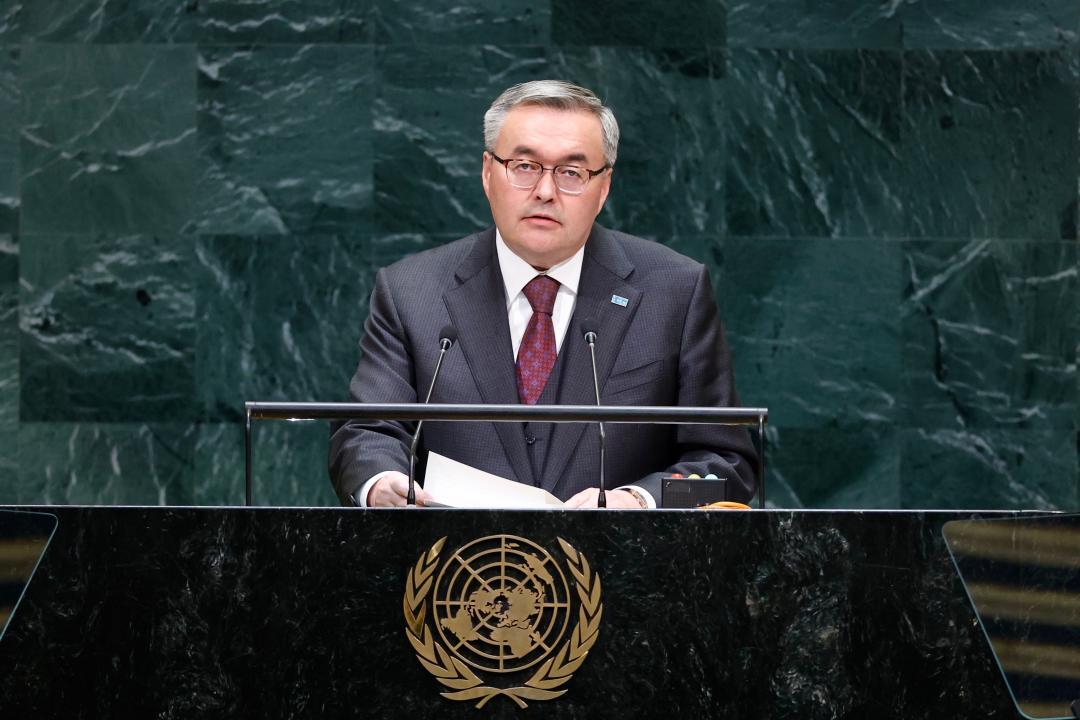
The speeches at this year’s UN General Debate are over. The disputes they exposed, including over war, international law and the UN’s ability to act, are not. Rivalry among major powers continues to constrain the Security Council, while other states live with the consequences. Middle powers cannot resolve those rivalries alone, but they can keep diplomatic channels open and help build practical cooperation. Kazakhstan’s approach to UN reform deserves a closer look for that reason.
In his September 25 address to the UN General Assembly, Kazakhstan’s foreign minister, Mukhtar Tileuberdi, called for broader Security Council representation and greater influence for middle powers. He also argued that reform should be judged by the organization’s ability to prevent conflict and deliver results. The UN remains indispensable as a forum where adversaries can engage under common rules. Washington should take this agenda seriously, while distinguishing between proposals that improve cooperation and those that merely create additional bureaucracy.
Kazakhstan is a useful case study because its commitment to multilateralism has a strategic logic. It shares borders with Russia and China while seeking investment, trade and political relationships with the United States and Europe. Predictable rules and functioning diplomatic channels help preserve its room to maneuver.
That logic informs President Kassym-Jomart Tokayev’s proposals for stronger representation for Asia, Africa and Latin America, alongside a greater voice for developing countries and responsible middle powers. The Security Council’s permanent membership still reflects the settlement of 1945; Africa and Latin America have no permanent seats. But adding seats would not, by itself, resolve veto-driven paralysis. Expansion requires a Charter amendment ratified by all five permanent members, making agreement difficult.
A practical reform agenda therefore needs measures that can advance while membership negotiations continue. Elected members should have greater opportunities to draft resolutions, shape priorities and bring regional knowledge into deliberations. During its 2017–2018 Council term, Kazakhstan prioritized Afghanistan and nuclear non-proliferation. Its experience illustrates why states closest to a problem can help identify consequences and options that larger powers might overlook.
Diplomatic convening offers another contribution. Kazakhstan hosted direct talks between the Armenian and Azerbaijani foreign ministers in Almaty in May 2024. The following year, their leaders signed a joint declaration in Washington, where their foreign ministers initialed a peace agreement. The Almaty talks were one part of a broader process, providing a channel for direct engagement. For Washington, this illustrates how partners’ convening efforts can complement American diplomacy.
Kazakhstan could offer a similar platform for Russia–Ukraine negotiations if both parties accepted it. Its ties with Moscow provide access. A useful role would depend on Ukraine’s consent, respect for sovereignty and territorial integrity, and coordination with other diplomatic efforts. Providing a venue cannot overcome incompatible objectives or guarantee a settlement. It can, however, help keep communication possible when official relationships are strained.
Meanwhile, nuclear risks are again rising. The standoff over Iran’s nuclear program, the expiration of New START, and the failure of the 2026 Nuclear Non-Proliferation Treaty Review Conference to produce a substantive outcome all point to a deteriorating nuclear security environment. Against that backdrop, Tileuberdi offered to host renewed dialogue among nuclear powers. Such talks could reopen channels on arms control. Kazakhstan’s nuclear history lends weight to the offer: it closed the Semipalatinsk nuclear test site in 1991 and subsequently relinquished the world’s fourth-largest nuclear arsenal, inherited after independence.
The same focus on practical outcomes should guide institutional reform. Member states should support the UN80 reform effort, which seeks to improve the UN’s efficiency, coordination and delivery. Reducing duplicated mandates and strengthening financial discipline are necessary, but savings should be assessed alongside operational results. Faster crisis responses and more effective prevention would justify reform more convincingly than an organizational reshuffle. Member states must also fund the mandates they approve.
Central Asia offers a concrete example. The UN Regional Centre for the Sustainable Development Goals for Central Asia and Afghanistan,approved in 2025 and based in Almaty, will bring UN expertise closer to a region whose economic, environmental and security challenges cross national borders. By supporting coordination and implementation across Central Asia and Afghanistan, the Center can complement wider UN reform efforts with a more regionally focused approach.
For Washington, a UN that draws more effectively on middle powers gives American diplomacy more options. Kazakhstan has brought Central Asian concerns to the Security Council and provided a venue for adversaries to talk. The United States and other major powers must still make the hard decisions on war and arms control. But they need capable partners to help create the conditions for progress. Washington should pursue a more representative Council while working with those partners now.














