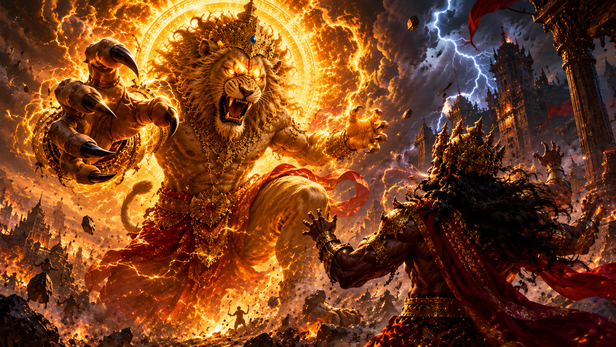
Among the countless “what if” questions hidden within Hindu mythology, few create as much awe, fear, and devotional curiosity as imagining Ravana facing not Lord Ram, but the terrifying Narasimha Avatar of Lord Vishnu. The very thought feels overwhelming. On one side stands Ravana, the mighty king of Lanka, master of the Vedas, devotee of Lord Shiva, conqueror of worlds, and one of the most powerful beings described in the Ramayana. On the other side stands Narasimha, the fierce half lion, half man incarnation of Vishnu whose divine rage shook the universe itself after the destruction of Hiranyakashipu.
When devotees imagine these two cosmic forces colliding, the question becomes emotionally and spiritually explosive. Would Ravana’s intelligence and power survive even for a moment before Narasimha’s unstoppable fury? Could Lanka itself withstand the terrifying energy of the Ugra Narasimha form? And perhaps most importantly, why did Vishnu choose the calm, disciplined, and dharmic form of Lord Ram to defeat Ravana instead of the terrifying Narasimha Avatar? The answers reveal profound truths about dharma, divine purpose, and the deeper meaning hidden within Vishnu’s avatars.