Get all your news in one place.
100's of premium titles.
One app.
Start reading
Cycling News
Cycling News
Sport
Paul Norman

What does it take to kit out a WorldTour cycling team? We go behind-the-scenes on EF Pro Cycling's wind tunnel testing

Assos/EF Education wind tunnel testing.

Aerodynamic advantage has become a key cycling battleground and not a week goes by without a new bike or wheelset being announced that’s X watts faster. But alongside aero equipment development, there’s a parallel arms race in aero optimisation of riders' clothing.

Since the rider, not the bike, represents around 80% of the total frontal area, drag reduction in clothing design is arguably more significant. At the same time, it’s harder to quantify and optimise. While the bike and wheels are rigid structures, riders move around on the bike, and each rider moves around and sits differently, so the fastest clothing for one rider could be the slowest for another; it's highly personal.

Assos and EF Pro Cycling granted Cyclingnews exclusive access as they wind tunnel tested Assos’s race clothing and explained how they’re working to develop the most efficient clothing for EF’s riders, the complexity involved and how different race kits suit different riders and situations.

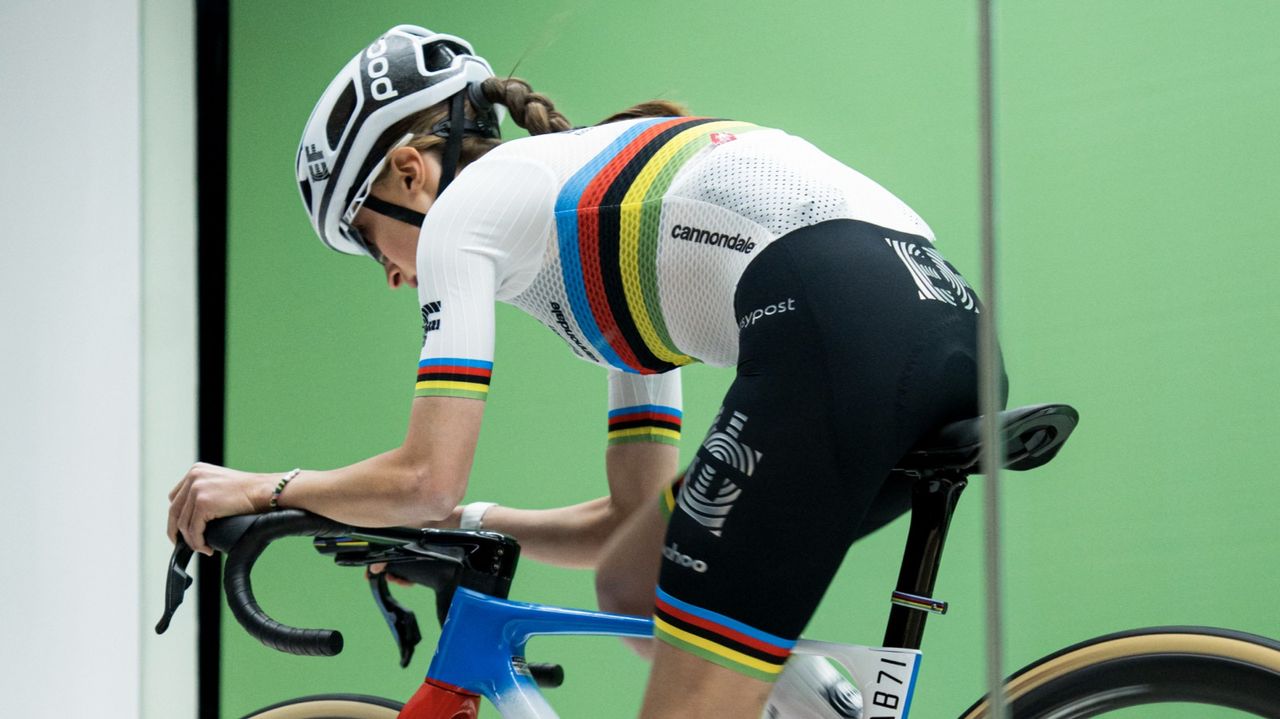
Cyclingnews followed as Assos, EF Pro Cycling and their partners tested a range of skinsuits and other clothing at the Flanders Bike Valley wind tunnel in Belgium, with star riders in the men's and women’s teams in late April 2026, ahead of the year’s major stage races.

Our paying subscribers helped to fund this in-depth tech content. To ensure we can continue providing world-class cycling journalism, support Cyclingnews by subscribing today.{kiosq_button:center}

More than a dozen speedsuits

Assos supplies EF Pro Cycling riders with multiple speedsuits adapted for different conditions and roles during a race (Image credit: Assos)

Between its men’s, women’s and development teams, EF Pro Cycling’s roster exceeds 60 riders. That’s a lot of pro cyclists to equip for the team’s list of sponsors, which, as of the start of 2026, includes Swiss clothing brand Assos after its high-profile move away from Rapha.

It’s not just the sheer volume of clothing needed for 60-plus riders that’s impressive; it’s the amount of detailed analysis required to develop cutting-edge kit for the pros. Between Assos, EF Pro Cycling and other staff and riders, around 20 people were involved in the multiple days of wind tunnel testing.

Races are now invariably ridden in one-piece speedsuits to optimise the rider’s aerodynamics, and these need to be fitted precisely to individual riders. Assos employs a team of seamstresses at its factory in Switzerland to tailor its speedsuits to the exact measurements of each rider.

There’s not just one speedsuit for all conditions, either. Assos has over a dozen options for different conditions, and it issues multiple suits to each rider.

Luca Zanasca, Assos’s Senior Manager of R&D and Innovation, explains that different speedsuits are optimal, depending on the race conditions and the role or tactics of the rider wearing it.

The same speedsuit may produce significantly different drag figures when worn by different riders (Image credit: Assos)

EF Education-Oatly’s Cédrine Kerbaol told Cyclingnews that Assos supplied multiple different skinsuits to the team's riders. Which to choose for a race day was determined by her and EF Education-Oatly’s performance team, depending on factors such as the weather, race speed and her role during the race.

Alongside wind tunnel testing, Assos also tests its speedsuits in the climate chamber at Flanders Bike Valley, measuring riders’ core and skin temperature. The climate chamber can be set to temperatures from 16 to 32°C and humidity levels between 75% and 80%, to confirm how effective a speedsuit will be for hot or cooler races.

Have you read the latest tests from Cyclingnews Labs?

(Image credit: Future)

A climber such as Richard Carapaz might choose Assos’s lightest speedsuit, which is also more suitable for very hot days. Assos’s wind tunnel and track testing shows that it’s not as aero as its fastest road speedsuit though.

There’s another speedsuit that Assos recommends to EF Pro Cycling riders for fast races, breakaways and sprinters, while there’s an even more aerodynamic speedsuit available for the Classics.

Assos’s fastest time trial suit is saved for the cream of its riders who specialise in that discipline, including Kerbaol, who was French national champion in the discipline in 2023 and again in 2025 and GC hopefuls such as Noemi Rüegg who won the Tour Down Under for a second time in succession at the start of 2026.

It gets even more complex, as Zanasca explains that the textiles used for its skinsuits differ between men’s and women’s versions. The average speed in a women’s race is lower than in a men’s race, and female riders are in general of smaller stature.

To take a concrete example, the Liege-Bastogne-Liege men’s race, which was run the week before Assos’s wind tunnel testing, was won by Tadej Pogačar at an average of over 44km/h, whereas Demi Vollering won the women’s race at around 37km/h.

Assos also adjusts the cut of women’s speedsuits, moving the seam at the waistband upwards, so it doesn’t sit over the rider’s hips, where it might cause irritation. It has positioned its pockets lower down at the rear, overlapping with the shorts part of the speedsuit to reduce their impact on drag.

Different results for different riders

Testing is resource-intensive, with multiple days in the wind tunnel and more still in the Flanders Bike Valley climate chamber (Image credit: Assos)

A speedsuit doesn’t perform equally for all riders, which is why EF Pro Cycling and Assos had booked the Flanders Bike Valley wind tunnel for multiple days to test the different options with the team’s elite men and women riders.

First to be tested was Kerbaol, who the following week broke away in the finale to win stage 3 of the Vuelta Feminina. She was followed by Rüegg, 2026 Women’s World Champion Magdeleine Vallieres, and a selection of EF Education–EasyPost’s elite men’s team riders.

Each was tested with a range of road and time trial speedsuits and accessories, including overshoes, during multiple wind tunnel runs at a variety of airspeeds, with the drag figures displayed on a large screen in the corner of the wind tunnel control room. Time trial suits were tested at higher wind speeds and a lower yaw angle (the angle of the wind as it hits the rider) than road speedsuits.

Kerbaol spent over four hours in the wind tunnel testing different Assos kit (Image credit: Assos)

By the end of her testing at 1:30 pm, Kerbaol had been in the wind tunnel for multiple runs for over four hours. Elite time trialists can typically hold their position with just 1% to 1.5% variation in drag, but by this time Kerbaol’s drag figure was varying by 4%, suggesting that she was becoming tired. Holding a time trial position can be difficult even for elite riders.

Comparing Kerbaol’s wind tunnel results to other elite riders, Assos found that the same speedsuit could produce drag figures relative to baseline that were up to 8 watts different.

Alongside its current speedsuit range, Assos also tested prototypes for new designs. Zanasca explains that Assos works with its technical fabric supplier and the team to select the optimum fabrics for its future skinsuit designs, which it was testing with EF Pro Cycling’s riders for the first time.

Again, there was variation between riders, with different degrees of drag reduction relative to the baseline speedsuit.

It’s not just wind speed which affects drag; the rider’s position on the bike and the interaction with the helmet can have a significant impact on the results, which is why testing individual riders is important to ensure they choose the best speedsuit for them.

On the other hand, it's very resource-intensive, which is why EF Pro Cycling only tested its top riders.

Multiple options for poor weather

It’s not just warm weather performance that’s important. Particularly in the early season, race conditions can be wet and cold.

Assos provides EF Pro Cycling riders with not one, but three different shell layers: its Equipe RS Schlosshund lightweight rain jacket, Mille GTS Sturmprinz rain jacket that’s more robust and the Equipe R Thermo short-sleeved rain jersey. Between them, they give riders the option to layer up for the worst conditions or to choose thinner layers for rain protection when it’s warmer.

Shell jackets are significantly more draggy than a speedsuit though, so Assos is working on improving the aerodynamics of its poor weather gear.

Add to that training kit for warmer and colder conditions, including bib shorts, jerseys, tights and accessories, as well as branded off-bike clothing, and equipping the EF Pro Cycling squad is a substantial commitment.

Zanasca won’t provide details, but equipping a complete pro team with a full range of cutting-edge clothing, along with the R&D needed to develop and test new designs, clearly takes considerable resources.

Subscribe to Cyclingnews to unlock unlimited access to more in-depth tech features like this, plus our comprehensive race reporting, industry-leading Cyclingnews Labs tests, and much more.

{kiosq_button:center}

Sign up to read this article
Read news from 100's of titles, curated specifically for you.
Already a member? Sign in here
Related Stories
Top stories on inkl right now
One subscription that gives you access to news from hundreds of sites
Already a member? Sign in here
Our Picks
Fourteen days free
Download the app
One app. One membership.
100+ trusted global sources.