
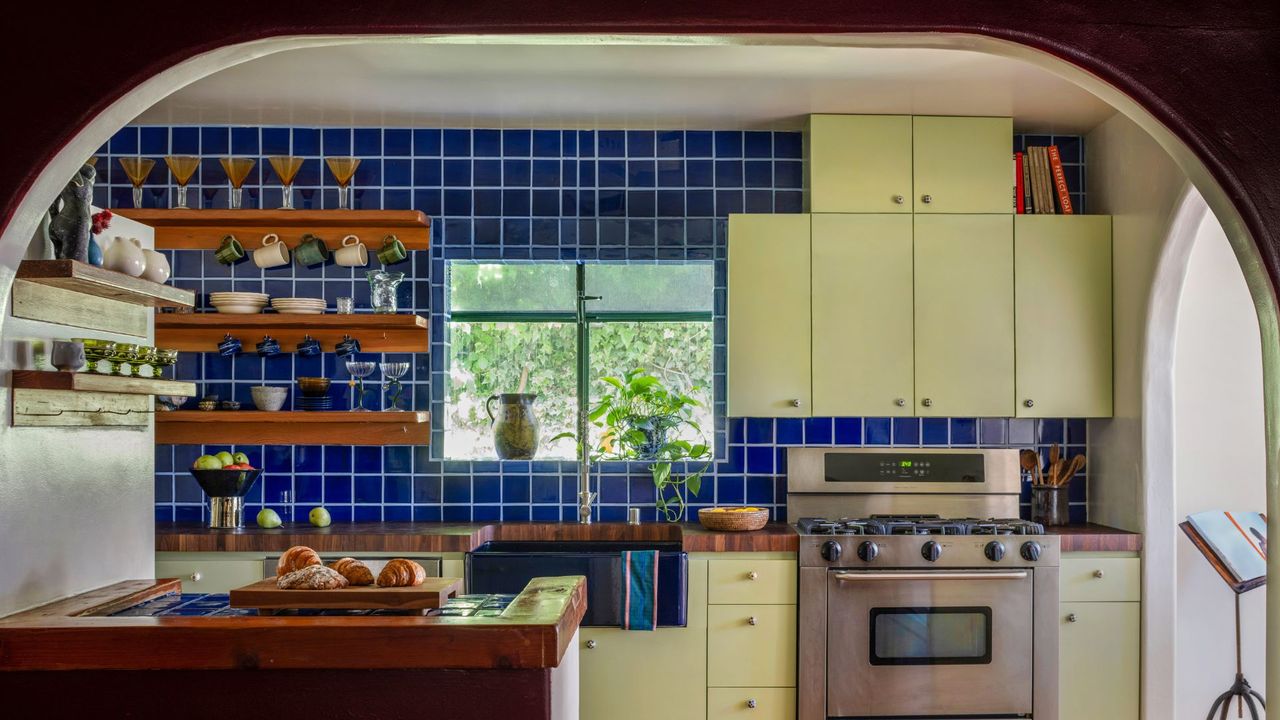
When you think of blue, you might immediately link it to the element of water. On the surface, it feels soothing, bringing in a calm energy that most people desire in their spaces. However, these Feng Shui experts tell me that blue actually has a much more complex personality, and it pays to know it when decorating your home.
First of all, understanding the bigger context that blue holds, as per the principles of Feng Shui, can actually help you identify the most compatible spaces in your home — and where is best to use it. It'll help make intentionally decorating with blue far easier while also improving the overall energy of your space.

So, let's take a look at what blue represents in Feng Shui and how you can use it to your advantage. Here's what you need to know.
What Does Blue Represent in Feng Shui?

Maxine McKenzie, co-founder of Yinteriors, tells me that blue might seem like one of the easiest colors to understand in Feng Shui, but that's not necessarily the case. "We tend to assume it represents water — calm, flow, serenity — but the reality is more layered," she explains. "In Feng Shui, color isn’t interpreted in isolation. Tone, intensity, and placement all change how a color behaves within a space."
"Deeper shades of blue are associated with the water element," Maxine continues. "Darker colors are considered more yin in nature, and water energy is linked with depth, reflection, creativity, and flow. It supports thinking, learning, and emotional sensitivity, which is why deep blues often evoke a naturally contemplative feeling."
However, she adds that not all blues carry the same energetic quality. "Pale or pastel blues sit closer to the metal element, which is connected to clarity, structure, systems, and organization," she says. "This is one of the reasons lighter blues often feel crisp and ordered rather than immersive or introspective."

Feng Shui expert Anjie Cho tells me that symbolically, blues are connected with the sky and the heavens. "Sapphire and indigo blues evoke a sense of mystery and wonder. Plus, they are connected to meditation and spiritual growth in Feng Shui," she says.
"Linked to the element of wood, mid-tone blues and teals embody energy, innovation, and spark new beginnings," she adds. "Meanwhile, brighter blues can help you get motivated and moving."
As you can tell, the way you use blue can drastically change the energy of a space. So, I recommend booking a Feng Shui color reading to truly help you identify your power blues and how to use them for best results.
How Is Blue Linked to the Bagua Map?

According to the bagua, also known as the Feng Shui map, Maxine McKenzie explains that blue appears in more than one place depending on the shade. "For example, deep blue is linked to the 'knowledge and self-cultivation' area, located towards the front left of the home," she shares.
"This area relates not just to learning or career skills, but to self-awareness, reflection, and personal growth, which aligns naturally with the inward, thoughtful quality of darker blues," she adds.
Next, she tells me that blue-green tones, such as teal, connect to the 'prosperity and abundance' area in the back-left of the home. "This part of the bagua is associated with growth and expansion," she explains. "Since water supports growth in Feng Shui theory, colors that sit between blue and green symbolize ideas, opportunities, and momentum developing over time."
How to Use Blue in Feng Shui?

When it comes to injecting your home with splashes of blue in accordance with Feng Shui, Maxine tells me that it's best to break it down by a tonal range. "Deep blues, connected to water, help balance spaces that feel overstimulating or energetically 'hot'. During a dynamic year such as the year of the fire horse, introducing water tones can help offset feelings of overwhelm or burnout," she advises.
"Think dark blue cushions, throws, or rugs, or even functional objects like cobalt glassware or a water jug," she adds. "These additions cool a room energetically while encouraging reflection and mental reset."
Anjie says she often recommends deep blues to clients who want to create a space that caters to personal growth. "I'd use deep blues in rooms for reading, meditation, journaling, and yoga," she says. "In the case of brighter blues, these colors can lift stale and stagnant energy in any room. "

If you're not drawn to a moody, deep blue, Maxine tells me that lighter blues can also be a good option. "They bring in the organizing quality of metal energy, making them particularly useful in spaces that benefit from clarity and efficiency," she explains. "Home offices, studios, and utility spaces are good areas for pale blue accessories, storage elements, or decorative accents to reinforce focus and structure."
Let's say you wish to go even lighter and brighter by decorating with teal. "This shade can be used to support growth and forward movement, particularly in the back left area of the home when aligned with the bagua’s 'prosperity' zone," notes Maxine.
"Plant pots are an easy way to introduce this color, as combining teal containers with living Feng Shui plants symbolically strengthens both growth and flow," she adds. "More broadly, teal works well anywhere you want ideas, projects, or ambitions to feel supported and in motion."
This Scalloped Edge Square Cushion channels a deep blue that would look beautiful in your living room.
Why stop there when you can layer it in with this Linange Washed Linen Throw from La Redoute?
This Jochen Holz Glass Jug has been on my wishlist for some time, and now it's Feng Shui-approved.
Since teal planters are in, this Elora Ceramic Planter from West Elm should be on your radar.
I'm obsessed with this Boden Vinyl Storage Table. Plus, you can use it to organize your manifestation diaries and junk journals.
This set of cups from H&M is a great way to subtly channel blue while playing into the element of water.
"In Feng Shui, if you’re attracted to the color blue, you may have a lot of wood element in your personality," says Anjie. "Or it may indicate there’s a longing for this kind of expression in your life."
Eitherway, you'll now be able to infuse blue into your home's color palette with confidence. And if you're confused about supportive shades, it's worth reading up on which colors go with blue, best.