Get all your news in one place.
100's of premium titles.
One app.
Start reading
MyLifeXP
MyLifeXP
Noopur Kumari

What Did the Sage See Inside a Tiny Banyan Seed?

A sage once asked his young son to break open a tiny banyan seed. The boy looked inside and said that he could see almost nothing. Then came a question that would lead him towards one of the deepest ideas in Indian philosophy: if you cannot see what is inside the seed, how does a gigantic banyan tree emerge from it? The lesson was not really about the tree. It was about something far more difficult to see: the invisible essence behind life itself. Through a seed, honey, rivers and a dying tree, the sage slowly revealed one powerful truth: Tat Tvam Asi, “That Thou Art.”

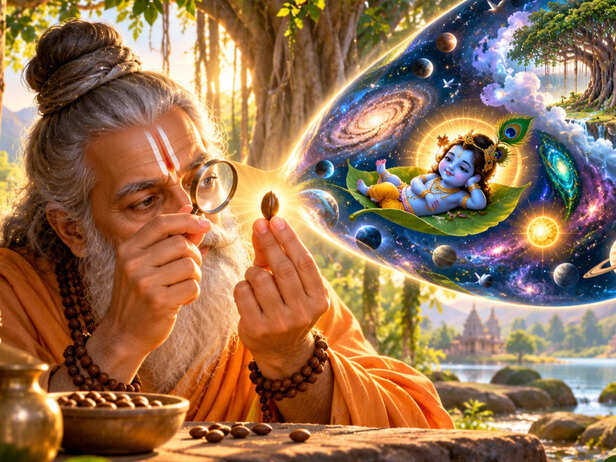
The Tiny Banyan Seed

Uddalaka Shows Shvetaketu the Banyan Seed
The sage uses a tiny banyan seed to reveal an invisible source of life.

When Shvetaketu returns home after years of learning, his father Uddalaka begins teaching him in a completely different way. He asks his son to bring a banyan fruit and break it open. Inside are tiny seeds. Uddalaka then asks him to break one of those seeds. Shvetaketu does so and says that there is practically nothing visible inside. The sage points to precisely that emptiness. Something invisible lies within the seed, yet from it can emerge an enormous banyan tree. The lesson is simple but profound: not everything real can be detected by the eyes.

The Invisible Source

Banyan Seed Growing Into a Vast Tree
The hidden potential inside a tiny seed becomes a symbol of the unseen essence of life.

The seed becomes a powerful metaphor for existence. Shvetaketu cannot see the force that allows the seed to become a tree, but the absence of visibility does not mean the essence is absent. Uddalaka uses this example to explain that the deepest reality behind life may also remain beyond ordinary perception. We see bodies, objects and individual identities, but the Upanishadic teaching asks us to look deeper. What is the invisible principle that makes life possible? This shift, from what the eyes can see to what understanding can grasp, is where Shvetaketu’s real education begins.

Honey From Many Flowers

Uddalaka then gives Shvetaketu another example. Bees collect nectar from countless flowers, each different in colour, shape and fragrance. Yet once the nectar becomes honey, it is no longer possible to identify which particular drop came from which flower. The individual sources have merged into something unified. The teaching points towards the idea that individual identities may appear separate while belonging to a deeper reality. We constantly define ourselves by names, roles and experiences, but the Upanishadic question is whether these differences represent the whole truth. Perhaps what appears separate on the surface has a deeper connection underneath.

Rivers Lose Their Names

The river becomes another striking comparison. A river may begin in a completely different place from another river and carry its own name for much of its journey. But when rivers finally enter the ocean, their separate identities disappear into the vastness of the water. Uddalaka uses this image to explain the relationship between individual existence and the ultimate reality. The point is not that individuality simply becomes meaningless. Rather, the teaching asks us to recognise that our individual existence may be connected to something much larger than ourselves. What looks separate may ultimately belong to one underlying reality.

What Happens at Death?

Uddalaka takes the lesson further by asking Shvetaketu to understand what happens when life leaves the body. In the traditional teaching, speech is said to merge into the mind, the mind into the vital force, and the vital force into the subtle essence. These descriptions are philosophical, not a scientific explanation of death. The deeper point is that the visible expressions of a person are not considered the whole of existence. The body changes and eventually dies, but the Upanishadic teaching directs attention towards the Atman, the deeper self that is understood as connected with ultimate reality.

Tat Tvam Asi

After using one example after another, Uddalaka arrives at the central teaching: “Tat Tvam Asi.” The phrase is commonly translated as “That Thou Art” or “You are That.” Here, “That” refers to the ultimate reality discussed in the teaching, while “you” points towards the deeper self, or Atman. The statement is not simply saying that a person is physically identical to everything around them. It is a philosophical teaching about the relationship between the individual self and ultimate reality. Shvetaketu is being asked to recognise that his deepest identity goes beyond his visible body and changing personality.

The Lesson for Us

The power of this story lies in how ordinary its examples are. A seed, a bee, honey, a river and a tree become doors to a much bigger question: Who are we beneath everything that can change? We often identify ourselves through our work, relationships, appearance and achievements. Yet all of these can change with time. The teaching of Tat Tvam Asi asks us to look deeper. It does not offer a quick answer but an invitation to reflect. Perhaps that is why this ancient dialogue still feels surprisingly relevant: it asks a question that success, wealth or knowledge alone cannot settle.

The Truth Behind the Story

The banyan seed cannot show Shvetaketu the entire tree, yet the tree's potential is already there. In the same way, the Upanishadic teaching says that the deepest truth of existence may not always be visible to the senses. Tat Tvam Asi becomes the final reminder that what we are searching for outside may also require us to look within. The story is not merely about a father teaching his son. It is about a human being slowly moving from curiosity to self-inquiry. And perhaps its most powerful message is this: you are more than everything that can be seen, named and measured.

Sign up to read this article
Read news from 100's of titles, curated specifically for you.
Already a member? Sign in here
Related Stories
Top stories on inkl right now
One subscription that gives you access to news from hundreds of sites
Already a member? Sign in here
Our Picks
Fourteen days free
Download the app
One app. One membership.
100+ trusted global sources.


