
Get all your news in one place.
100’s of premium titles.
One app.
Start reading
Tom’s Hardware
Tom’s Hardware
Technology
Anton Shilov

Western Digital doubles the performance of hard drives with dual-actuator High-Bandwidth, with path to 8X performance increase — Power-Optimized HDDs will reduce power by 20 percent

(Image credit: Tom's Hardware)

Although NAND memory has replaced traditional hard disk drives in the vast majority of client PCs, HDDs can still offer capacities at costs not achievable by solid-state drives today, particularly in the data center space. In a bid to retain the relevance of hard drives for years to come, Western Digital on Tuesday announced two distinct families of HDDs: one aimed at applications that require maximum performance and decent IOPS-per-TB, another designed for power-optimized applications that value limited power consumption and predictable performance.

High-Bandwidth HDD

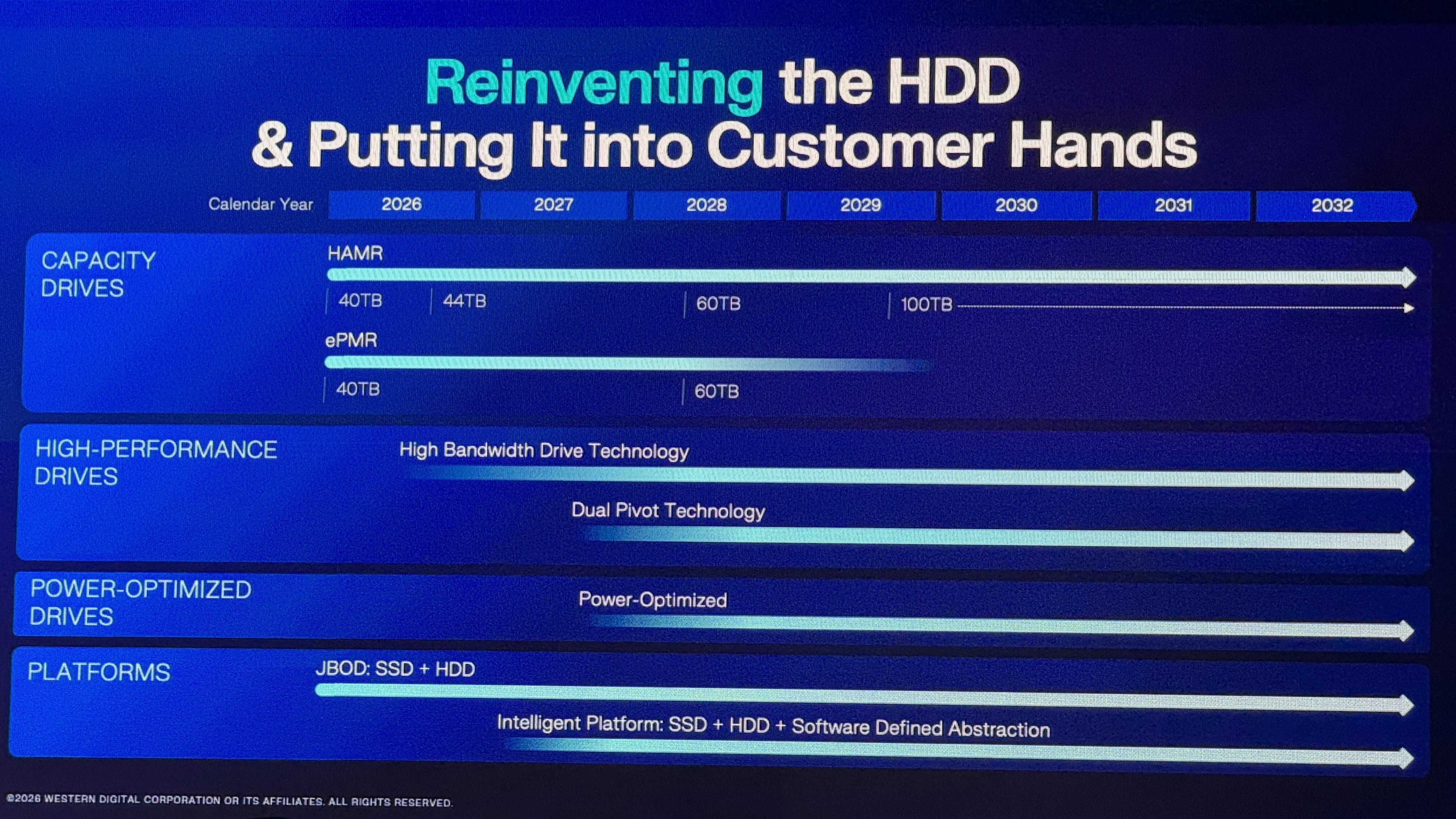
The whole concept of Western Digital's High-Bandwidth HDD stems from reading data from the media using more than one head and transferring it to one or two hosts. The company showcases two types of High-Bandwidth HDDs at its Innovation Day: one uses more than one head for reading and writing at the same time to achieve 2X bandwidth compared to conventional HDDs, and another one features a second fully independent actuator to achieve 2X bandwidth and 2X sequential I/O performance. Over time, High-Bandwidth HDDs are projected to scale up bandwidth by eight times and I/O by four times when both approaches are combined within a single HDD.

(Image credit: Western Digital)

WD's original dual-actuator High-Bandwidth HDD architecture — which is already being validated by the company's clients — allows multiple heads on multiple tracks to read and write simultaneously, thus exploiting internal parallelism to deliver 2X bandwidth of traditional 3.5-inch HDDs.

The next step for Western Digital is its Dual-Pivot High-Bandwidth HDD architecture is to add a second, fully independent actuator on a separate pivot inside the same 3.5-inch drive. Each actuator controls its own set of heads and enables two independent read/write operations at once, thus delivering up to 2X sequential I/O performance without reducing capacity. Dual-Pivot HDDs are currently in the lab and are targeted to become available in 2028. Over time, the two architectures will be combined to deliver 4X higher I/O performance compared to traditional hard drives.

Power-Optimized HDDs

In addition to offering High-Bandwidth drives for performance-demanding applications, Western Digital is also working on Power-Optimized HDDs that reduce power consumption by 20% for 'active cold' storage tier.

Western Digital positions Power-Optimized HDDs for 'active cold' storage tier for AI workloads that generate massive volumes of data — such as datasets, checkpoints, and logs — which must remain quickly accessible (which rules out tape), but cannot be stored on traditional high-capacity HDDs or SSDs due to cost concerns.

The company says that these power-optimized 3.5-inch HDDs use a 'minimal random IO' for 20% less power than conventional drives, which reduces ownership costs and makes 'active cold' storage cheaper to run. WD expects the first power-optimized HDDs to enter customer qualification in 2027.

Competing with QLC-based SSDs

Although High-Bandwidth and Power Optimized HDDs serve completely different purposes, they are paradoxically designed to rival the wide product category — data center-grade 3D QLC NAND-based SSDs. Such drives can offer storage density and performance that cannot be achieved by modern HDDs. However, by tailoring features and performance of hard disk drives for particular applications, Western Digital believes it can offer better value than QLC NAND-based SSDs.

Follow Tom's Hardware on Google News, or add us as a preferred source, to get our latest news, analysis, & reviews in your feeds.

Sign up to read this article
Read news from 100’s of titles, curated specifically for you.
Already a member? Sign in here
Related Stories
Top stories on inkl right now
One subscription that gives you access to news from hundreds of sites
Already a member? Sign in here
Our Picks
Fourteen days free
Download the app
One app. One membership.
100+ trusted global sources.