Get all your news in one place.
100's of premium titles.
One app.
Start reading
The Conversation
The Conversation
Jennifer Raynor, Assistant Professor of Natural Resource Economics, University of Wisconsin-Madison

We tracked illegal fishing in marine protected areas – satellites and AI show most bans are respected, and could help enforce future ones

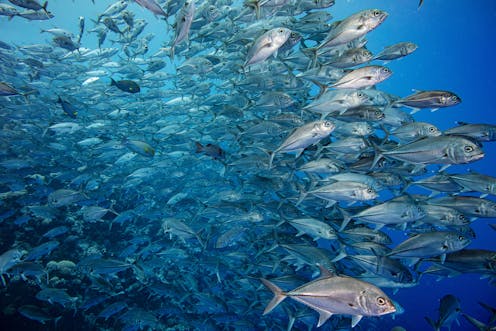
A school of bigeye trevally swims near Bikar Atoll. Enric Sala/National Geographic Pristine Seas

Marine protected areas cover more than 8% of the world’s oceans today, but they can get a bad rap as being protected on paper only.

While the name invokes safe havens for fish, whales and other sea life, these areas can be hard to monitor. High-profile violations, such as recent fishing fleet incursions near the Galapagos Islands and ships that “go dark” by turning off their tracking devices, have fueled concerns about just how much poaching is going undetected.

Sign up to read this article
Read news from 100's of titles, curated specifically for you.
Already a member? Sign in here
Related Stories
Top stories on inkl right now
One subscription that gives you access to news from hundreds of sites
Already a member? Sign in here
Our Picks
Fourteen days free
Download the app
One app. One membership.
100+ trusted global sources.