
Get all your news in one place.
100’s of premium titles.
One app.
Start reading
Digital Camera World
Dan Mold

We need to talk about Canon's Digic Accelerator – it's NOT going to trickle down from the EOS R1 and R5 Mark II

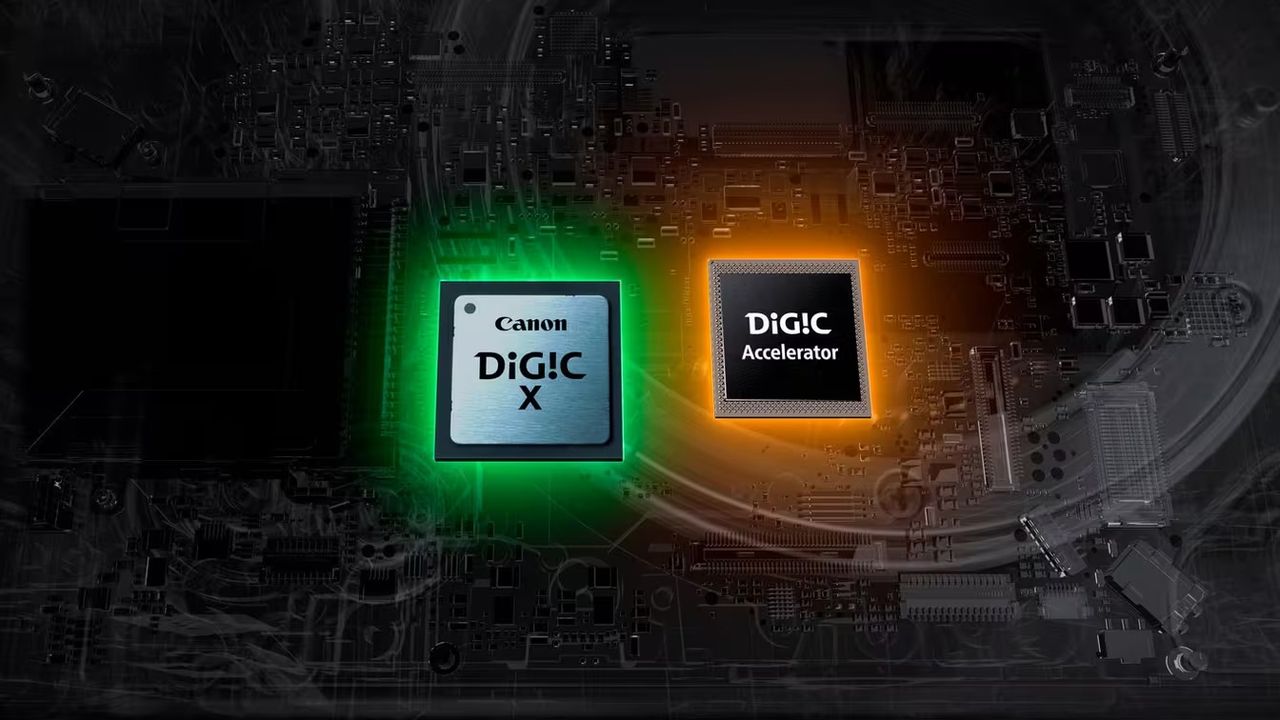
A press shot from Canon showing the inside view of a Canon camera where the Digic X and Digic Accelerator can be seen highlighted with a green and orange glow.

As a photographic journalist, from time to time I have the privilege of visiting Canon's headquarters in London. It's always an opportunity to see the latest equipment, talk to the Canon team and see what's happening with the company's camera lineup.

I’d been under the impression that Canon’s innovative Action Priority (a predictive autofocus feature for photographing sport) could possibly trickle down to cameras below the EOS R5 Mark II, so my eyes were firmly fixed on the Canon EOS R6 Mark III when it launched recently.

I don’t think there’s any question that Canon’s latest full-frame prosumer camera could be one of the best hybrid cameras in terms of sheer value for money. However, we now know that Digic Accelerator – the clever tech that powers advanced AF functions – has been left on the cutting room floor. But does it even matter?

To answer that, let's first take a look at what Digic Accelerator actually is. In a nutshell, it’s a secondary processor that dedicates extra bandwidth to a range of AI algorithms that Canon’s standard Digic X processor alone would struggle to deal with.

These tasks include Action Priority (for enhanced autofocus tracking for soccer, basketball and volleyball) but also assists with AI noise reduction and in-camera image upscaling. It can also help with data transfer to reduce rolling shutter, too.

All that being said, the R6 Mark III is a formidable camera and doesn’t seem to be too hamstrung by omitting that second processor – which would have inevitably driven the price up. So I actually think Canon has made a clever business decision to omit this feature and keep the price down.

The dual SD card slots of the previous EOS R6 Mark II were clearly a bottleneck for data transfer. Now sporting a new CFexpress Type B slot the new EOS R6 III is much quicker without the additional Digic Accelerator processor (Image credit: Canon)

What is remarkable is that Canon has found a way to make the same Digic X processor found in the Mark II more efficient. The new Mark III model shifts its 35% larger files not only faster, but with the option for pre-capture – so you can start to capture images before you’ve even pressed the shutter.

However, much of this is likely thanks to its new, faster CFexpress Type B memory card slot (above).

So overall, I don’t feel disappointed that the Canon EOS R6 Mark III doesn’t feature the Digic Accelerator or Action Priority – these are quite niche sports features that pair better with the Canon EOS R1 and Canon EOS R5 Mark II, being two of the best sports cameras.

Unless Canon brings out a new line between the R6 and R5, I don’t think we’ll be seeing a new camera sporting these features any time soon. And with the EOS R1 now on store shelves, there’s little reason for Canon to update its EOS R3, either.

Could we see it in a flagship APS-C model? Perhaps, though we won't have to wait long to find out; I would expect 2022's EOS R7 and EOS R10 to be updated in the next year or so, and the camera rumors certainly suggest that the R7 is going to be something very special…

You might also like…

Here are 6 differences between the Canon EOS R6 Mark II vs R6 Mark III. And if you're a sports shooter, take a look at the best lenses for sports photography.

Sign up to read this article
Read news from 100’s of titles, curated specifically for you.
Already a member? Sign in here
Related Stories
Top stories on inkl right now
One subscription that gives you access to news from hundreds of sites
Already a member? Sign in here
Our Picks
Fourteen days free
Download the app
One app. One membership.
100+ trusted global sources.