
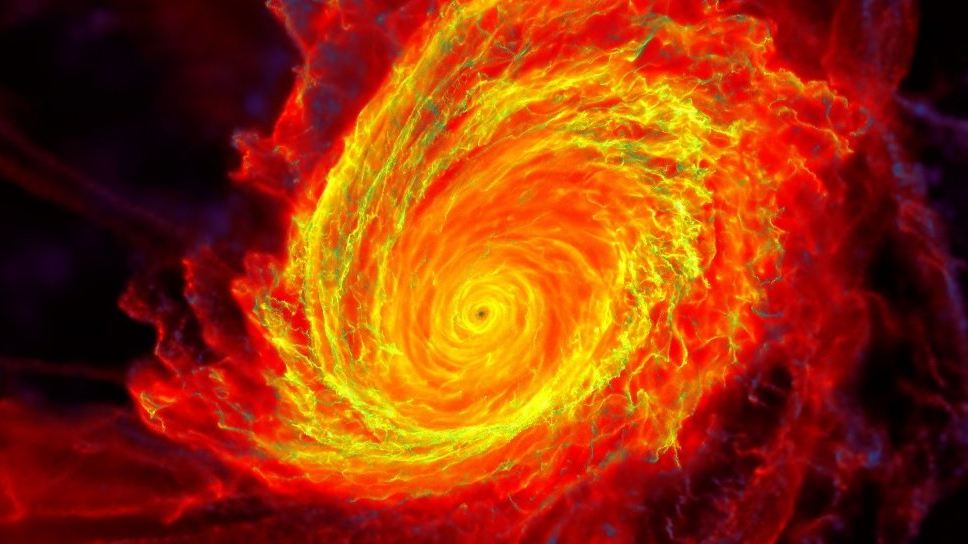
Supermassive black holes are behemoths between millions and billions of times heavier than our sun that lurk at the centers of most galaxies in our universe, including our own Milky Way — and they're best known by the brilliant disks of gas swirling around them. These disks are the remains of ill-fated stars that were once shredded and trapped by the black holes, which actually feed off of these disks themselves. Yet, scientists still aren't certain how, exactly, black holes feast.
For instance, astrophysicists have puzzled for decades over why material that gets swept up by the black hole does not immediately fall into its abyss. Instead, it all comes together to form and maintain a hot, rapidly spinning disk that then spirals toward the black hole. And, in the process, the disk radiates brilliantly while converting gravitational energy into heat. The disk is the main source of light from a black hole, and hovers as long as there is material nearby for the void to suck in.














