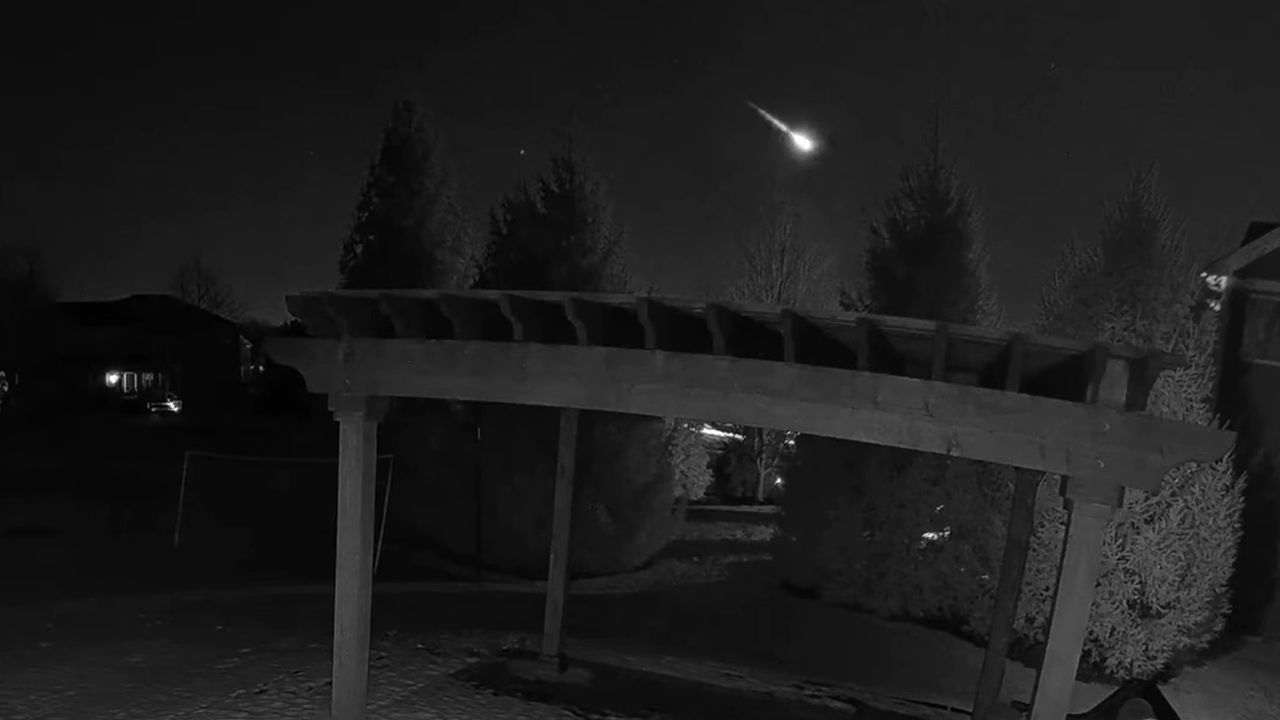
Residents of several Midwestern U.S. states were treated to a dramatic natural light show in the early hours of Feb. 10, when a fireball meteor made a fiery descent, brightening the winter sky before appearing to disintegrate as it neared the horizon.

The meteor's fiery passage generated over 120 reports on the American Meteor Society website from skywatchers in Ohio, Wisconsin, Indiana, Kentucky and Illinois, some of whom captured its 48-mile (77 kilometer) journey on security cameras, dashcams and in the footage of smart doorbells.
The meteor was first spotted at 11:32 p.m. EST on Feb. 10 (0432 GMT on Feb. 11) as it streaked Earthward above the town of Trinity in Indiana while travelling at a blistering speed of roughly 29,000 miles per hour (46,670 kilometers per hour). The fireball flared repeatedly before finally appearing to break apart 27 miles (43 km) above Dayton, Ohio, per a NASA report.

Robert Lunsford of the American Meteor Society notes the possibility that the fireball is likely sporadic in nature, meaning that it doesn't belong to any specific shower or radiant group. "As for the possibility of this fireball producing meteorites, we look for reports that mention sounds associated with the event," Lunsford told Space.com in an email. "These are usually delayed sonic booms. Out of all these reports, none mention the fact that they heard sounds associated with this fireball. Therefore, it is most likely that this fireball completely disintegrated while still high in the atmosphere."
Meteors become visible when tiny shards of comets or asteroids known as meteoroids collide with Earth's atmosphere while travelling at tens of thousands of miles per hour, compressing the air in their paths and causing it to glow.
Larger chunks of debris — which can range in size from a baseball to an SUV and beyond — create dazzling fireballs as they plough through the atmosphere, which are bright enough to outshine the brightest planets in the night sky. The relatively slow speed of the fireball led NASA to conclude that the object meteoroid that spawned it was likely once part of a larger asteroid — rather than a faster moving comet — which subsequently fractured into smaller pieces.
Feeling inspired to snap your own meteor imagery? Then be sure to read our guide detailing how to photograph shooting stars and to check out our roundups of the best camera bodies and lenses for capturing the night sky!
Editor's Note: If you would like to share your astrophotography with Space.com's readers, then please send your photo(s), comments, and your name and location to spacephotos@space.com.