Get all your news in one place.
100's of premium titles.
One app.
Start reading
The Times of India
The Times of India
World
TOI World Desk

Washington’s 12 introduced mountain goats multiplied into more than 1,000; decades later, 325 were airlifted out beneath helicopters

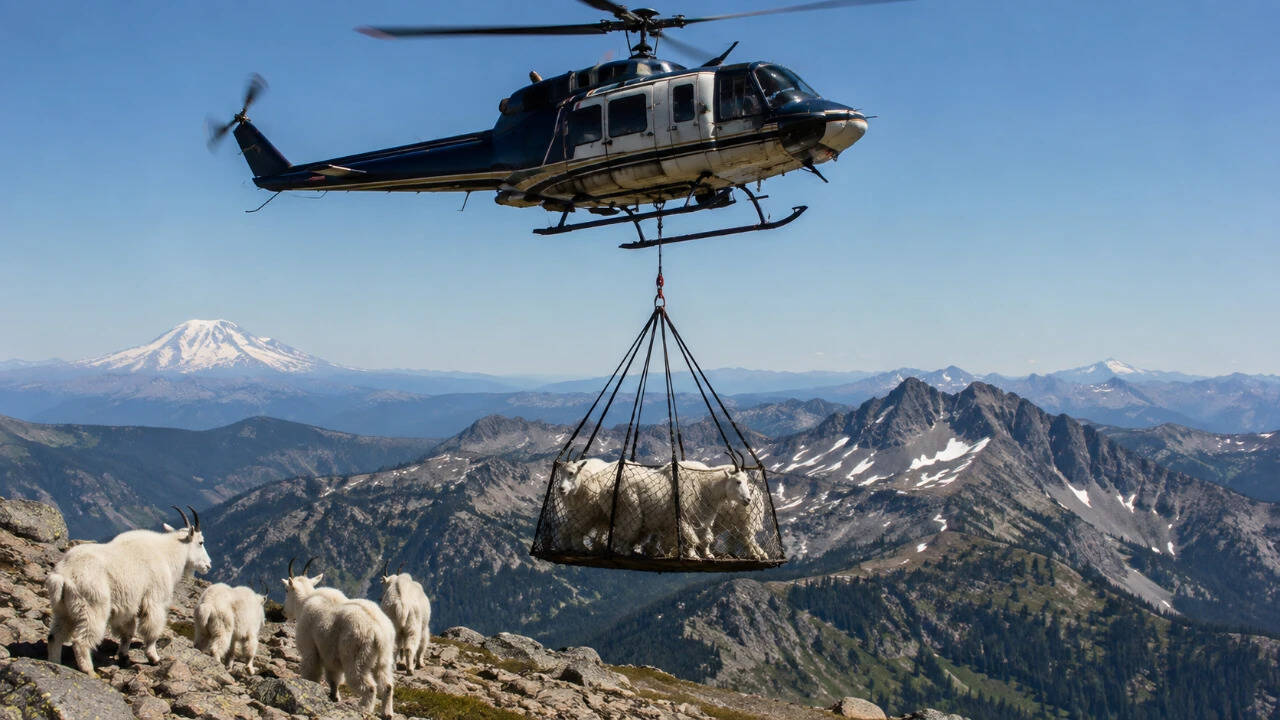
Twelve mountain goats released into Washington’s Olympic Mountains in the 1920s eventually multiplied into a population of more than 1,000, spreading across a landscape where the species had never been native. Decades later, the same animals became the focus of one of the most unusual wildlife operations in the region: goats were captured from steep mountain slopes, suspended beneath helicopters and flown to staging areas before being transported to the Cascade Mountains, where mountain goats are native. Between 2018 and 2020, 325 were successfully moved in this way.

Get breaking news anytime, anywhere. Download the TOI app now!

According to a study published in Population Ecology , 11 or 12 mountain goats were introduced from Alaska and British Columbia to the foothills of Washington’s Olympic Range between 1925 and 1930. The animals were released near Lake Crescent and the surrounding area before Olympic National Park was established in 1938. The Olympic Mountains had long been geographically isolated from the Cascades, and mountain goats were not native there. By 1970, descendants of the introduced goats had spread across the entire mountain range, establishing a population that would later become the focus of conservation management.

From a hunting introduction to an expanding population

Their numbers grew and their range expanded across the Olympic Mountains. By the 1970s, concern had emerged over their effects on high-elevation plant communities. The National Park Service began moving goats out of the Olympics between 1981 and 1989 in an earlier attempt to control their numbers. Those earlier removals did not solve the problem. The goats were also damaging soils and rare plants through grazing and wallowing. A study published in Conservation Biology described the introduced goats as a source of soil erosion and changes in floral composition, adding scientific weight to concerns that had developed over decades.

According to the National Park Service , a park visitor died in 2010 after being gored by a mountain goat, turning the issue into a public-safety concern as well. The agency eventually decided that controlling the population was no longer enough. Its 2018 Mountain Goat Management Plan called for removing more than 90% of the animals from the Olympic Peninsula. The solution was to relocate many of them to the Cascades.

A helicopter operation in the high country

Beginning in September 2018, wildlife specialists began capturing goats from terrain that was often too steep and inaccessible for conventional operations. Helicopter crews used net guns and immobilising darts, then placed captured animals in specially designed slings beneath the aircraft. The goats were flown to staging areas, where veterinarians examined them before they were placed in temperature-controlled trucks.

The goats were sent to the North Cascades, where mountain goats are native but had become scarce in some areas. Washington Department of Fish and Wildlife officials saw the operation as an opportunity to address two problems at once: remove a non-native population from the Olympics while strengthening depleted native populations in the Cascades. The relocated animals were released at selected sites with suitable habitat.

The operation took place over four aerial capture periods between 2018 and 2020. By August 2020, 325 mountain goats had been translocated to the North Cascades. The wider operation removed 381 goats from Olympic National Park and Olympic National Forest, including animals that were transferred to zoos, died during capture or transport, were euthanised because they were unfit for relocation, or were lethally removed.

The operation was more complex than simply catching the animals and loading them onto trucks. Once the goats reached Cascade staging areas, they were placed in crates and, where necessary, airlifted by helicopter to release locations. Weather sometimes forced crews to alter their plans, highlighting how difficult it was to move animals between remote alpine landscapes.

The end of the large-scale operation

After the translocation phase, managers used ground-based and aerial lethal removal to target goats that could not be captured. The National Park Service reported that highly trained volunteers removed 31 goats on the ground in 2020, while aerial operations in 2021 and 2022 removed another 192. These removals were part of the broader effort to reduce the remaining population after the earlier translocation work, rather than a separate population total to be added to the overall figure.

By 2023, the operation had entered a maintenance phase, with the long-term objective of removing the remaining mountain goats from the Olympic Peninsula. The park recorded four reported goat sightings during 2023 and 2024, but only one of those sightings was confirmed, indicating that the population had been reduced to a very small number of known animals. The case shows that an introduction nearly a century ago can still shape wildlife management today. Although only 12 goats were introduced for hunting, managers later had to remove them with helicopters, veterinarians and wildlife biologists.

Sign up to read this article
Read news from 100's of titles, curated specifically for you.
Already a member? Sign in here
Related Stories
Top stories on inkl right now
One subscription that gives you access to news from hundreds of sites
Already a member? Sign in here
Our Picks
Fourteen days free
Download the app
One app. One membership.
100+ trusted global sources.