
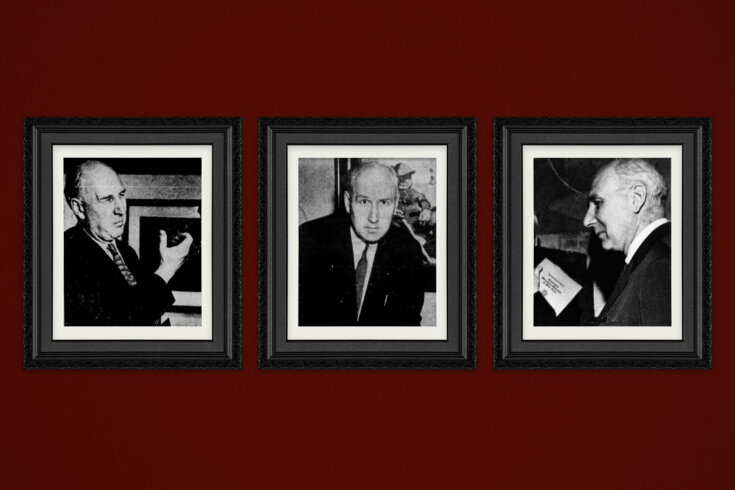
On July 5, 1973, a German ethnographer named Karl Stumpp stood in the Winnipeg Art Gallery and delivered a lecture called “The Fate of the Russian Germans.” Stumpp was on a speaking tour across Canada, and his Winnipeg stop was highly anticipated. A key figure in “Germans from Russia” studies, he was admired by a network of North American academics and Germanophiles, many of whom treated his wartime research as foundational. The lecture’s subject—ethnic Germans in Eastern Europe and their abuse at the hands of the Soviet Union—would also have struck a chord with the city’s large German community, some of whom had fled communist persecution.
The WAG advertised the free public event in its 1973 event calendar, and the city’s Canadian German newspapers promoted it. But one would be hard pressed to find mention of the lecture anywhere else. One reason might be that Stumpp, as is more widely known today, was a Nazi whose legacy is inextricably linked to the Final Solution. His authority on the lecture’s subject rested largely on surveys of German Ukrainian villages he’d overseen in the 1940s in Nazi-occupied Ukraine. This occupation gave Stumpp unique access to German communities hitherto hidden behind Soviet borders. But his studies were decidedly not of the disinterested scientific variety. After Einsatzgruppen killing squads cleansed a village of “undesirables,” Stumpp’s own eighty-man action unit moved in to determine the survivors’ racial character. Those deemed lacking sufficient “German blood” were likely murdered, helping rid the Greater Reich of what Stumpp’s diaries describe as “the Bolshevik-Jewish plague.”