
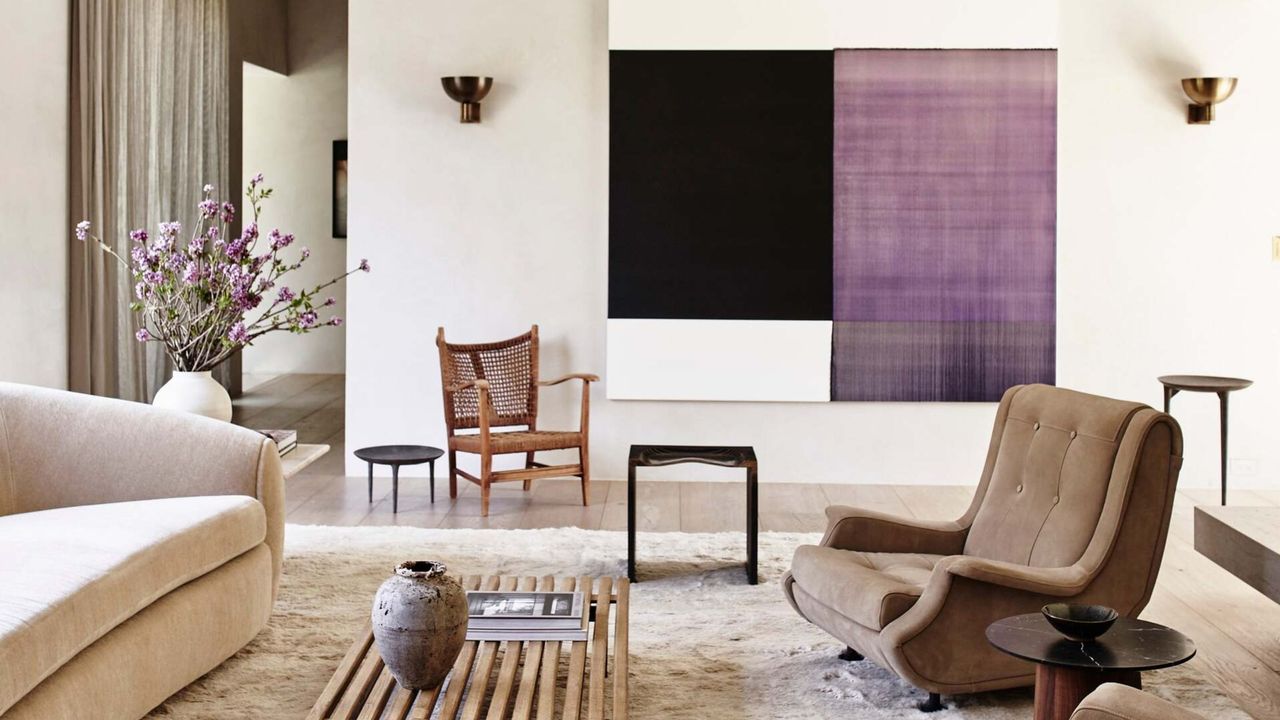
Have you ever got the feeling that your room isn’t working, but you’re not quite sure why? It’s likely the visual weight of your space is unbalanced. The silhouettes of individual pieces of furniture not only affect how a room looks and the way it flows, but also how it makes you feel. If the visual weight is ‘off’, the whole space can seem disjointed.
Achieving the right balance in interior design is essential, so it’s no wonder that experts are paying increasing attention to this concept. “Every element in a room carries visual weight, from furniture to accessories, and learning how to balance these elements within your scheme is so important to create somewhere that feels cohesive and harmonious,” says interior designer Laura Hammett.

So, what is visual weight — and why does it matter? Read on as interior design experts share tips on mastering this all-important formula in your own space.
So, What is 'Visual Weight' in Interior Design?

Visual weight refers to how different pieces within a space relate to each other and whether or not that interplay feels balanced. The physical attributes of furniture not only affect its visual presence, but also how it feels on a floor plan.
A boxy, blocky armchair in a solid fabric, for example, can seem to occupy more space in a room than an open-framed, slim-leg sofa, even if the latter is technically larger.
"Visual weight is the idea that certain elements in a room can feel heavier or lighter, both physically and visually, and balance comes when the overall composition works," agrees Katerina Tchevytchalova, founder of K’Arte Design.
"It’s about the colors, textures, and in particular, the shapes in a space," adds Rebecca Hughes. "When the visual weight of a room is right, it feels immediately grounded and composed."

"It hasn’t got anything to do with actual kilograms, but rather scale and proportion," says London-based interior designer Juliette Byrne. "A heavy piece with a strong base gives presence, but that only works when you shift the composition with lighter pieces. It’s about giving pieces room to breathe."
A chunky fluted base makes this table the perfect partner to slimline dining chairs.
Why Does Visual Weight Matter in Interior Design?

When the balance of visual weight is wrong, you’ll instinctively notice. "If something’s not correct about the visual weight in a space, you feel it the moment you walk into the room," agrees Laura Hammett.
When everything in a room ‘reads’ as bulky or leggy, there’s not enough contrast in the design. "It’s the difference between making a space look and feel harmonious or not," says Laura.
This impact goes well beyond first impressions, though. "Visual weight also affects how people navigate around a room and function within it," says Siyanda Mbele of Pinda Interior Design. "Finding the correct balance makes you feel calm and relaxed, but also keeps up visual interest as you interact with the space."

"When it’s balanced correctly, visual weight feels effortless and calm but also architectural and international," believes Juliette Byrne. "It allows your eye to travel from the floor to a table to a pendant to a window comfortably. Misjudging visual weight makes spaces feel wrong, while getting the balance right is often what separates decoration from design."
This sleek side table would be ideal at either side of a wide, blocky sofa.
How to Balance Visual Weight in Interior Design

Achieving a balance of visual weight in your space starts with stepping back and looking at the pieces already in it. If one side of a room is full of bulky furniture and the other has hardly anything in it, it’s obvious that the dimensions aren’t adding up.
In most spaces, though, you need a little nuance — as a rule of thumb, heavy pieces should be visible from multiple angles rather than hidden by surrounding pieces of furniture.
"Focus on making the heavier items in your space the critical items for comfort, like a fully-upholstered sofa or bed," suggests interior designer Maggie Smith. "Then, balance these out with chairs and tables that incorporate wood or metal legs, to introduce a different layer of texture. The perfect formula involves embracing negative space."
“Ask yourself where your eye naturally lands,” advises Rebecca Hughes. “Balance is about counterpoint: if you have something visually strong on one side of a room, you can offset it with a cluster of lighter elements, a change in texture, or a contrasting color elsewhere.”

“It helps to think in contrasts,” agrees Katerina Tchevytchalova, who agrees that material can be just as important as scale. “Balance heavier textures like marble and timber with slimmer pieces in metal and glass. More transparent materials and furniture on legs work best alongside something solid and substantial." (Like in the kitchen, pictured above.)
Once you’ve got everything in position, interior designer Juliette Byrne suggests an unusual technique for checking if you’ve got things right. “Squint your eyes to make everything blur,” she says. “This way, you’ll see only light and dark blocks. If one side feels visually heavier, you need to rebalance.”
Designed in collaboration with Says Who (a Danish design studio), this sculptural piece ‘reads’ heavy but can appear lighter depending on your fabric choice.
It’s clear that the balance of visual weight affects how a room physically feels, as well as how we interpret it visually. Interior designers have long negotiated the practical considerations of balancing shapes, sizes, and materials when planning a space and mapping its layout, so it makes sense that the concept is now a hot topic.
Need more inspiration? Discover one designer’s ratio rule for balanced spaces.